Automatic washing of complex parts using spray, flood and controlled movement of the load.
A part may appear clean on the outside but still contain oil, swarf or particles inside its channels. The ROTAX hydrokinetic washing machines are designed for components where surface cleaning by spraying is not always sufficient.
The system applies a high flow rate of aqueous solution, fills the process chamber and can incorporate rotation or tilting of the basket. This facilitates contact between the liquid and internal surfaces, blind holes, lubrication galleries and other areas that are difficult to access.
The process is tailored to the material, the contaminant and the outcome required for your production, with options including rinsing, ultrasonic cleaning, surface protection and drying.
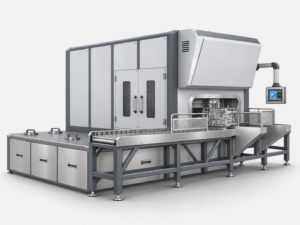
ROTAX: external view of an industrial hydrokinetic washing machine. The final design is tailored to each installation.
The various stages are organised within a single chamber. The equipment can operate with one or more process baths and combine cleaning methods according to the requirements of each part.
Centrifugal pumps force the liquid through nozzles to dislodge dirt and carry away accessible debris.
The chamber is filled with process fluid. Circulation and, where applicable, basket movement help to reach the cavities.
Separate baths for rinsing with treated water may be added and, where appropriate, a passivation stage.
Blowing and hot air remove moisture; vacuum drying can be used for complex geometries.
The support holds the part in place during the cycle. Illustrative image.
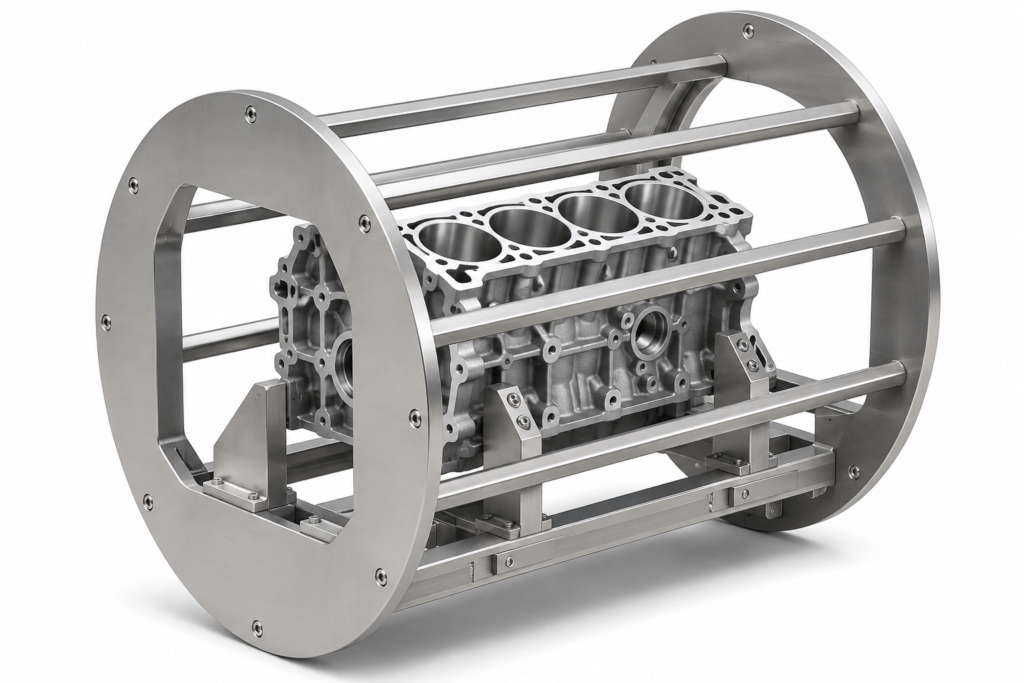
In conventional spray washing, the impact of the jets depends on each surface being correctly exposed. ROTAX incorporates the concept of flood washing or dynamic immersion washing: the liquid quickly fills the chamber and circulates around the load.
Rotation and changes in orientation, when implemented, facilitate the successive emptying and filling of holes, oil passages and cavities. For components with complex geometries, the following can be considered adjustable or directional nozzles and specialised clamping fixtures.
The positioning of the components is crucial. That is why the basket, the support and the liquid flow path are defined before the final configuration is finalised.
The performance of an industrial washing machine also depends on the condition of the wash bath. ROTAX can be configured with separate tanks for washing, rinsing and demineralised water, with heating and level control depending on the process.
The advanced configurations incorporate progressive filtration: screens to trap larger chips and debris, followed by bag and cartridge filters for finer particles. A coalescence oil separator helps to remove free oils from the wash bath.
Automatic filling, detergent dosing and process control reduce the need for manual intervention and enable operation within defined parameters. The frequency of maintenance and fluid replacement depends on the actual level of contamination.
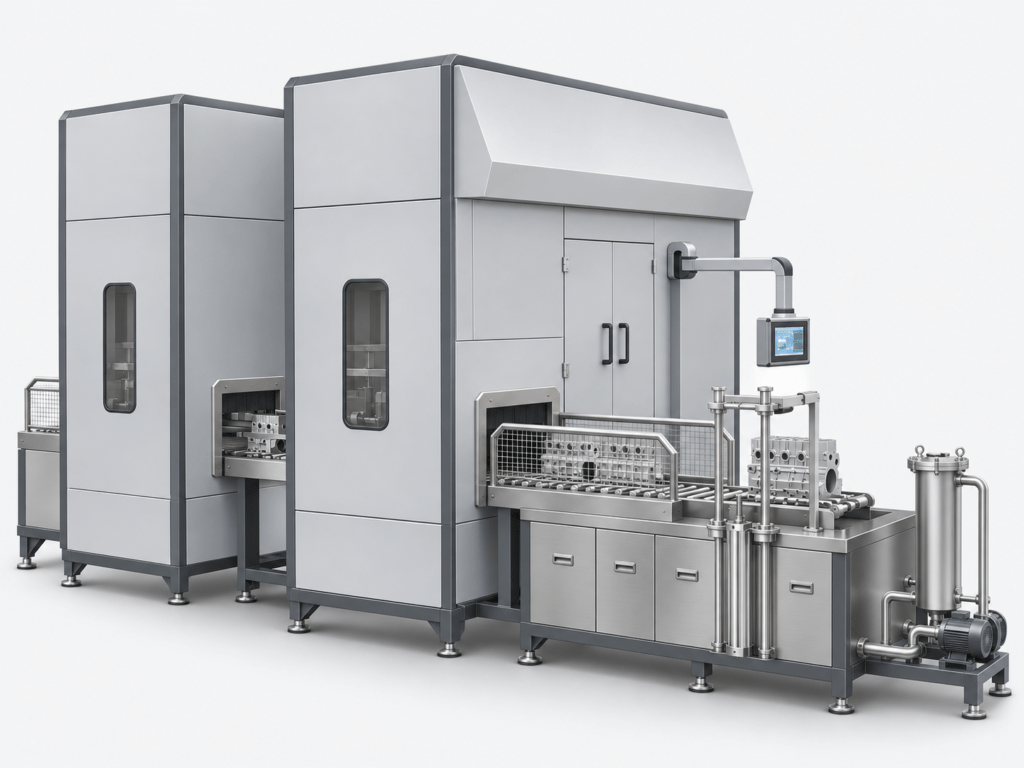
External view of the machine. The tanks and circuits are specified for each application.
The liquid surrounds the part inside the chamber. The use of ultrasound is optional.
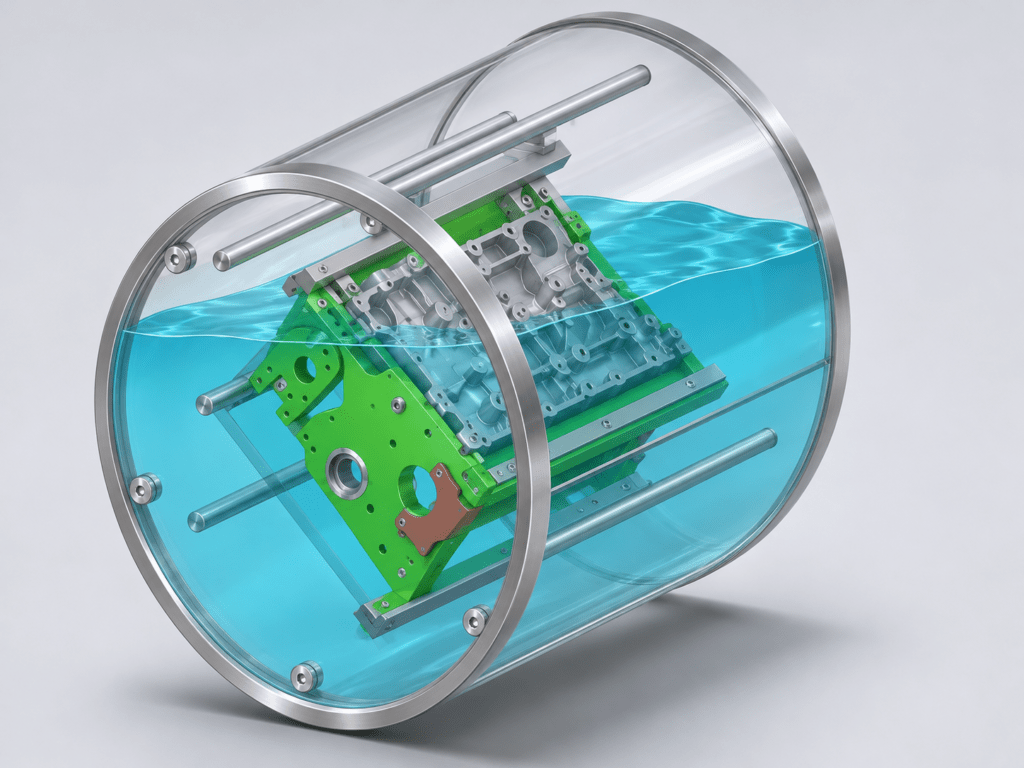
Where the application requires it, the hydrokinetic process can be combined with ultrasound during the immersion phase. Cavitation in the liquid helps to dislodge small particles and certain deposits in areas that are not directly exposed to the jets.
The reference technical proposal includes a module for 25–27 kHz and 6–8 kW. These are values for a specific configuration, subject to the type of material being processed, bath volume and the level of soiling. Ultrasonic treatment is selected after assessing whether it actually improves the result.
For delicate parts or those with specific cleaning requirements, it is advisable to test the process using samples before finalising a production programme.
After washing, the rinse removes detergent and carried-in contaminants. Where a lower level of salts or stains is required, demineralised water may be used. Parts susceptible to rust may require a stage of passivation or anti-corrosion protection, with the product and dosage specified for each material.
Drying can be carried out by blowing, hot air recirculation and, as an option for complex geometries, vacuum drying. This final stage helps to remove residual moisture from areas where air has limited access.
The equipment integrates the selected stages into a programmable cycle. The sequence and duration are designed according to the workpiece, the contaminants and the output requirements.
Overview of the equipment; drying times depend on the selected settings.
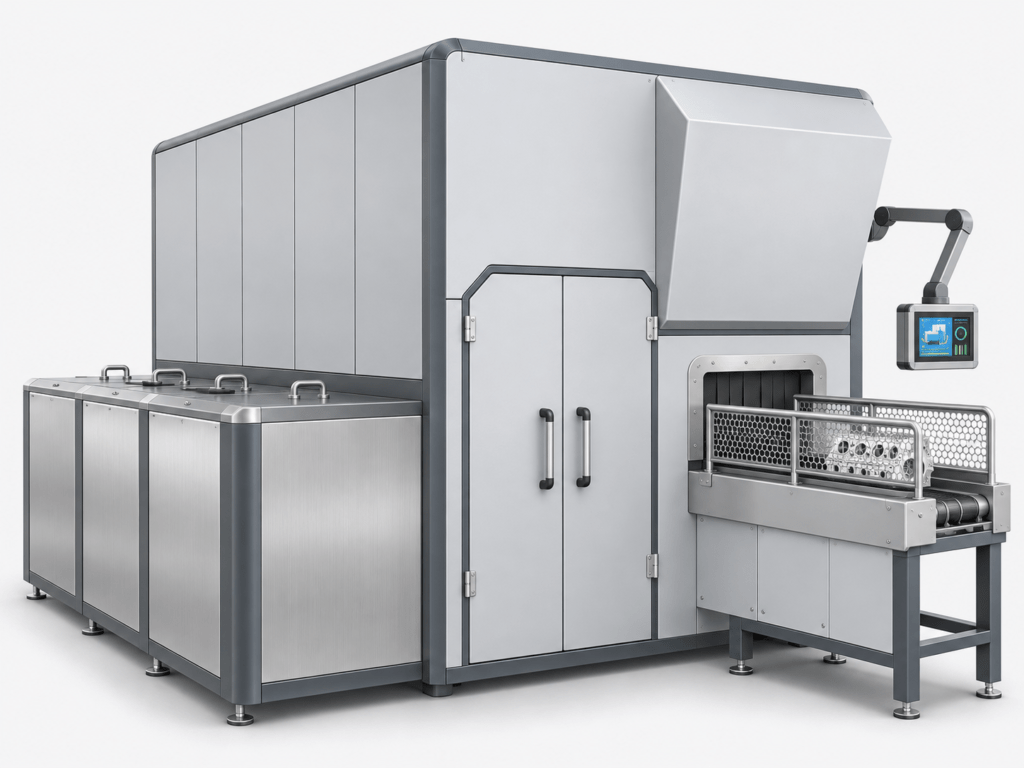
The range features water-contact surfaces made of stainless steel and a robust industrial frame. In this specially designed configuration, the chamber and tanks are specified in AISI 304 stainless steel, with external cladding made of steel painted with an epoxy coating.
The enclosed chamber limits the escape of steam during the wet and drying phases. It can be fitted with a pneumatic lid with a viewing window, thermal insulation, ventilation, level controls and safety devices.
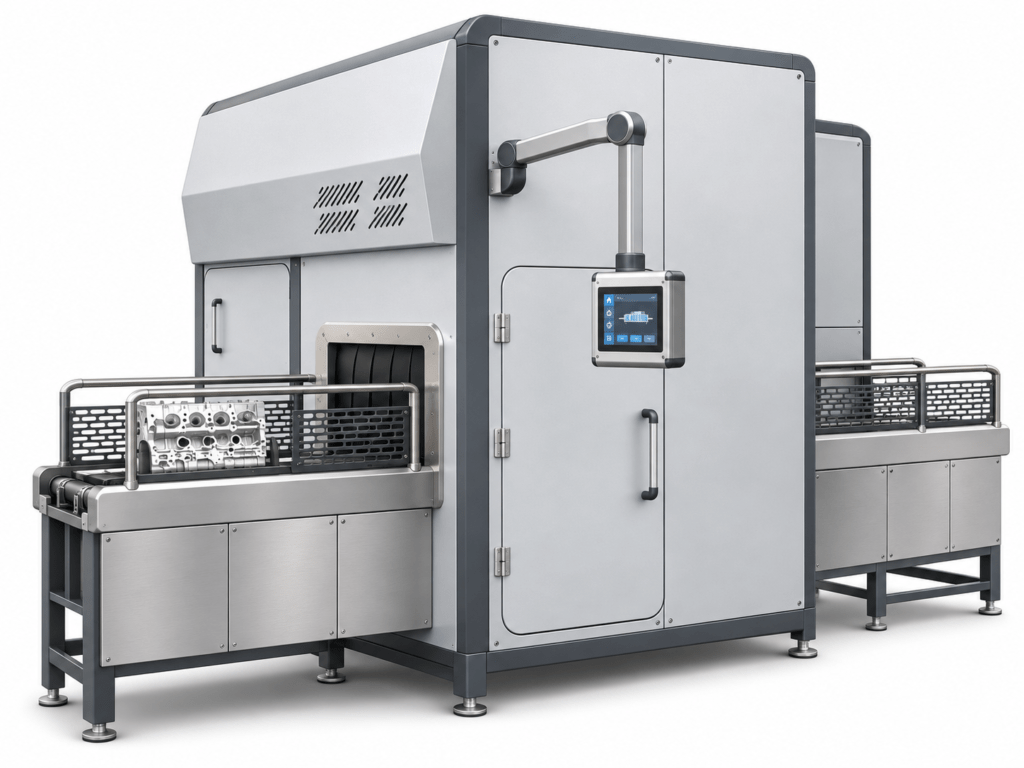
The PLC with HMI display It enables the management of recipes by part type, times, temperatures, rotation speed, pump pressure and alarms. An automated architecture makes it easier to repeat defined process cycles and diagnose faults.
Selection of programmes, times, temperatures and sequences tailored to the items.
Infeed and outfeed via a basket; integration with conveyors depending on the project.
These references enable you to compare the basket sizes within the catalogue range. Additional equipment is determined on a project-by-project basis; specific availability must be confirmed for each model.
| Feature | ROTAX 450 | ROTAX 550 | ROTAX 650 |
|---|---|---|---|
Basket dimensions (mm) | 450 × 260 × 260 | 550 × 330 × 330 | 650 × 380 × 380 |
Spray washing | Including | Including | Including |
Flooding in the cabin | Included | Included | Included |
Time and temperature control | PLC | PLC | PLC |
Rinse | Depending on the settings | Depending on the settings | Depending on the settings |
Drying | Depending on the settings | Depending on the settings | Depending on the settings |
Ultrasound | Optional extras | Optional extras | Optional extras |
Basket rotation | Depending on the settings | Depending on the settings | Depending on the settings |
Chemical dosing | Optional | Optional | Optional |
Nominal catalogue dimensions. The figures do not include the maximum permissible load, electrical power or guaranteed performance; these details are specified in the quotation.
When a part requires additional cleaning stages or a specific production process, ROTAX can be designed with a specialised configuration. A standard configuration for machined aluminium parts It comprises three tanks, ultrasonic cleaning, passivation, hot air drying, vacuum treatment, oil separation and automatic control.
The following specifications are taken from a specific technical proposal. These serve as examples of the customisation options available and should not be interpreted as standard features of the three models mentioned above.
Illustration of an industrial setup with parts being loaded.
ROTAX is designed to assess the cleanliness of parts that feature a combination of accessible external surfaces, internal channels and machining residues. Here are some common examples:
Cleaning of lubrication galleries, cavities, cylinder heads, casings and other parts prior to assembly or repair.
Removal of oils, emulsions, swarf and particles from metal or cast aluminium components.
Applications to be studied include fuel injectors, carburettors, brake components, bearings and small assemblies.
Cleaning of channels, housings, blind holes and technical surfaces prior to subsequent operations.
For parts with a simple geometry, where dirt is accessible from the outside, a rotary spray washer that might be enough.
If the component has blind holes, internal passages, deep cavities or high drying requirements, it is advisable to evaluate a hydrokinetic process involving flooding, basket movement and additional stages. For certain types of fine waste, it may also be useful to investigate ultrasonic cleaning.
The selection is based on a test using actual parts, the type of contamination, production capacity and the cleaning objective.
It is an automatic washing machine that combines high-flow liquid supply, spraying and flooding of the chamber. When the configuration includes basket rotation, the parts change orientation to improve the liquid’s access to their various surfaces.
Conventional rotary washing machines are mainly used for spray degreasing. ROTAX can combine spray, flood or immersion cleaning, basket movement and other cleaning stages within a single chamber. This difference is particularly significant for parts with internal channels and cavities.
These are applications for which this technology is particularly suitable. Effectiveness depends on the geometry, the liquid’s access route, the type of contamination and the orientation of the part. For demanding requirements, targeted nozzles, ultrasound and wash tests are being investigated.
No. They are an option that is incorporated when the level of dirt, the geometry and the cleaning objective warrant it. A standard configuration specifies 25–27 kHz and 6–8 kW, but these values do not apply across the entire range.
Yes, depending on the project specifications. Separate tanks for washing, rinsing and demineralised water can be provided, as well as passivant dosing and hot-air or vacuum drying. The materials and the level of corrosion protection are validated for each component.
After removing surface water by blowing or using hot air, a vacuum aids the evaporation of residual moisture in cavities and complex geometries. Its suitability depends on the required drying result and the materials involved.
Applications involving oils, machining emulsions, swarf, particles and certain process residues are investigated. The choice of aqueous detergent, temperature, filtration and duration are determined following an analysis of the parts.
The duration depends on the stages and the condition of the parts. In a multi-phase project, indicative cycles of 10 to 30 minutes per basket were envisaged. This is not a guaranteed throughput for all configurations.
It is possible to implement automated loading and unloading using basket conveyors, as well as programmes based on part numbers. The layout, safety features and integration with the production line are determined during the design phase.
Please let us know which parts you wish to clean, their size, material, degree of contamination and the number of parts per hour. We will help you select the appropriate process and equipment.
