
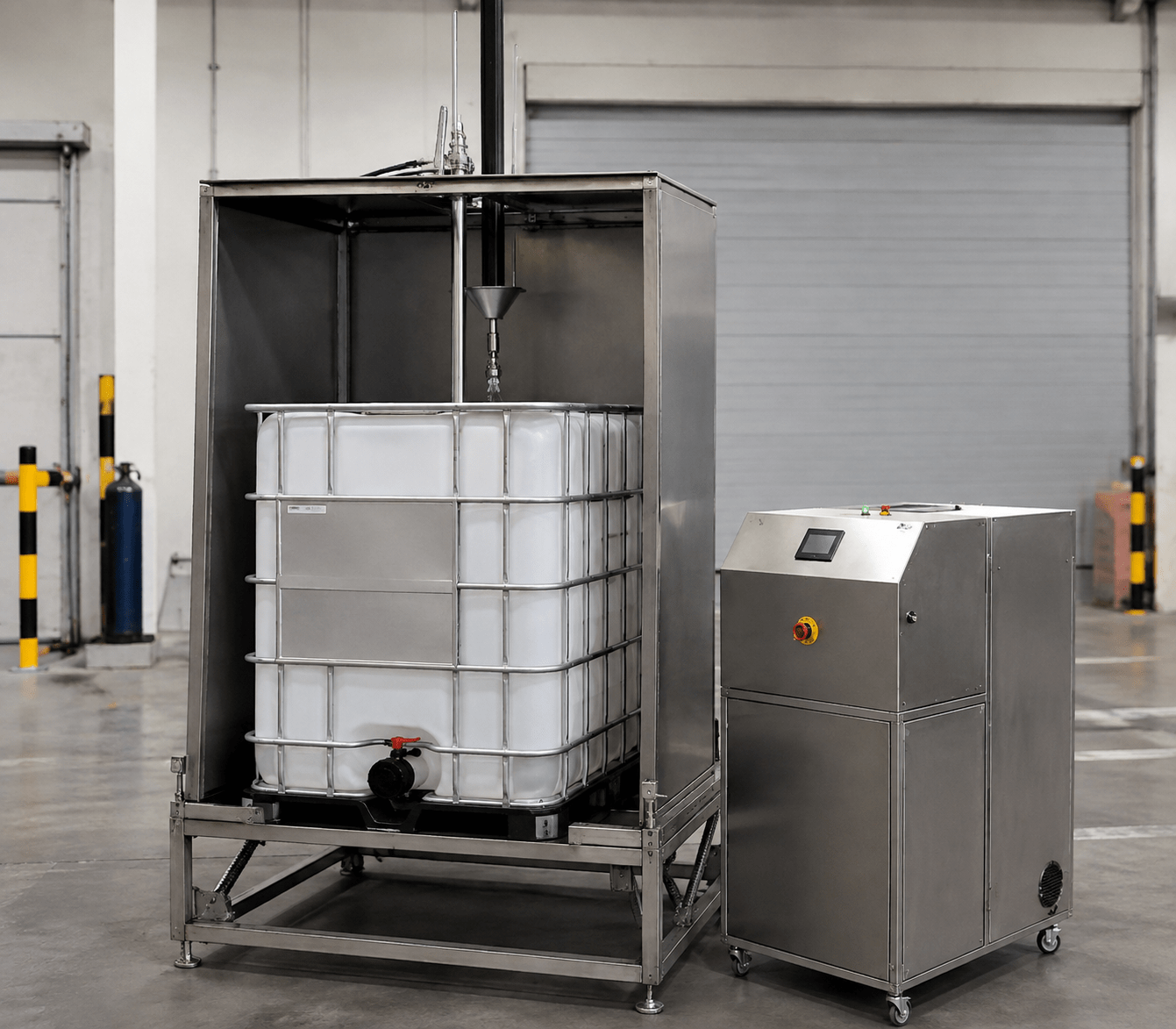
How to clean a 1,000-litre IBC using a spray-cleaning machine
Cleaning a 1,000-litre IBC It is not simply a matter of inserting a hose through the top opening and applying pressurised water. The shape of the container, the corners, the inside of the roof, the base, the drain valve and any residue from the previous product make it difficult for a manual procedure to reach all surfaces evenly.
When containers are reused frequently, manual cleaning can also become a bottleneck. The result depends largely on the operator, the time spent on each unit and how easily the interior areas can be reached. Furthermore, water consumption and exposure to splashes can vary considerably from one cycle to the next.
A machine for cleaning 1,000-litre IBCs using a spray system It enables this task to be transformed into a controlled industrial process. The IBC is positioned in a washing station; a cleaning head is inserted through the top opening and the cleaning solution is sprayed onto the inner walls, following a defined path. Depending on the company’s requirements, the equipment can also incorporate external washing, rinsing with clean water, filtration, recirculation, detergent dosing, drying and the recording of cycle parameters.
The aim is not to apply the highest possible pressure, but to correctly combine mechanical action, temperature, chemicals and time. The washer’s settings must therefore be adapted to the residue, the number of IBCs to be processed and the required level of cleanliness.
At IBERAt KLEEN, we design spray-cleaning solutions tailored to each client’s specific process, ranging from equipment for cleaning the inside of IBCs to more comprehensive systems that include external cleaning, rinsing, filtration and drying.
How to clean a 1,000-litre IBC
1,000-litre IBC cleaning machine: a solution for repetitive industrial processes
A IBC washer It is designed for businesses that need to clean containers on a regular basis and do not want to rely solely on a pressure washer, a hose or an external service. Unlike these methods, the machine allows you to define a work sequence and repeat it under similar conditions.
At the heart of the system is the spray circuit. A pump delivers water or a detergent solution to a spray head, which distributes the fluid throughout the interior of the container. Rotating spray heads can move across surfaces via controlled movements on one or two axes, increasing coverage on the walls, ceiling, base and hard-to-reach areas. This type of technology is used in industrial equipment to achieve a more uniform internal wash than that provided by a fixed jet.
However, the spray head should not be selected in isolation. The result will also depend on the available flow rate, pressure, distance to the surface, spray pattern, viscosity of the residue, temperature and cleaning agent. A correctly sized system must take all these factors into account.
The machine can be regarded as a station intended exclusively for the internal cleaning of IBCs or as a cabin capable of working on the cage, the pallet, the top and the valve as well. This second configuration is particularly useful when the container returns with external dirt, labels, spills or debris accumulated around the discharge point.
Which businesses need an IBC washer?
The purchase of a IBC washing machine It makes sense when containers are a regular part of the production, storage, distribution or return process for packaging. In these situations, cleaning is no longer an occasional task but has a direct impact on the availability of containers, operating costs and the organisation of the plant.
Potential users include manufacturers of chemicals, lubricants, oils, paints, inks, detergents, resins, adhesives, cosmetics and other liquid or viscous formulations. It may also be useful for packaging management companies, reconditioners, IBC hire companies, waste management organisations and plants that use returnable containers.
Furthermore, certain food, cosmetics and pharmaceutical industries may require hygienic configurations, specific materials, rinsing with water of a controlled quality, filtered drying and validation systems. In such cases, simply installing a conventional washing machine is not sufficient: the design must meet specific requirements for cleaning, documentation and the prevention of cross-contamination.
An automatic or semi-automatic station offers greater value where there is a consistent volume of IBCs, multiple production shifts, difficult-to-handle waste, traceability requirements or a clear need to reduce manual intervention.
Can any 1,000-litre IBC be cleaned and reused?
Not all IBCs should be reused simply because they can be washed. Before starting the process, it is necessary to consider what product they contained, the physical condition of the container and how they are to be used afterwards.
Identify the content above
The first step is to establish exactly what product is in stock. The label, batch documentation and safety data sheet enable us to determine its hazardous properties, solubility, viscosity, compatibility with water and reaction to different detergents.
This step determines the entire process. A water-soluble residue may require a relatively simple cycle, whilst oil, grease, dried paint, resin or adhesive may require specific temperatures, specific chemicals and more intensive mechanical action.
If you are unfamiliar with the above information, the IBC must not be incorporated directly into a standard cycle. Before doing so, it will be necessary to identify the waste and assess the risks of mixing it with water, detergents or residues from other containers.
Check the bottle, the cage, the pallet and the valve
The inspection must include the inner container, the metal frame, the pallet, the top opening, the cap and the bottom valve. Cracks, deformations, leaks, damage to connections or any deterioration affecting stability may prevent its reuse.
Furthermore, some waste penetrates the material, stains it or leaves persistent odours. A visually satisfactory clean does not always mean that the container is suitable for any subsequent use.
Define what it will be reused for
Reusing an IBC for the same product generally involves fewer uncertainties than using it for a different substance. However, even in that case, the quality requirements set by the company responsible for the process must be met.
When there is a change of product, it is necessary to analyse compatibility and the level of cleanliness required to prevent contamination. In food, cosmetics, pharmaceutical or high-purity applications, the acceptance criteria may be much more stringent than in general industrial applications.
The machine therefore cleans the container, but authorisation to reuse it must be based on the previous product, future use, inspection and the validation method defined by the company.
How an IBC spray-cleaning machine works
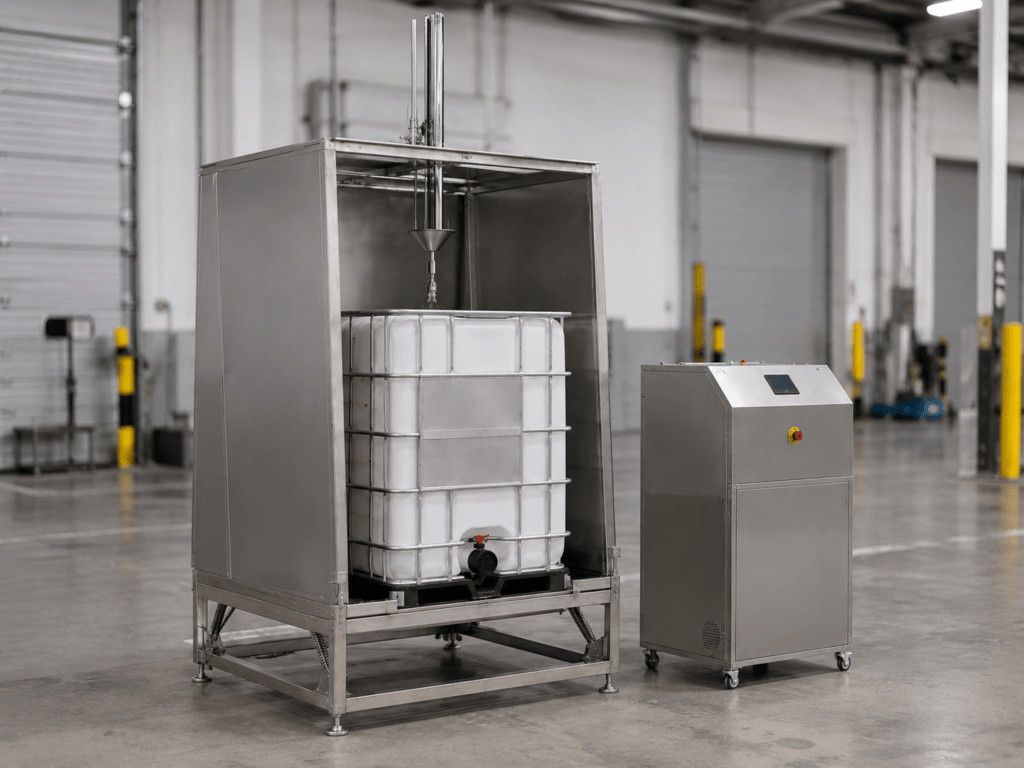
How a IBC washing station It can be organised in several stages. The exact sequence will depend on the type of waste and the modules installed, although the general principle remains the same.
Identification, removal and recovery of waste
Before placing the container in the machine, as much of the previous product as possible is removed. This process prevents the residue from being unnecessarily diluted, reduces the pollutant load in the wash water and facilitates its recovery or separate management.
In certain processes, it may be advisable to collect the first drain or pre-wash in a separate tank, particularly when it contains a high concentration of the product.
IBC’s Position
The container is positioned in the work area using a forklift, pallet truck, conveyor or the loading system specified for the installation. The guides and supports ensure that it is correctly positioned in relation to the head and the drainage point.
A position sensor may prevent the cycle from starting if the IBC is not correctly positioned. In addition, the station may incorporate guards, enclosures or interlocked doors to contain splashes during washing.
Internal pre-wash
Pre-washing removes the loosest debris and reduces the surface concentration of the contaminant. Depending on the product, it can be carried out using water recovered from a previous rinse, clean water or a specific solution.
It is not always necessary to recirculate this initial liquid. When the dirt is highly concentrated or could contaminate the main tank, it is preferable to collect it separately.
Spray washing
During the main phase, the pump delivers the cleaning solution to the head fitted inside. The movement of the system distributes the jets across the various surfaces of the container.
Mechanical action helps to dislodge dirt, whilst the temperature and detergent help to dissolve, emulsify or loosen it. When the process operates in recirculation mode, the liquid returns to the machine’s tank, passes through the filtration system and is pumped out again.
To achieve a uniform result, the spray head must reach the inside of the ceiling, the top corners, the walls, the back and the area around the outlet. Dual-axis rotating spray heads are designed to sweep across the surface of the tank, following a cleaning pattern over a set cycle.
External cleaning of the IBC
Where the installation includes external cleaning, a network of nozzles sprays water or detergent onto the bottle, the cage, the pallet and the areas around the valve. The arrangement of the nozzles should minimise the shadowed areas created by the metal structure.
On the other hand, external cleaning may be carried out either within the same chamber or as a separate stage. The decision will depend on the degree of soiling, the required productivity and whether the intention is simply to clean the inner vessel or to recondition the entire unit.
Clarified
Rinsing removes any remaining detergent and any dirt that may still be suspended in the water. It can be carried out using tap water, treated water, demineralised water or another type of water specified by the intended use of the IBC.
In sensitive processes, it is advisable to separate the wash circuit from the final rinse circuit. This prevents the recirculated liquid from redepositing contaminants onto the surface that has already been cleaned.
Drainage and drying
Once rinsing is complete, the water must be drained off completely. The shape of the support, the position of the container and the valve opening all affect the amount of residual liquid.
If the IBC is to be stored sealed or filled with a water-sensitive product, an air-drying stage may be added. The specific solution will depend on the time available, the permissible temperature and the acceptable level of humidity.
Inspection and release
The cycle concludes with an inspection of the vessel, a check of the valve and, where appropriate, a leak test. For the most demanding applications, checks may also be carried out on the water from the final rinse, including conductivity, pH, residue analysis, microbiological testing or laboratory validation.
360° coverage for cleaning critical areas of the IBC
The main difficulty with an IBC is not its volume, but its shape. A jet directed from above may clean the area directly in front of it effectively, whilst at the same time leaving other areas inadequately cleaned.
The top corners, the underside of the ceiling and the area around the opening require an appropriate spray pattern. At the bottom, the slopes, the reinforcements and the outlet leading to the valve may also accumulate product.
A rotating head for cleaning IBCs It distributes the fluid in a defined pattern. Free-rotation systems produce a rapid repetition of the spray, whilst controlled-rotation systems allow for a more even pattern. When the spray head moves along two axes, the jets progressively cover the entire surface of the container.
However, the term “360° coverage” should not be used as a generic promise. To verify its actual effectiveness, it is necessary to examine the IBC’s aperture, the insertion length, the position of the nozzle, the spray pattern, the dynamic pressure and the time taken to complete the sweep.
At IBERKLEEN, these parameters must be determined on the basis of the container’s geometry and tests carried out using the actual waste. This prevents the pump from being oversized or a pump head being selected that is incapable of delivering the necessary impact.
Internal and external cleaning of IBC containers
Not all companies require the same level of cleaning. Some simply want to remove the product contained in the inner bottle, whilst others receive IBCs with spillage, dirt in the cage, residue on the top or build-up around the valve.
A machine designed for internal cleaning of IBCs It can be more compact and straightforward. The container is placed beneath the head, the cycle is run, and the liquid is collected at the bottom. This solution is suitable when the exterior is reasonably clean and the main priority is to get the container back into production quickly.
On the other hand, a IBC washing bay for interior and exterior cleaning It features additional nozzles around the container. These can be directed towards the top, the sides, the base and the outlet. The enclosure also provides a sealed environment to contain the water, detergent and splashes.
What types of waste can be disposed of from an IBC?
Whether an IBC can be cleaned depends on the type of product, how long it has been in the container, and whether it has dried out, hardened or reacted with the surface. It should not be claimed that a machine can remove any substance without first carrying out a test.
Type of waste | Standard cleaning approach | Issues to be examined |
Water-soluble products | Pre-wash and wash with water, followed by a rinse | Concentration, temperature and final water quality |
Oils, lubricants and greases | Suitable detergent, temperature and mechanical action | Viscosity, emulsion, foam and oil separation |
Paints, inks and coatings | Specific chemical and greater spray impact | Whether the residue is aqueous, solvent-based, dry or partially cured |
Resins, adhesives and polymers | Preliminary trial and adapted cycle | Degree of hardness and compatibility of the cleaner |
Food or cosmetic products | Validated hygiene process | Materials, temperature, rinse water and drying |
Acids, bases or reactive substances | Specific procedure and risk assessment | Chemical compatibility, neutralisation and equipment materials |
Unknown product | Do not include in a standard cycle | Preliminary identification and security analysis |
Fresh waste is usually easier to remove than waste that has been sitting in the bin for days. Therefore, the time elapsed between emptying and washing can be just as important as the machine’s power.
In the case of paints, resins or adhesives, it is also important to know whether the product cures through heat, moisture, oxidation or a chemical reaction. Applying hot water without first assessing the residue could make cleaning easier or, conversely, accelerate the hardening process.
Manual cleaning, spray machine or external service
Method | Main advantage | Main limitation | Correct application |
Hose or hand-held pressure washer | Low initial investment | Variable results and a high degree of operator intervention | Very occasional cleaning |
Semi-automatic spraying machine | Manually loaded controlled cycle | Each IBC must be handled individually | Moderate recurring volume |
Automatic car wash | Productivity and repeatability | Greater investment and integration | High volume or continuous process |
Outsourced cleaning | No machinery needs to be installed | Transport, lead time, dependency and unit cost | Small quantities or special waste |
Manual cleaning may be a solution for a one-off task, but it is difficult to maintain the same distance, pressure, angle and duration every time. Furthermore, the top corners and the underside of the ceiling are not easy to reach from the opening.
A spray cleaning machine for IBCs converts these variables into process parameters. The spindle follows a defined path and the cycle maintains the times, temperature and concentration within the programmed values.
Manufacturers of container washing machines highlight automation as the key to achieving consistent results, reducing manual labour and minimising downtime.
Outsourcing, for its part, may be a sensible option when the volume is small or the waste requires specialised facilities. However, it is important to take into account transport costs, turnaround times, the need for additional storage containers and reliance on an external supplier.
Price of a machine for cleaning 1,000-litre IBCs
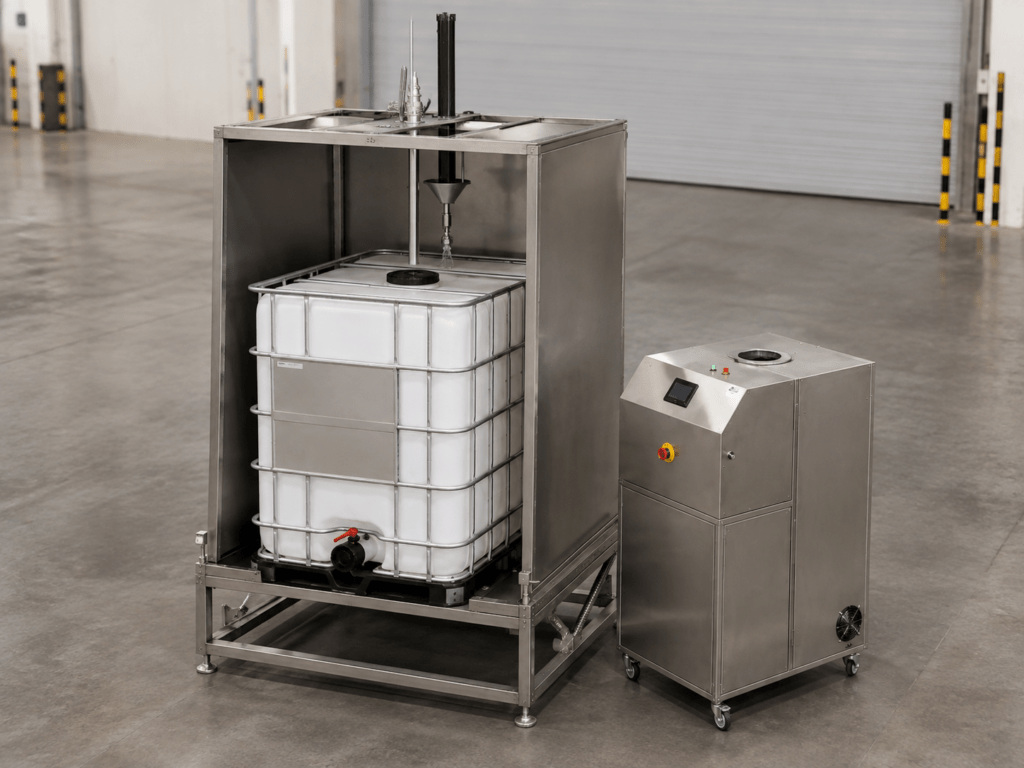
The price of a IBC cleaning machine It depends mainly on the scope of the project. A manually loaded interior washing unit does not cost the same as an automatic wash bay with exterior washing, multiple tanks, heating, filtration, drying and traceability.
Other factors that play a part include pressure and flow rate, materials, chemical compatibility, the handling system, productivity, the level of automation and the installation conditions.
A machine designed for aqueous waste in a general industrial setting may have a very different configuration from one designed for corrosive products, hygiene requirements or potentially explosive atmospheres.
For this reason, it is not reliable to quote a price without knowing the application. A properly tailored quote must avoid both over-specification and an inadequate solution.
To draw up a technical and financial proposal, the following information is required, as a minimum:
- Type and format of IBCs.
- Product previously listed.
- Condition of the residue at the time of cleaning.
- Number of containers per day, week or shift.
- Do you need to clean just the inside, or the outside as well?.
- Level of cleanliness and validation method.
- The need for rinsing, drying and traceability.
- Water, power, compressed air and space must be available.
- Safety requirements, materials or zone classification.
- Photographs of the IBC and the proposed site.
Our proposal for cleaning IBCs
The proposal from IBERKLEEN depending on the type of soiling and the desired result. Rather than applying a one-size-fits-all approach to all customers, we analyse the process to determine which combination of spray head, pump, temperature, detergent, filtration and cycle time delivers the right result.
The machine can be designed as a compact interior cleaning station or as a more comprehensive booth. Depending on the project, modules for pre-wash, recirculating wash, independent rinse, exterior cleaning, dosing, heating, filtration, drying and recipe-based control can be considered.
Based on the information gathered, we determine the specifications of the components and define the procedure. This methodology avoids making generic performance claims and provides data that can subsequently be incorporated into the technical data sheet, the manual and the cleaning protocol.
❓ Frequently asked questions about cleaning 1,000-litre IBCs
A pressure washer can be useful for occasional cleaning or for specific outdoor areas. However, it is difficult to ensure even coverage of the ceiling, corners and floor when using the top opening.
When IBCs are washed on a regular basis, a machine with a rotating head provides a more controlled process and reduces the need for direct operator intervention.
A pressure washer delivers pressurised water, but the operator directs the jet manually. An IBC washer incorporates the spray head, positioning, water collection and a programmed sequence.
In addition, it can incorporate heating, detergent, filtration, recirculation, rinsing, external washing and drying.
It depends on the configuration. It can be designed solely for internal cleaning or installed inside a chamber with external nozzles aimed at the bottle, the cage, the pallet and the valve.
The choice should be based on the condition in which the containers are returned and on the objective of the process.
There is no single pressure setting that applies in all cases. The figure depends on the type of dirt, the nozzle, the flow rate, the temperature, the chemicals used and the time available.
IBERKLEEN determines the operating point after analysing the application and, preferably, carrying out a test using the actual waste.
Not always. Some soluble products can be removed with water at room temperature. Oils and greases may respond better to a higher temperature, provided that the detergent and the materials are compatible.
Heating should be incorporated where it demonstrably improves the result or reduces the washing time.
The product is selected according to the contaminant. It must be compatible with the bottle, the seals, the valve and the machine’s materials.
In recirculating systems, foam formation, filtration capacity and ease of rinsing are also taken into account.
The duration depends on the type of soiling and the stages involved. A cycle may include a pre-wash, wash, rinse and dry, so it is not appropriate to specify a time without knowing the process.
In many applications, it is possible to recirculate the wash solution after it has been filtered. Water from the rinse cycle can also be recovered for use in a subsequent pre-wash.
However, recovery should be ruled out where it may lead to cross-contamination, reactions or an unacceptable loss of quality.
Only after identifying the product, checking its safety data sheet and assessing the risks. Some waste streams require specific facilities, ventilation, special materials or protection against explosions.
A standard water-based washer should not automatically be considered suitable for flammable, reactive or unknown products.
It can be programmed to run different cycles, but you must first check that the waste is compatible and ensure there is no cross-contamination between batches.
Where products are incompatible, it may be necessary to separate tanks, circuits and filters, or even to use dedicated equipment.
It is possible to design solutions for sectors with hygiene requirements, but the machine, materials, water, drying process and validation method must be tailored to the application.
It is not enough for the container to appear clean: the company must establish acceptance and traceability criteria.
The solution can be adapted to various formats, provided that the dimensions, opening, support system and geometry are taken into account during the design stage.
When processing different sizes, adjustable guides, set-up instructions and interchangeable accessories can be used.
Maintenance includes checking nozzles, filters, the pump, seals, valves, tanks and safety devices. The frequency will depend on operating hours, chemical composition, temperature and the amount of dirt.
An accessible design and the machine’s own cleaning programme help to maintain process repeatability.
To select the correct equipment size, it is necessary to specify the type of IBC, the previous product, the throughput, the required output and the services available at the plant.
Wherever possible, the proposal should be supported by a test using a representative container and waste.