
Electrostatic filter cleaning: a complete maintenance guide
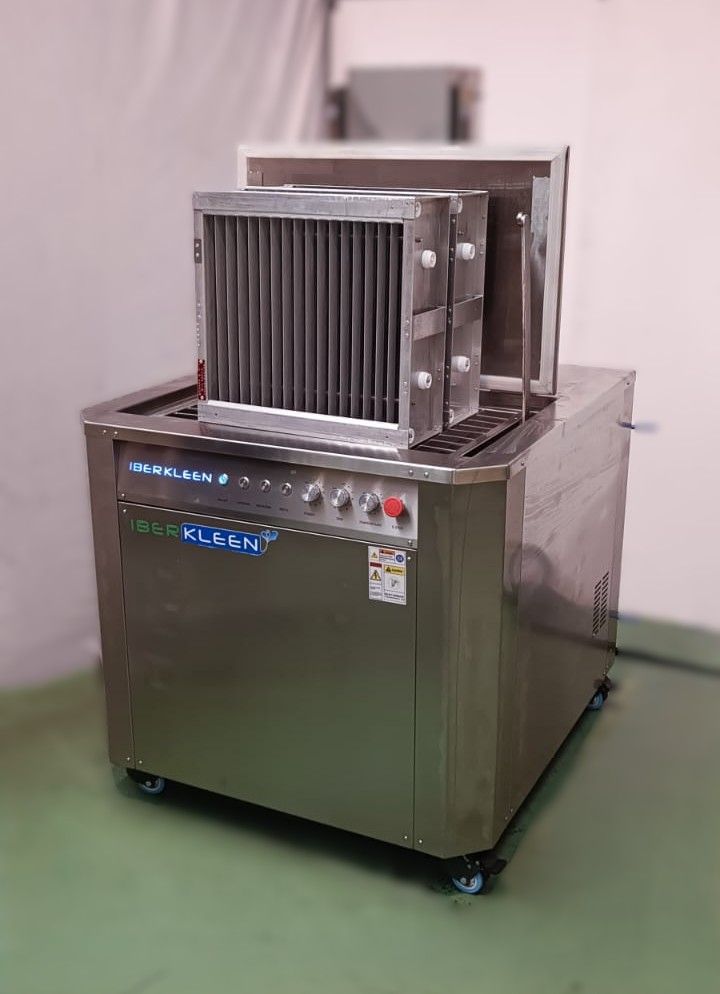
The accumulation of grease, dust and adhering dirt progressively reduces the efficiency of electrostatic filters. When this happens, the system loses its collection capacity, air circulation worsens and the need for maintenance increases. For this reason, having a electrostatic filter cleaning machine The right way of working allows for more regular work, better results and a much more controlled process.
At IBERKLEEN we manufacture industrial cleaning solutions for companies that need to wash electrostatic filters in an efficient, safe and repeatable way. We design equipment adapted to the type of filter, the level of dirt and the volume of work, both in standard versions and in customised projects.
Cleaning of electrostatic filters:
What is an electrostatic filter and how does it work?
A electrostatic filter is an air purification device that uses static electricity to capture airborne pollutants: dust, smoke, oil mists, aerosols and other pollutants that conventional mechanical filters miss.
Unlike sieve filtration systems - where the air is passed through a physical mesh - this equipment acts on the particles themselves by modifying their electrical charge.
The principle of operation is divided into two distinct stages. First, the impurity-laden air passes through an ionisation zone where ions are generated by a high-voltage electrical discharge. These particles are thus electrically charged. The ionised air flow then passes through a collector zone consisting of oppositely charged metal plates: the electrostatic attraction retains the particles on the filter surfaces, resulting in significantly cleaner air.
One of the advantages that explains its widespread adoption is the low resistance to air flow. By not interposing a dense physical barrier, the system does not penalise fan performance or increase energy consumption to the same extent as mechanical high-efficiency filters. This makes them the preferred solution in industrial machining facilities, professional kitchens, hospitals, hotels and any environment where indoor air quality is an operational or health priority.
However, its effectiveness has a well-known Achilles' heel: the collector plates rapidly accumulate the pollutants that they hold back, and this progressive accumulation deteriorates the electrostatic field and, with it, the filtration capacity.
Regular cleaning is therefore not an option, but a prerequisite for the system to fulfil its function.
Why it is essential to clean electrostatic filters regularly
Dirt accumulated on the collector plates is not only an aesthetic problem.
When deposits of grease, dust and particles reach a certain thickness, they begin to act as an insulator that weakens the electric field between the electrodes. This results in is a progressive drop in collection efficiency.The equipment continues to run, consumes energy and creates the appearance that the system is working, but an increasing fraction of pollutants escapes filtration and is re-circulated into the environment.
From an energy point of view, A clogged filter requires more effort from the electrical generator to try to maintain the load on the plates. This results in an increase in consumption which, over the course of months, represents a cost overrun that is perfectly avoidable with proper maintenance.
Studies in industrial settings estimate that an uncleaned filter can consume 15 to 30 % more energy than one in optimal conditions.
On the other hand, neglect of maintenance has direct consequences on the durability of the equipment. Fatty deposits are difficult to remove once they are polymerised by heat or combined with metal particles from machining. In extreme cases, such an insulating layer can cause electrical arcing between plates, damage ionisation electrodes and turn a routine cleaning operation into a costly repair or even component replacement.
Nor should the regulatory framework be ignored. In sectors such as industrial catering, component manufacturing or healthcare environments, current legislation requires proof of the correct functioning of air filtration systems. A poorly maintained filter can result not only in a fine, but also in the stoppage of the activity until the deficiency is rectified. Keeping a documented record of cleaning operations is, in this context, as important as performing them.
How often should an electrostatic filter be cleaned?
There is no universal answer to this question, because the optimum cleaning frequency depends directly on the pollutant load to which the filter is subjected..
The same model of equipment may require monthly maintenance on the extractor hood of an industrial kitchen with a high volume of frying, and a quarterly intervention in an office with moderate levels of ambient dust may be sufficient.
As a general reference, manufacturers generally recommend a cleaning cycle every four to six weeks in environments with high grease or fume production. -professional kitchens, machining workshops, food processing plants - and every two to three months in installations with moderate contamination. In office or hotel use, a six-monthly inspection may be sufficient, but should always be supplemented by regular visual inspections.
Beyond the calendar, there are unmistakable signs that the filter needs cleaning urgently, without waiting for the next scheduled cycle.
The presence of a persistent greasy odour in the environment, a visible reduction in the exhaust air flow rate, the lighting of saturation indicators in electronically monitored equipment or simply the visual check of plates with dark, compact deposits are alerts that should not be ignored.
Acting now, and not weeks later, makes the difference between a quick clean-up and a complex technical intervention.
How to clean an electrostatic filter
There are three main approaches to cleaning an electrostatic filter, and the choice between them depends on the degree of soiling, the geometry of the equipment and the resources available.
Knowing the advantages and disadvantages of each method allows the most appropriate decision to be made in each situation.
Manual cleaning
Manual cleaning with a cloth, sponge and degreasing agent is the most accessible and does not require additional equipment. It is suitable for preventive maintenance on moderately soiled filters, or as a complement between deep cleaning cycles.
Their main limitation is the difficulty in accessing the spaces between electrodes and the interior areas of the modules., where dirt tends to accumulate more intensively and where manual cleaning tools simply cannot reach.
Immersion cleaning
Cleaning by immersion in a hot detergent bath is the most widespread method in professional environments.
The entire module is immersed in an aqueous solution containing degreaser for a specified time - usually 20 to 40 minutes at 60 °C - and then rinsed with water at moderate pressure.
This process softens and emulsifies the fatty deposits much more effectively than manual cleaning and allows several trays to be treated simultaneously in large baths, which is particularly advantageous in installations with many modules.
Ultrasonic cleaning of electrostatic filters
Ultrasonic cleaning represents the most advanced and effective technology available today for such components.
The filter is immersed in a water bath containing surfactant to which high-frequency ultrasonic vibrations are applied.
These vibrations generate millions of cavitation micro-bubbles that implode on the filter surfaces, dislodging dirt from even the most inaccessible corners without any mechanical contact.
The result is a deep cleaning that respects the geometry of the lamellae and does not alter the surface charge of the electrodes.
The entire process, including rinsing, is carried out at 15-20 minutes, as opposed to the hours that the manual method may require.
If you are looking for the most efficient solution to keep your electrostatic filters in optimal condition, our ultrasonic cleaning machines are the answer.
Specifically designed for this type of components, The ultrasonic power, temperature control and bath capacities are adapted to different module sizes.
Contact us without obligation and we will help you choose the equipment that best suits your workload and type of installation.
Demonstration video on how to clean an electrostatic filter
youtube.com/watch?v=uKLJk_Y9J8s&pp=0gcJCdkKAYcqIYzv
.
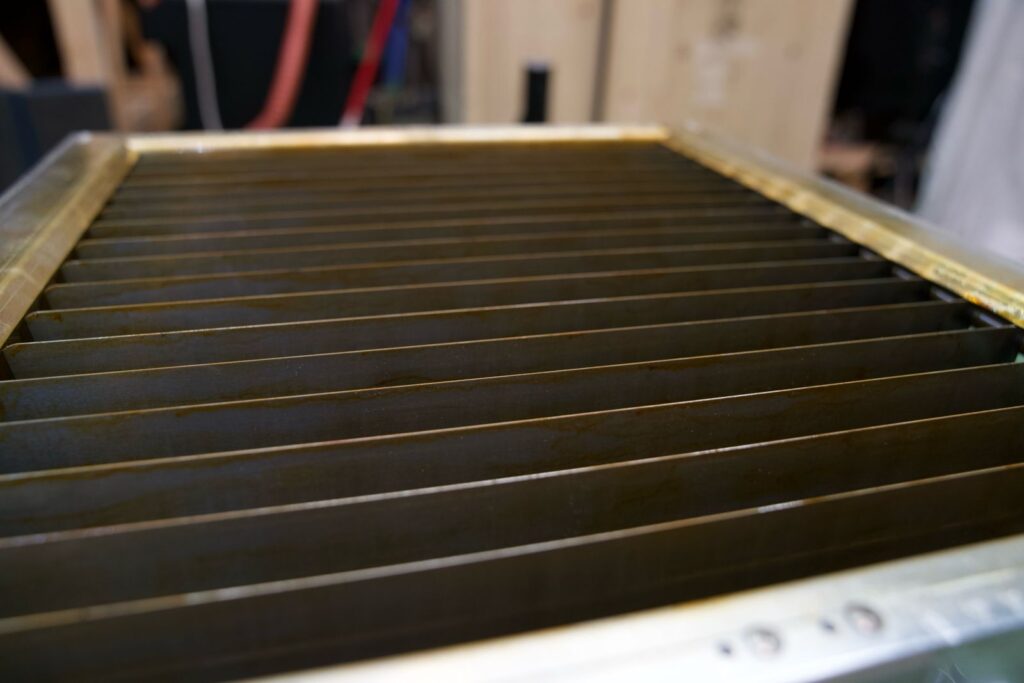
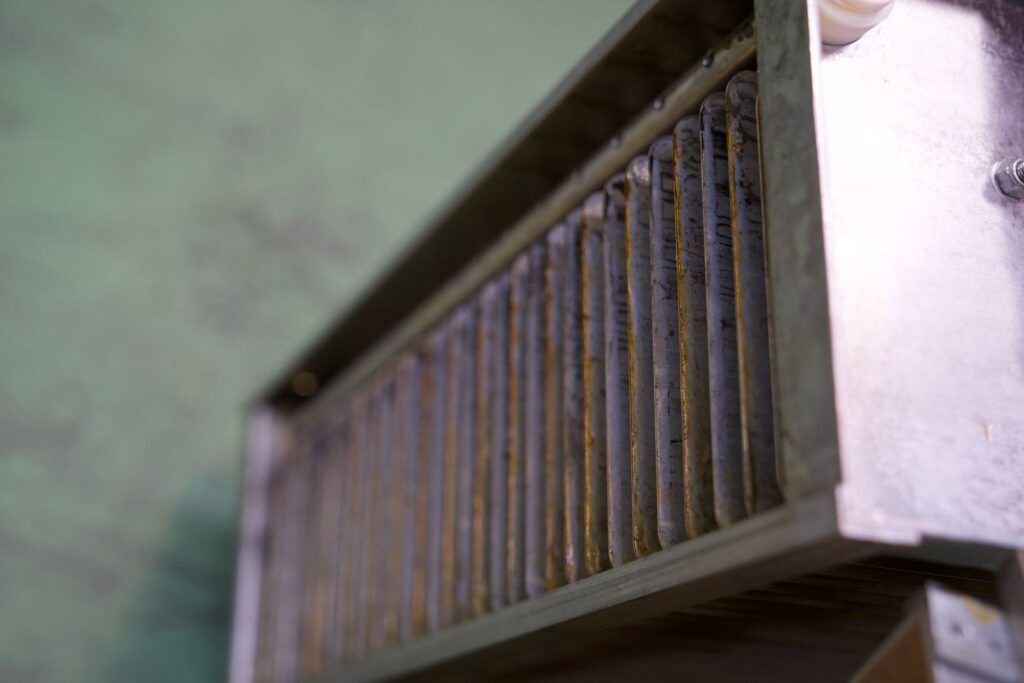
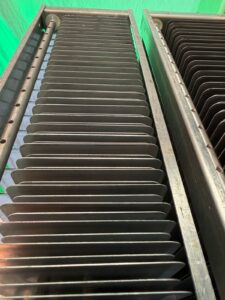
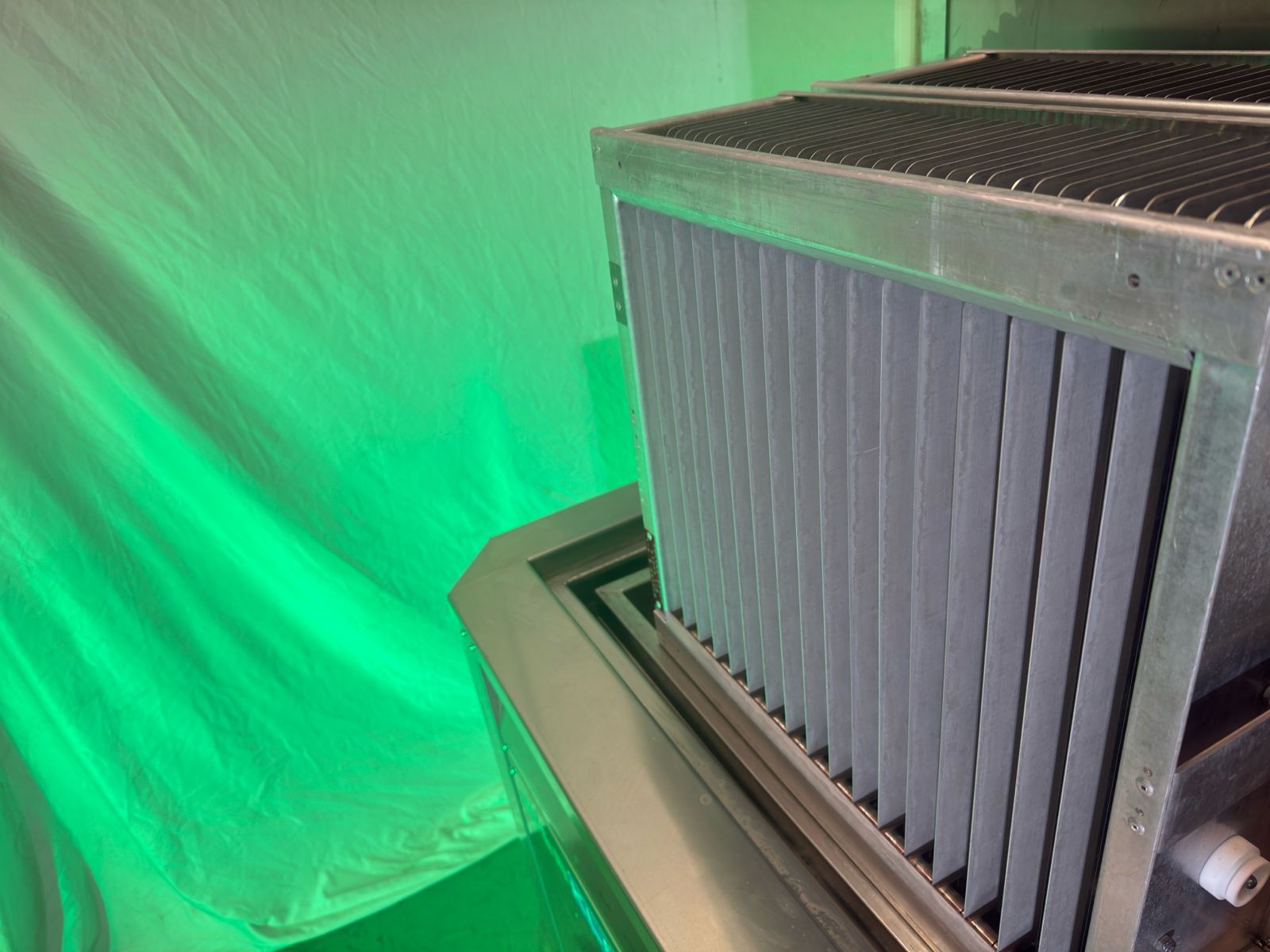
Cleaning results
Formerly
Then
Frequent errors in electrostatic filter cleaning
One of the most common errors is use of high-pressure washers to speed up the process. Although the power of the jet removes visible deposits quickly, excessive pressure can bend or misalign the thin metal lamellae of the collector plates, altering the distance between electrodes and permanently reducing the efficiency of the electric field.
The working pressure with water should never exceed 30-40 bar for this type of component, and the application distance should always be maintained at a distance of more than 30 centimetres.
Equally problematic is the use of aggressive solvents such as acetone, trichloroethylene or highly alkaline degreasers not formulated for electronics. These substances can attack the plastic coatings on insulators, degrade connectors and leave residues that alter the dielectric properties of the filter. Always use a degreasing detergent specifically formulated for electrostatic components or, failing that, a neutral biodegradable detergent compatible with aluminium and technical plastics.
Reinstalling the filter without completely drying the filter is another recurring error, especially when there is pressure to return the equipment to service quickly. As mentioned, residual moisture can generate electrical arcing during system start-up, which in addition to damaging the electrodes can activate the equipment's protection systems and take the installation out of service at the worst possible moment.
Finally, ignoring the ionisation electrodes during servicing is an omission that takes its toll in the medium term. These elements - usually metal wires or needles of very small diameter - are responsible for charging the air particles.
A bent, broken or fouled electrode drastically reduces ionisation and with it the overall efficiency of the system. Inspection and cleaning with a soft cloth soaked in isopropyl should be a standard part of every maintenance cycle.
IBERKLEEN Electrostatic Filter Cleaning Solutions
At IBERKLEEN we design and manufacture industrial cleaning equipment for demanding applications.
We study each case in order to propose the most suitable machine according to the dimensions of the filter, the dirt to be removed, the frequency of work and the level of automation required.
In this way, we can offer everything from compact equipment to tailor-made solutions for more intensive processes.
Our aim is to provide each customer with an efficient, reliable machine adapted to their real electrostatic filter cleaning needs.
Request for information
If you are looking for a electrostatic filter cleaning machine to improve your maintenance process, in IBERKLEEN we can help you. We analyse your application and propose the most suitable solution, whether it is standard equipment or a custom-made machine.