
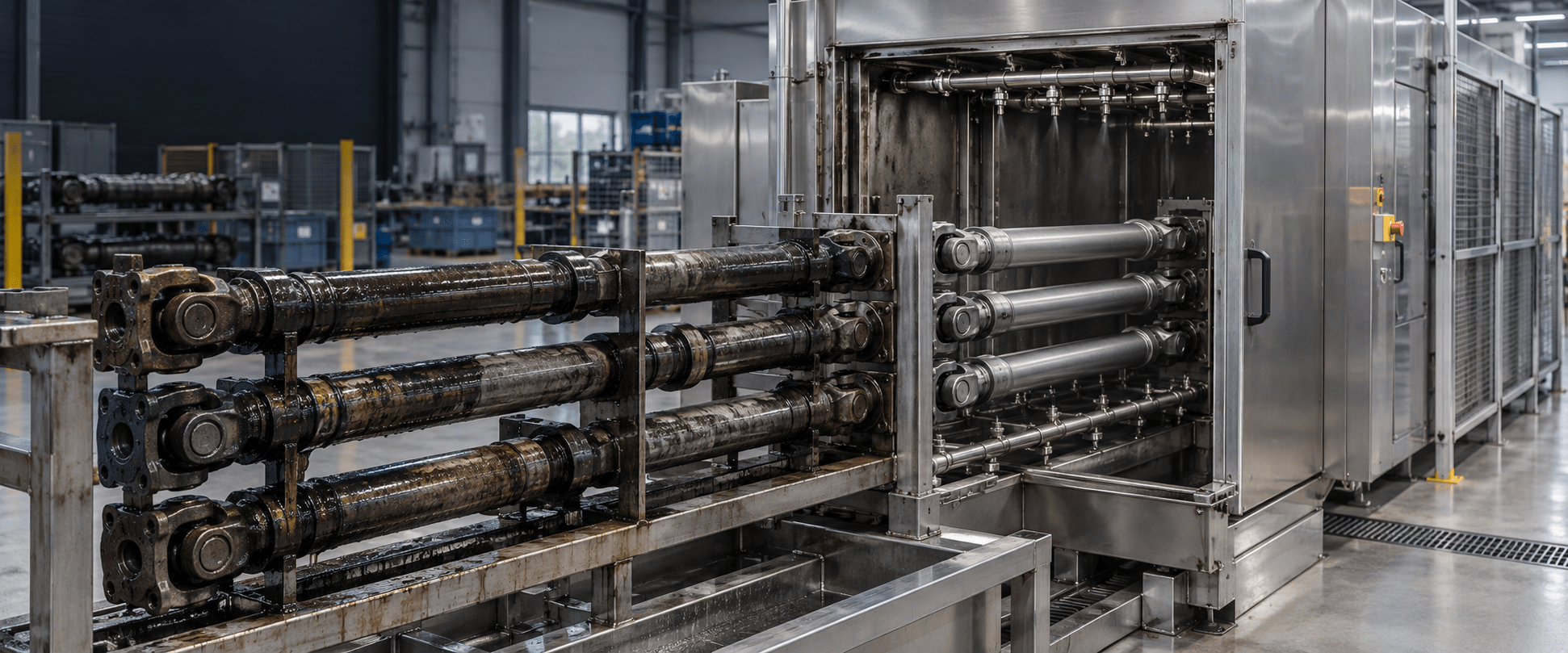
Cleaning of drive shafts using industrial systems
The cleaning of drive shafts It is not simply a matter of removing visible fat.
During manufacture, refurbishment and maintenance, a shaft may arrive at the washing stage covered in machining oil, coolant, metal shavings, abrasive dust, anti-corrosion protection or residues accumulated during service.
If these contaminants remain in the grooves, recesses, bores or inside a tubular component, they may hinder inspection and compromise subsequent operations such as assembly, balancing, shot blasting, coating or the application of a new lubricant.
That is why, The right machine is not chosen solely on the basis of the length of the workpiece. It is necessary to assess the type of shaft in question, whether it has been dismantled or still contains seals and bearings, where the dirt is concentrated, how many units are to be processed, and how the result will be verified. Based on this information, a process can be defined using spray cleaning, ultrasonic cleaning, a continuous tunnel system or a combination of several stages.
Cleaning drive shafts: methods and industrial machinery
What is involved in cleaning a drive shaft?
A drive shaft combines several challenges in a single component.
Its length determines the load and support; its cylindrical shape can cast shadows in front of fixed nozzles; and the ridges, grooves, flanges, cross-braces or cavities trap debris that is not always removed by external washing.
With open hollow shafts, it is also necessary to check whether the liquid can enter, flow through the shaft and exit without being trapped.
The first decision is to define the scope. Cleaning a machined shaft prior to assembly is not the same as cleaning a used universal joint from a commercial vehicle. New parts usually require testing for oil, coolant and particles. A reconditioned part may contain aged grease, environmental contamination, abrasives from a previous treatment or surface rust.
An assembled unit includes seals, elastomers and lubricated components, the compatibility of which with the bath must be verified before immersing them or spraying the product onto them.
What dirt should be removed?
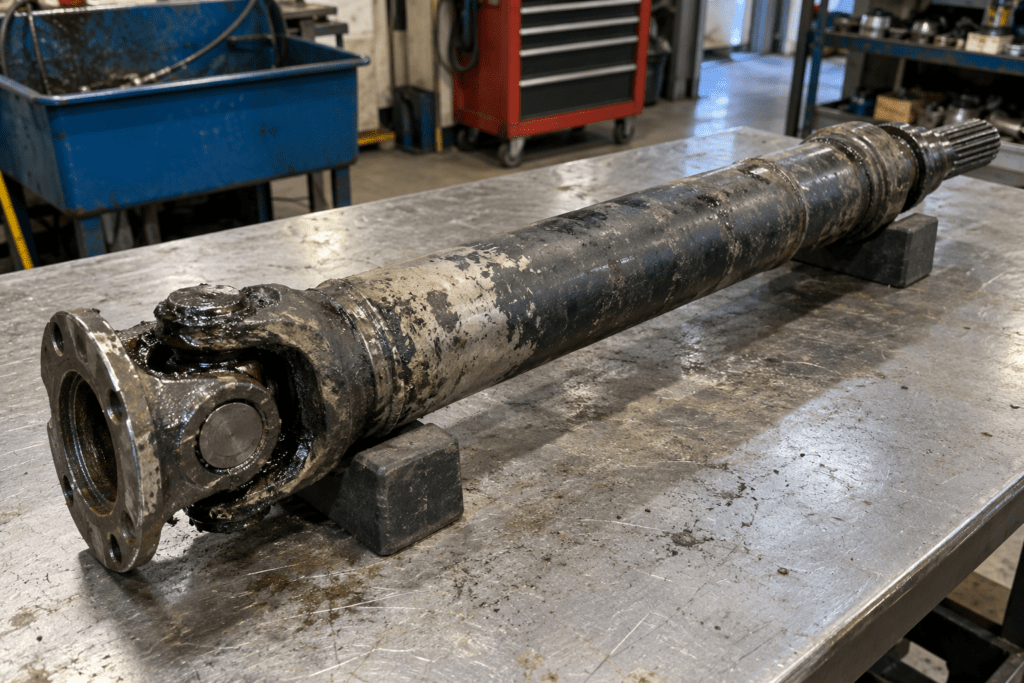
The pollutant plays a major part in the process.
The machining oils and cutting fluids are usually treated using a compatible aqueous solution and sufficient mechanical action.
The thick or old greases may require longer contact time, a controlled temperature or a preliminary stage.
The shavings and particles They require conveyance, filtration and a design that prevents them from being redeposited onto the workpiece.
It is also important to distinguish between adhering dirt and loose contamination left behind after processes such as shot blasting, sanding or machining.
A shaft that appears to be clean may still harbour fine particles in a groove, a drill hole or the interior of a tube. Conversely, a component that is to be degreased prior to visual inspection may not require the same level of particle control as a component intended for a sensitive assembly.
Situation | Common pollutants | Purpose of washing |
After machining | Oil, coolant, metal shavings and fine metal particles. | Prepare for measurement, assembly, treatment or cleanliness checks. |
After shot blasting or repair | Abrasive dust, loose particles, grease residues and flaked-off rust. | Remove process residues and ensure that surfaces are accessible for inspection or finishing. |
Stored item | Protective oil or wax, environmental dust and handling marks. | Remove the protective film without damaging the material and prepare for the next step. |
Used cardan shaft or drive shaft | Grease, mud, dust, oil and caked-on dirt. | To facilitate dismantling, diagnosis and reassembly using a process that is compatible with the assembly. |
When is the shaft cleaned? Manufacturing, refurbishment and maintenance
At production, cleaning is usually carried out between operations. It can take place after machining, before a measurement, before applying a coating or just before assembly.
What matters here are repeatability, throughput and the prevention of recontamination. The machine’s output must be coordinated with subsequent handling, as a validated part may become contaminated with particles or moisture again if left exposed or transported on a dirty carrier.
At reconstruction, the aim is to pave the way for a reliable inspection. Grease and deposits can conceal marks, cracks or wear, although cleaning alone is no substitute for the appropriate inspection method. The process may include an initial wash to remove coarse dirt, a more thorough stage with the part dismantled, and thorough drying before measurement or repair.
At maintenance, variability tends to be greater. Different part numbers, varying levels of contamination and partially assembled components are received. In this environment, a configurable machine and adaptable fixtures are useful, but the programme must still be validated for each family of parts. Flexibility does not mean using the same chemicals or the same cycle for everything.
Industrial methods for cleaning drive shafts
There is no one-size-fits-all technology. The best solution depends on the geometry, the contaminant, the production process and the acceptance criteria. In many projects, the result is achieved by combining chemical action, temperature, mechanical action and time, as well as a rinsing and drying process tailored to the part.
Spray washing
The spray washing It is a common method for degreasing the outer surfaces of shafts and metal components.
A network of nozzles directs the cleaning solution onto the part whilst it remains on a support, moves or rotates in a controlled manner.
On long spans, the coverage depends on the position of the nozzles, the distance, the angle of impact and the shadows cast by the flanges or the supports themselves.
Where there are ridges, grooves or complex geometries, it may be necessary to reinforce specific areas with directed jets or to adjust the orientation during the cycle.
If the shaft is tubular and open, cleaning the interior requires nozzles or lances aligned with the bore and a clear outlet for the liquid and particles. Spraying water onto the exterior does not prove that the interior has been cleaned.
Ultrasonic cleaning
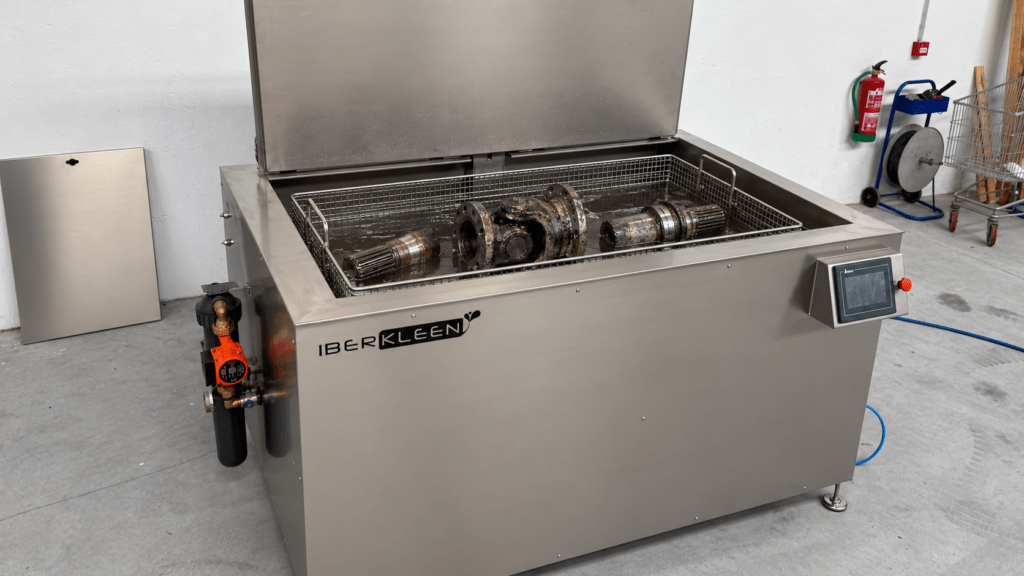
The ultrasonic machines work by immersion and are particularly useful when the disassembled part has cavities, grooves, small holes or surfaces that are difficult to reach with a direct jet. Cavitation acts on the areas wetted by the bath, so positioning, the removal of air pockets and the circulation of the liquid remain important.
For very long shafts, feasibility depends on the dimensions of the tank, the weight, the handling method and the need to submerge the entire component. The compatibility of the assembly must also be checked: a shaft that retains sealed bearings, elastomers or internal lubrication should not be treated as a bare metal part without first examining its materials and condition.
Tunnels and automated lines
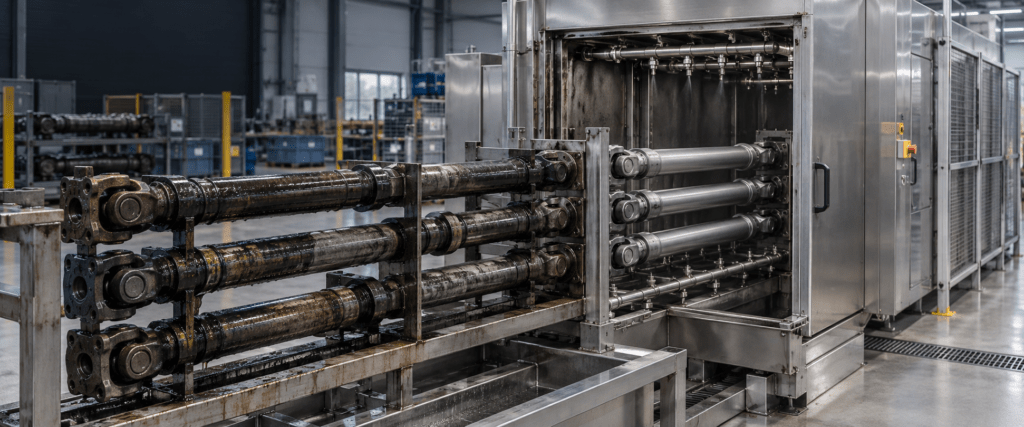
When production volumes are high or the washing process needs to be integrated with other operations, a parts cleaning tunnel or an automated line makes it possible to separate the stages and control the flow.
The process can be configured to include pre-washing, washing, rinsing, blowing, drying and, if required by the specification, temporary protection compatible with the subsequent operation. Loading can be carried out manually, via a conveyor or by a robot, provided that the fixture keeps the part stable and exposes the necessary surfaces.
Automation ensures repeatability, but it does not rectify a poorly defined process. Before setting the conveyor speed or the number of stages, it is necessary to know the level of dirt on the incoming parts, the variation between parts, the required level of dryness and the time available until the next operation.
Controlled manual cleaning
Manual cleaning it may make sense for very small-scale productions, exceptional pieces or spot repairs.
Its limitation lies in the variability between operators and the difficulty of ensuring consistent coverage. An enclosed booth with a spray lance, filtration and liquid collection improves control compared with open cleaning, but it is no substitute for an automated system where there is a repetitive specification or a high production rate.
Technology | It fits better when | Points to check |
Spraying in the cabin | Individual spindles or small to medium-sized batches with external contamination. | Cover, shaded areas, support, rotation, filtration and drying. |
Ultrasound | Dismantled parts with grooves, cavities or geometries suitable for immersion. | Tank dimensions, weight, air pockets, materials and rinsing. |
Tunnel or line | High throughput, multiple stages and integration with production. | Wayfinding, transport, toilet segregation, traceability and carbon footprint data available. |
In-cockpit manual | Variable order volumes, low production volumes or localised finishing. | Ergonomics, repeatability, safety and effluent management. |
How to clean the outside of the splines and the inside of a hollow shaft
Coverage should be analysed by zone. On the cylindrical exterior, rotating the nozzle or spraying from various angles helps to avoid dead spots. Supports must not obscure critical areas or leave marks on functional surfaces. In grooves and channels, the jet must strike at an angle that carries dirt towards an outlet, rather than pushing it into a closed recess.
In the case of a hollow shaft, you must first check that the duct is clear and can be drained. The internal lances or nozzles must be adapted to the diameter, length and changes in cross-section. If there are transverse holes, blind ends or connected passages, the coverage is verified using the actual component. A clear external view does not allow one to deduce the condition of these spaces.
Seals, cross-pieces and housings require special treatment. If they are cleaned whilst disassembled, they can be positioned or submerged to allow access to their internal surfaces. If they remain assembled, the process must prevent detergent or water from displacing essential lubricant, passing through a seal or becoming trapped. This decision must be agreed with the person responsible for the component before the cycle is designed.
Solutions for external and internal degreasing and cleaning of pipes and tubes
Recommended washing, rinsing, drying and protection process
An industrial project is usually defined as a sequence of steps, rather than a single operation. The following structure provides an engineering framework that must be adapted to the component and the required outcome:
- Characterise the part and the contamination. Record materials, coatings, dimensions, weight, internal geometries, markings and actual contaminants.
- Prepare and load. Remove any excess dirt where necessary, place the shaft in a stable fixture and align any critical passages or areas.
- Wash. Apply the chosen method using a compatible chemical and parameters determined by testing.
- Rinse when required by the process. Ensure that no detergent or loosened dirt remains on functional surfaces.
- Drain and dry. Design the blowing or drying process to cover grooves, ends and cavities, not just the visible surface.
- Protect and handle. If the steel requires temporary protection, select a product that is compatible with subsequent assembly, coating or storage.
- Verify. Apply the agreed acceptance criteria and record the variables required to repeat the process.
Bath management is part of the outcome. Free oil, particles and the concentration of contaminants vary with each load. Filtration, oil separation, draining and top-up must be sized according to the level of contamination entering the machine. A well-tuned cycle can become unstable if the fluid is not maintained within its operating parameters.
Which machine is required for each application?
A workshop that assembles only a few items does not require the same facilities as a production line.
For small batches and external contamination, a spray-wash machine fitted with a specific cleaning tool may be sufficient, provided the part fits, is correctly supported and is fully covered. If the part’s geometry includes complex cavities or grooves and it is suitable for immersion, ultrasonic cleaning can provide a more uniform clean in areas accessible to the cleaning bath.
When rinsing, drying or protection are required within a single cycle, a multi-process solution eliminates the need for intermediate handling. For large-scale production runs, a tunnel or an automated cell enables the co-ordination of loading, turning, internal and external washing, and unloading. For long or heavy shafts, the solution is usually bespoke, as the effective length, support distribution, total load and handling method all influence the design.
At IBERKLEEN We manufacture spray washers, ultrasonic systems, tunnels and specialised production lines. The proposal must be based on a test and the process data; it must not be based on assigning a model simply based on the part’s name.
 Frequently asked questions about industrial turbine cleaning
It depends on the level of soiling, the geometry, the assembly condition, the production process and the required outcome. Spray cleaning is usually effective on external surfaces; ultrasonic cleaning can be helpful for disassembled parts with complex geometries; and a tunnel cleaner is suitable where there is a high throughput or multiple stages. The choice must be validated using actual samples.
External washing may be carried out provided the process is compatible with seals, gaskets and lubricated areas. It should not be assumed that an assembled unit can withstand immersion, high pressure or any detergent. The materials must be identified and the ingress of liquid must be prevented where it could displace lubricant or become trapped.
Using appropriate guidance, directed jets or immersion, depending on the part. The tool must expose the critical areas and allow the liquid to carry the contamination towards an outlet. Coverage is checked using the actual part.
It must be confirmed that the duct is open, that it can be drained, and that a nozzle, jet or immersion process reaches its full length. Changes in cross-section, blind ends and transverse holes require specific validation.
It depends on the chemical composition and the subsequent process, but the outcome must be defined from the outset. If any detergent residue or moisture remains in grooves and cavities, this may interfere with assembly, coating or storage. In the case of steel, the need for temporary corrosion protection must also be assessed.
The method must comply with the specification: visual inspection, residual film testing or particle analysis, amongst other options. For automotive components with technical cleanliness requirements, the company may use ISO 16232 or VDA 19.1, but the specific limit must be agreed between the customer and the supplier.
Request a test with your axles
If you need to automate the cleaning of drive shafts, universal joints or machined shafts, please send us photographs, dimensions, weight, production volume, degree of soiling and output requirements.
At IBERKLEEN We will assess whether the application requires spraying, ultrasonics, a multi-process machine or a bespoke production line, and we can arrange a trial using representative parts before finalising the configuration.