
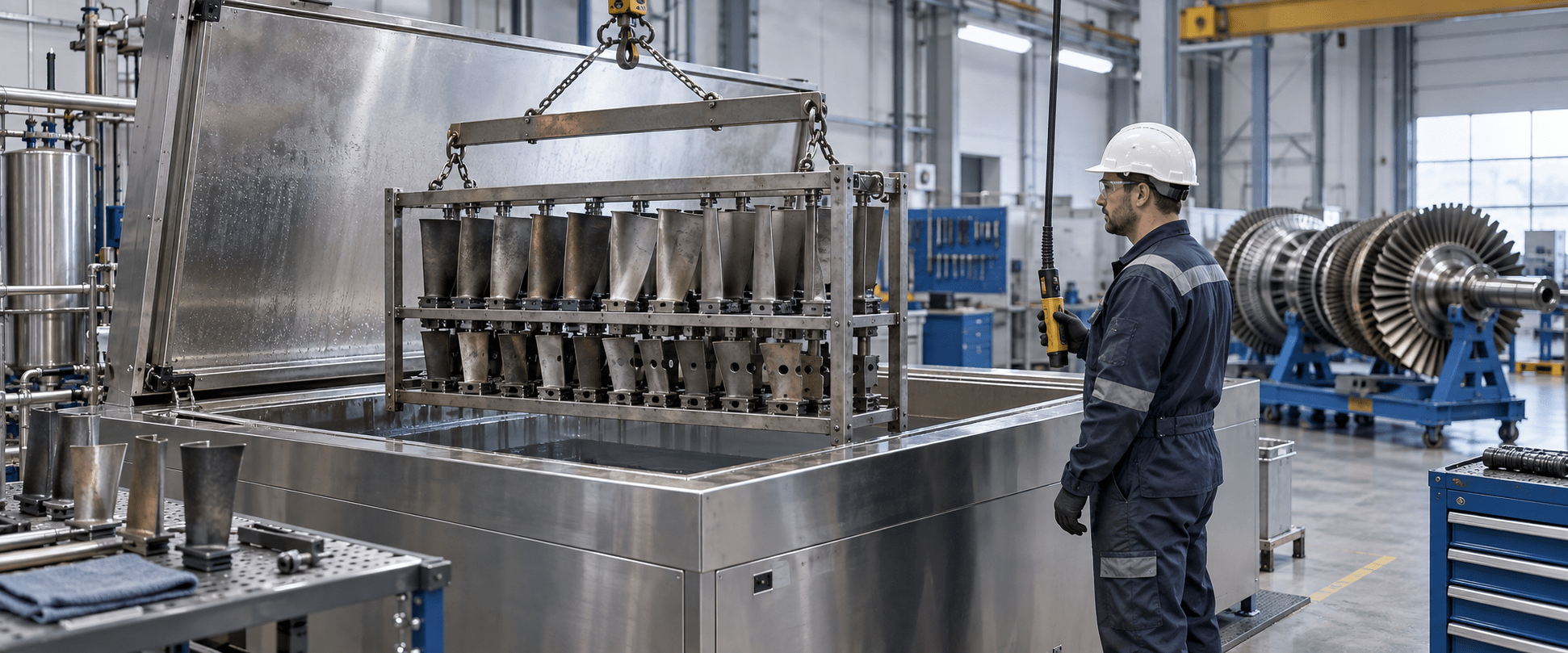
Cleaning industrial turbines: how to clean blades and components
The cleaning of industrial turbines It covers a wide range of tasks. It may refer to flushing the compressor of a gas turbine without dismantling the machine, removing deposits from a steam turbine during a shutdown, or cleaning blades, discs, diaphragms, valves and casings in the workshop.
Confusing these scenarios leads to the selection of equipment that fails to remove the residue or, in the worst-case scenario, to the use of a process that is incompatible with the material or coating.
For a power station, a combined heat and power plant or a turbomachinery workshop, the aim is not for the part to “look new” either.
Cleaning must be carried out in accordance with a verifiable need: to restore accessible surfaces, prepare a component for inspection, remove oils or process residues, prevent contamination between repair stages, or meet an internal acceptance criterion.
This guide compares the main methods and focuses on disassembled parts that can be processed in an industrial washing machine. It explains when ultrasonics and spray washing add value, what limitations must be taken into account, and what information a manufacturer needs to design a reliable solution.
Cleaning industrial turbines: how to clean blades and components
What is actually cleaned in an industrial turbine?
In a gas turbine, air first passes through the intake system and the compressor. It is then mixed with fuel in the combustion chamber, and the hot gases transfer energy to the turbine stages. Each zone experiences different temperatures, flow rates and contaminants. Cleaning a compressor whilst it is fitted is not the same as cleaning a blade from the hot section that has been removed for inspection or repair.
In a steam turbine, the fluid expands as it passes through stationary and moving blades arranged in several stages.
Deposits originate from the water and steam cycle itself, from corrosion products or from carried-over contaminants. The nature of these deposits and the condition of the surface determine whether an aqueous, chemical, mechanical or combined treatment is appropriate.
During an overhaul, the workshop may receive blades and nozzles, discs, complete or partial rotors, diaphragms, seals, housings, valves, fasteners and auxiliary components.
Not all parts should go into the same machine. Weight, volume, masked areas, internal ducts and the presence of coatings all affect the process.
Why contamination must be identified before cleaning
Particles and aerosols from the intake air are deposited in gas turbine compressors.
EField studies have identified combinations of mineral dust, oxides, soot and fibres or particles associated with the filtration system.
Moisture and oily contaminants can cause them to stick. Nor is the distribution uniform: the initial stages and the later sections may respond differently to washing.
Components in the combustion chamber and hot section may be subject to soot, burnt residues, oxides and contamination adhering to surfaces exposed to high temperatures. Some incorporate superalloys and thermal or environmental protective coatings.
The cleaning objective cannot be defined without knowing which surface is to be preserved and which layer is actually intended to be removed.
In steam turbines, deposits of salts, silica and corrosion products may form, in addition to oils or dirt introduced during dismantling. A soluble deposit requires a different approach to a hard layer or carbonised residue. Before increasing the mechanical force applied, it is advisable to analyse a sample and review the equipment’s history.
What are the potential consequences of inadequate cleaning?
Dirt alters the profile and roughness of the surfaces through which the fluid flows.
In the compressor, the fouling It is a well-known form of degradable waste, which is why recycling schemes exist.
During the overhaul, a poorly prepared surface may also conceal indications, contaminate a subsequent stage or result in a component having to be sent back for cleaning after inspection and repair capacity has already been utilised.
However, it would be a mistake to attribute any loss of performance to dirt.
Erosion, corrosion, loss of coating, cracks, deformation and changes in clearance cannot be rectified by washing. Inspection and operating data must distinguish between what can be removed and what constitutes damage to the component.
Preliminary diagnosis: the data that define the process
A serious proposal starts with the part and the expected result, not with the power of a machine.
As a minimum, the following information must be known: the turbine and the stage from which the component originates, the component reference number, the base material, the coatings, any contamination, the dimensions, the weight and the number of parts to be processed.
The acceptance criteria must also be defined. These may be visual, linked to a penetrant inspection or other non-destructive testing (NDT) method, aimed at limiting residual contamination, or designed to prepare the surface for repair or coating. These criteria determine the rinsing, drying and handling procedures, as well as the need to record parameters.
Where there is no previous experience with the combination of material, coating and residue, it is preferable to carry out a test on a non-critical part or a representative sample rather than setting a cycle by analogy. Validation must include not only the removal of dirt, but also the absence of any undesirable effects on the finish and functional layers.
Methods for cleaning industrial turbines
The methods differ in terms of the location of the intervention, the energy applied and the waste they generate. The following comparison is intended to guide the study; the procedures specified by the turbine manufacturer and the component owner take precedence.
Method | Typical application | Advantage | Limit to be monitored |
In-line or off-line cleaning of the compressor | Gas turbine fitted in accordance with OEM procedures. | It tackles fouling without having to dismantle all the components. | Water, detergent, the condition of the unit, drainage and parameters specified by the manufacturer. |
Water spraying | Dismantled parts with accessible surfaces and soluble or degreasable dirt. | It automates the washing process and can be integrated with the rinse and dry cycles. | Shadows caused by spray, pressure, orientation, coatings and internal geometries. |
Immersion ultrasonography | Blades, discs and dismantled parts that may be submerged and become completely wet. | Cavitation acts on wetted surfaces and complex geometries. | Chemistry, material, coating, trapped air, acoustic load and distribution. |
Dry cleaning by soaking or circulation | Deposits resulting from a specific reaction. | It can break down or dissolve stubborn contaminants. | Compatibility, bath control, neutralisation, rinsing and effluents. |
Dry ice or dry mechanical cleaning | Accessible surfaces, on-site work or the preparation of specific areas. | It prevents water from entering and can reduce secondary waste from the environment. | Access, projection, containment, ventilation and surface sensitivity. |
Abrasive blasting or laser cutting | Specialised preparation in accordance with an approved procedure. | Localised action and effectiveness against resistant strains. | Material loss, surface roughness, coatings, dust, fumes and qualification. |
Combined process | Mixed soiling or a multi-stage process. | Match each stage to the pollutant and the outcome it best addresses. | Drag, compatibility between stages, handling and traceability. |
Flushing the compressor with the turbine fitted
In-line and off-line flushing are part of the maintenance of the installed turbine. In the former, the system operates under the conditions specified by the OEM; in the latter, the unit is shut down and a specific cycle of injection, rotation, soaking and rinsing is carried out.
Both are designed to tackle deposits in the compressor, but they are no substitute for cleaning components that have been removed when the turbine undergoes an overhaul.
Spray cleaning of dismantled parts
Water spraying is suitable for degreasing casings, brackets, valves and other parts whose surfaces can be exposed to the spray.
In a automatic parts washer, the tooling and orientation are essential to ensure that the liquid reaches the required surfaces and drains away after the cycle.
Where there are narrow passages, closely spaced blades or shielded areas, the direct impact may not be distributed evenly. In such cases, the spray pattern can be adjusted, directional nozzles can be fitted, controlled manual washing can be incorporated, or immersion cleaning can be considered. It is not advisable to increase the pressure without first checking the sensitivity of the part and the coating.
Ultrasonic cleaning of blades and components
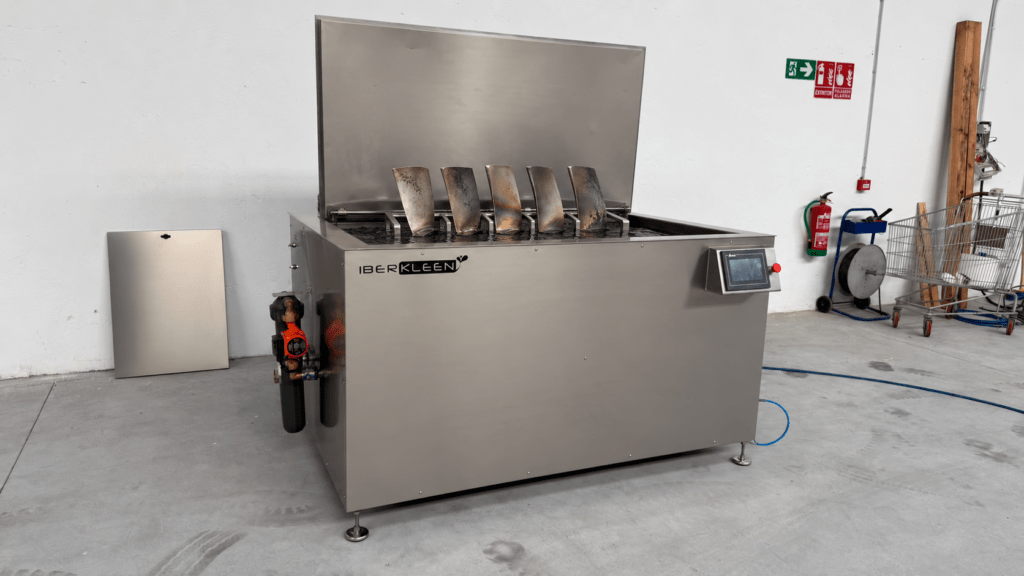
In an ultrasonic tank, the transducers generate acoustic waves in the liquid. Cavitation helps to dislodge contamination from wetted surfaces and can reach areas that are not directly exposed to the jet. This feature makes it particularly suitable for batches of blades, discs with housings, valves and parts with complex geometries.
Immersion does not eliminate the need for process engineering. The cavities must be filled, air must be able to escape, the parts must not become jammed together, and the rack must not create sheltered areas. With large loads, the position of the transducers, the distance from the part and any vertical movement help to distribute the force. The rated power, on its own, does not guarantee uniformity.
Nor is there a universal frequency, temperature or detergent for “turbines”. An uncoated superalloy, an aluminised component and a blade with a thermal barrier each present different risks. The choice must be based on the relevant documentation and on tests demonstrating cleanliness without any undesirable changes.
Dry cleaning, blasting and other technologies
The dry ice It can be useful when you want to avoid water coming into contact with accessible surfaces and there are appropriate arrangements in place for CO₂, compressed air, ventilation and safety.
The dripping An approved cleaning agent is used to remove deposits and prepare surfaces, particularly when the aim is to achieve a condition suitable for inspection.
The laser cleaning It offers localised action, although it requires control of the process, as well as the removal and assessment of the substrate and the coating.
These technologies do not always compete with ultrasound.
A facility may use dry cleaning on a large rotor or housing and reserve immersion cleaning for removable components. A useful guideline is to assign each method to the surface area it can treat in a controlled manner.
When is an ultrasound machine recommended?
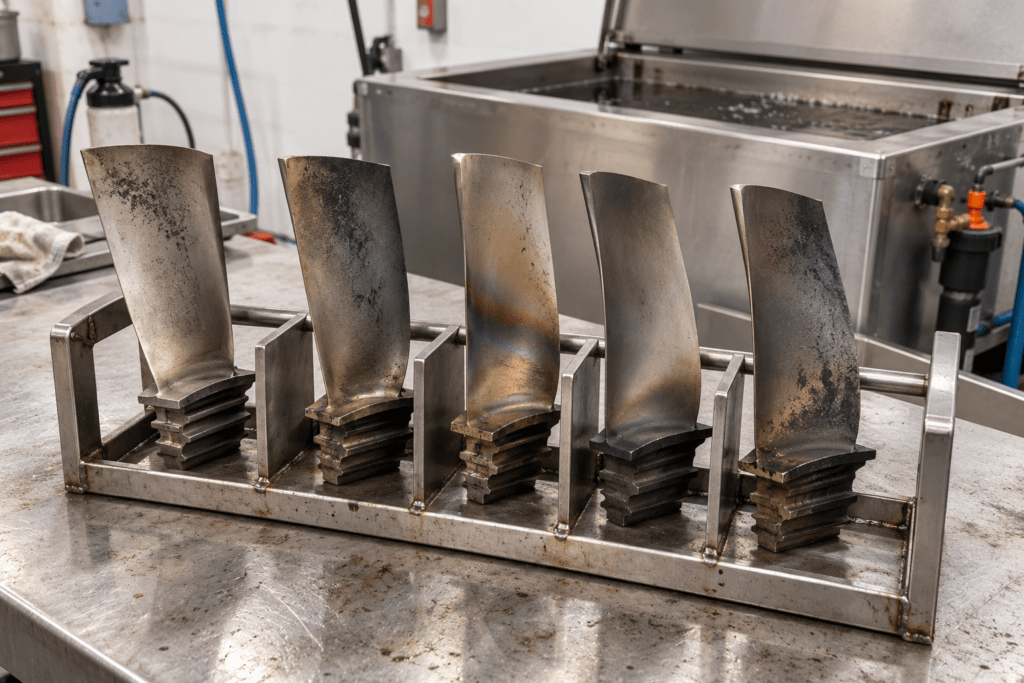
The Ultrasonic cleaning machines are a contenderThis is particularly the case when the part can be fully submerged, the residue is compatible with an aqueous medium, and the part’s geometry includes areas that are difficult to clean by brushing or spraying. These methods are also useful when the aim is to process batches using a repeatable formula and to reduce the variation associated with manual work.
They must be ruled out or subjected to enhanced validation where the component cannot be immersed, where there are coatings whose behaviour is unknown, where there are cracks or damage that may trap liquid, where the geometry prevents air from being evacuated, or where the criteria require the removal of a layer that necessitates a specific chemical or mechanical process. A rotor that exceeds the weight or usable dimensions must not be forced into a tank designed for smaller parts.
Professional process for dismantled components
The process must be designed from the end to the beginning, starting with the condition in which the part must arrive for inspection, repair or assembly. A typical sequence may include the following stages, tailored to the customer’s specification:
- Receipt and identification. Record the reference number, origin, material, coating, condition and visible contamination.
- Pre-inspection and masking. Document any existing damage and protect areas that are not to be treated.
- Remove loose waste or bulky items that would clog the main drain.
- Fitting to the jig. Avoid contact with critical surfaces and ensure that the liquid can enter and the air can escape.
- Apply spraying, ultrasonic treatment or chemical treatment using parameters established through testing and established procedures.
- Remove detergent and loosened contaminants, whilst monitoring carry-over between stages.
- Drying and protection. Prevent water retention and determine the temporary protection required, depending on the material and the subsequent process.
- Validation and recording. Check the acceptance criteria and retain the data required to repeat the cycle.
❓ Frequently asked questions about industrial turbine cleaning
This is not the usual approach. Immersion ultrasonic cleaning is used on dismantled parts that fit into a tank and can come into contact with the liquid. The cleaning of an assembled gas turbine involves systems and procedures specific to the turbine manufacturer.
Blades, nozzles, discs, valves, fasteners and certain combustion or auxiliary components may be suitable. The decision depends on dimensions, weight, material, coating, internal geometry, residue and acceptance criteria. Compatibility should not be assumed solely on the basis of the part’s name.
They can help to remove these contaminants when used in combination with a compatible chemical and a validated process. Heavily encrusted residues, certain layers of rust or materials intended for stripping may require pre-treatment, a specific chemical or another method. A test run determines the appropriate sequence.
The criterion depends on the following operation. It may include visual inspection under defined conditions, the absence of film, particle control, or preparation compatible with NDT or coating. The customer must provide the applicable specification; the machine is validated against that result.
Drawings or dimensions, weight, photographs, identification of the material and coating, description of the contaminant, number of parts per shift, current method, cleaning criteria, subsequent process, supplies and available space. If possible, a part or sample will enable the process to be validated before the facility is designed.
We study the process using the actual parts
At IBERKLEEN We manufacture ultrasonic cleaning machines, parts washers and multi-stage systems for maintenance and industrial applications.
If you need to standardise the cleaning of blades, discs, valves or turbine components, please send us the details of the part and the residue. We will analyse the suitability of the process, the tooling, the rinsing and drying stages, and the required capacity.
Where the application requires it, we will carry out preliminary tests on a representative sample before sizing the machine.