
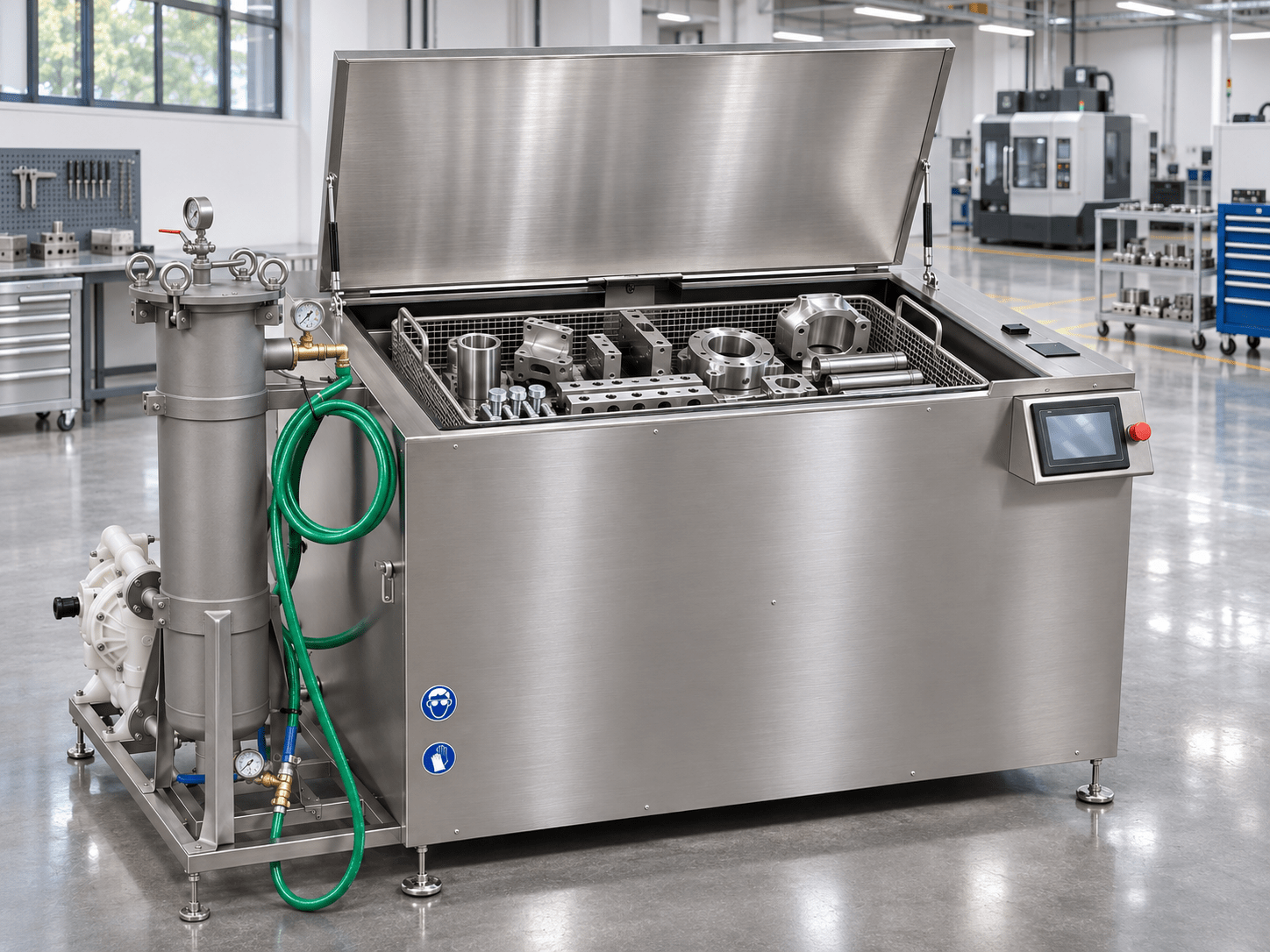
Weapons cleaning: ultrasonic cleaning and washing of defence components
Ultrasonic weapon cleaning is of interest to gun shops, maintenance workshops and specialist companies that need to process components in a repeatable manner.
In the defence industry, the same technology can also be used to clean parts during the manufacturing process, alongside other methods such as water spraying.
The requirements are not identical. During maintenance, combustion residues, grease and contamination from normal use may be encountered; in the factory, machining oils, emulsions and particles are the most common. The machine, the cleaning fluid and the subsequent stages are selected according to the part, the material, the finish and the required result.
IBERKLEEN factory ultrasound equipment and industrial washing machines, as well as bespoke multi-stage systems. We examine both batches of approved maintenance components and the cleaning of production parts, carrying out preliminary tests where the process so requires.
Weapons cleaning: ultrasonic cleaning and washing of defence components
Ultrasonic gun cleaning in gun shops and professional maintenance
At a gun shop or a specialist workshop, cleaning firearms may involve regularly treating numerous dismantled components.
Ultrasonic cleaning allows for batch processing on wet surfaces and in areas accessible to the liquid, without relying solely on manual brushing. The result depends on the material, the level of soiling and the arrangement of the parts in the basket.
Before using a tank, it is necessary to identify Which components does the gun manufacturer approve? and which surfaces or coatings are compatible with the bath.
Optics, electronics, wood, adhesives, seals, polymers and special finishes require validation or exclusion. It should not be assumed that a complete weapon can be submerged.
The parts may need to be rinsed and dried before inspection. Any subsequent protection or lubrication must be carried out in accordance with the authorised maintenance procedure. The residues removed, which may include metals and other hazardous substances, must be taken into account in the risk assessment and in the management of the bath.
What sort of businesses need professional cleaning?
Gun shops and workshops They are looking for a system that will enable them to organise batches of compatible components.
Maintenance centres and public bodies may require the identification of sets and records.
The arms manufacturers and their suppliers They also need to integrate washing into production operations, with defined frequencies and acceptance criteria.
Cleaning of weapon components during manufacture
A part that appears to be clean may still contain traces of cutting fluid in a cavity, particles in a recess or residues from the previous process. Such contamination may hinder an inspection, interfere with a surface treatment or require additional operations before production can continue.
Requirements vary depending on the stage of the process. An intermediate degreasing stage may be carried out to remove oil and swarf. During the final cleaning stage, the customer may require the absence of visible residues, specific particle limits or a particular surface condition. These criteria must be agreed upon before selecting the machine.
Common contaminants in the production process
Industrial components intended for the defence sector may contain machining oils and emulsions, protective greases, metal particles, polishing residues, abrasives, handling dust and detergent residues from a previous stage. The choice of cleaning agent must take into account not only the type of contamination but also the material and surface treatment.
It is not advisable to apply a single method across different components. A solution suitable for machined steel may require modifications or prove unsuitable for certain alloys, coatings, adhesives or joints.
Cleaning of parts prior to assembly and between industrial processes
Washing can be incorporated after machining, between processing operations, before quality checks or as a final preparation for the next stage of the process. The machine’s position within the production line affects logistics, throughput and the level of automation required.
Stage | A regular need | Point to check |
Post-machining | Remove oils, emulsions and loose particles | Residual contaminants and access to cavities |
Before surface treatment | Prepare a surface suitable for the subsequent process | Surface condition required for the treatment |
Before inspection or assembly | Minimise waste that hinders control or handling | Acceptance criteria defined by the client |
Final wash | Carry out cleaning, rinsing and drying where necessary | Residues, moisture and batch traceability |
The examples describe general industrial applications. Each component must have a process specification approved by the relevant technical manager.
Which defence parts and components may require cleaning?
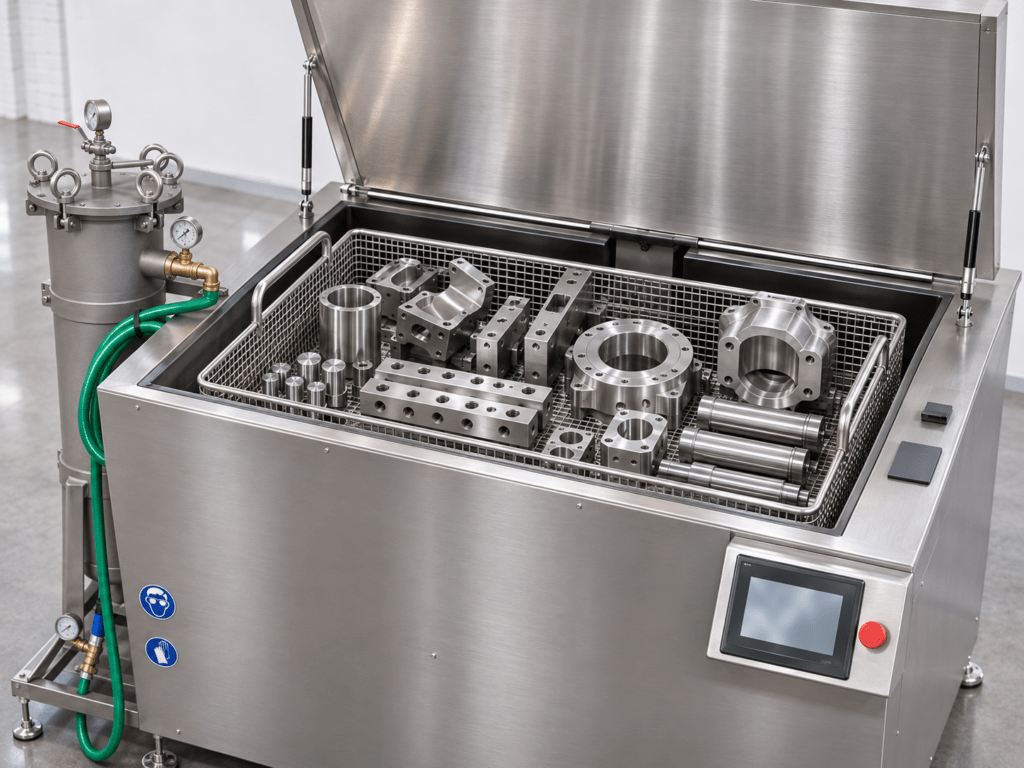
The scope of application covers machined metal parts, brackets, housings, auxiliary assemblies, blocks and hydraulic system components, jigs and precision components used in various types of equipment within the sector.
There are also cleaning requirements at facilities involved in the manufacture and maintenance of land vehicles, aircraft and naval systems.
Whether a part is suitable for ultrasonic cleaning, spray cleaning or immersion cleaning is not determined by the sector to which it belongs. Its geometry, accessibility, mass, base material, tolerances, finish and the presence of sensitive components must be assessed. Certain coatings, porous materials, electrical components or enclosed assemblies may require specific testing or may be excluded from the process.
The selection and approval of components is the responsibility of the manufacturer or the person in charge of the process. Ammunition, energetic materials and pyrotechnic devices must not be introduced into conventional parts-washing equipment. Assemblies presenting special risks require a specific assessment and appropriate equipment.
Ultrasound, spraying and multi-stage washing: which system to choose
Cleaning technologies cater to different needs. The choice should be based on representative samples and a trial to verify the results, rather than assuming that a single method is suitable for the entire production run.
Technology | Where it might fit in | What does studying involve? |
Ultrasound | Parts compatible with recesses, grooves and dirt adhering to wet surfaces | Equipment, orientation, compatibility, chemistry and bath conditions |
Water spraying | Robust components, accessible geometries and recurring cleaning processes | Nozzle coverage, shaded areas, flow rate, filtration and load |
Multistage | Processes requiring washing and distinct subsequent stages | Rinsing, drying, automation, transfer and acceptance criteria |
Ultrasonic cleaning for weapons and defence components
In ultrasonic cleaning for weapons and defence components, cavitation acts on wetted surfaces and can facilitate the removal of residues from hard-to-reach areas. Its effectiveness depends on the geometry, the arrangement of the load and the bath conditions. Material compatibility and the cleaning result are confirmed by testing on representative parts.
Spray washing
Spraying allows a cleaning solution to be directed onto accessible surfaces and to treat batches of items in baskets, trays or containers. It may be suitable when the main objective is to remove grease and manufacturing residues from mechanical parts. The spray angles and any potential blind spots must be assessed based on the actual load.
Multi-stage installations
Where the process requires a part to be prepared for a subsequent operation, the system can incorporate washing, rinsing and drying. The design depends on the type of dirt, the material, the production rate and the required delivery condition. Automation must meet specific requirements for handling and repeatability.
How to establish a cleaning process for arms manufacturers and defence contractors
1. Identify the component and the required outcome
Dimensions, weight, materials, finishes and areas to be cleaned are documented. For maintenance, the manufacturer’s authorisation and the assembly’s identification must also be confirmed. During manufacture, the steps following washing are checked: inspection, storage, surface treatment or assembly.
2. Distinguish between waste from use and waste from manufacturing
In maintenance, wear deposits and greases are analysed; in manufacturing, oils, emulsions and particles are analysed. Substances that may leach into the bath are also examined. This information guides the choice of chemicals, the cleaning method and waste management.
3. Calculate the effective basket size, batch sizes and cadence
The calculation is based on the longest part, the weight, the number of units per batch, the shifts and the estimated time. Ultrasound is used to check the usable volume of the basket; in spray cleaning, the orientation and coverage of the parts are checked. The nominal capacity of the tank in litres is not sufficient to correctly size a weapons cleaning machine or a production system.
4. Define rinsing, drying and bath treatment
Depending on the final requirement, it may be necessary to remove detergent residues, monitor water quality and ensure that cavities are dried thoroughly. Filtration, oil removal, replenishment and the management of the process liquid are also assessed. These decisions affect both operating costs and the stability of the washing process.
5. Verify the result and document the recipe
A test using representative samples allows cleanliness and compatibility to be verified. Acceptance criteria may include visual inspection and, where specified by the customer, measurements of residual contamination, particles or other agreed checks. Recording the batch, conditions and result helps to ensure repeatability.
Traceability, quality and process safety
On a production line, it is useful to be able to link each batch to the cleaning process applied. Depending on the contractual requirements, the record may include the part identification, recipe version, date, condition of the bath and inspection.
The scope of the documentation must be defined by the client: simply having a programmable machine does not, in itself, certify a level of cleanliness.
The chemical must be compatible with the materials and used in accordance with its technical data sheet and safety data sheet. Furthermore, the process requires a risk assessment covering handling, ventilation, staff exposure and waste. Flammable liquids must not be used in equipment that is not designed and certified for that purpose.
If the specimen or waste is subject to special requirements regarding safekeeping, confidentiality or management, these requirements must be incorporated into the project before any testing or handling of samples takes place.
IBERKLEEN machines for cleaning weapons and defence components
At IBERKLEEN We manufacture standard equipment and bespoke washing solutions.
The following are being considered for gun shops and maintenance centres ultrasonic tanks depending on the size and number of compatible components per batch.
At defence manufacturing Industrial ultrasonic systems, spray washers or multi-stage lines incorporating rinsing and drying may be suitable.
The SPICA and POLARIS families, the spray washers SIRIUS and DENEB multi-process solutions form part of our range.
A specific range or configuration is recommended following a review of the parts and washing requirements. Compatibility and performance are validated on a case-by-case basis.
With over 30 years’ experience in ultrasonic technology, the team at IBERKLEEN discuss the components with the maintenance, process engineering or quality managers, depending on the application.
Frequently Asked Questions
It depends on the part and the task. For disassembled, compatible metal components, ultrasonic cleaning may be useful for complex geometries. For industrially manufactured parts with accessible surfaces, spray cleaning may be appropriate. A comparative test allows the result to be verified.
Yes, when defining and validating the surface preparation required for the subsequent treatment. The cleaning process must be compatible with the material, the existing finish and the acceptance criteria for the next process.
First, an acceptance criterion is agreed upon. A visual inspection may be sufficient for simple applications, or a specific method for measuring residual contamination may be required, as always specified by the customer.
This should not be taken for granted. Differences in material, coating and chemical composition may require batch segregation and different formulations. Compatibility is checked in advance.
No. In some processes, a single washing stage, supplemented by external operations, is sufficient. A multi-stage system is justified when the end result, production rate or handling requirements make it advisable to integrate the stages.
This should not be taken for granted. Professional cleaning is carried out on components that have been dismantled and expressly authorised by the manufacturer. The presence of sensitive materials, electronics, optical components, coatings or incompatible parts may prevent immersion.
An aqueous formulation approved for use on the contaminant and compatible with all materials and finishes in the batch. Selection requires checking the technical and safety data sheets and validating the result. Flammable liquids must not be used in equipment not designed for that purpose.
The calculation is based on the dimensions of the authorised components, the weight, the usable basket capacity, the number of units per batch and the frequency of use. It is also advisable to define the rinsing, drying and bath monitoring stages before selecting a piece of equipment.
Dimensions and weight, materials and finishes, contaminants, units per batch and per shift, and acceptance criteria. Please send this information to the technical team: info@iberkleen.com