
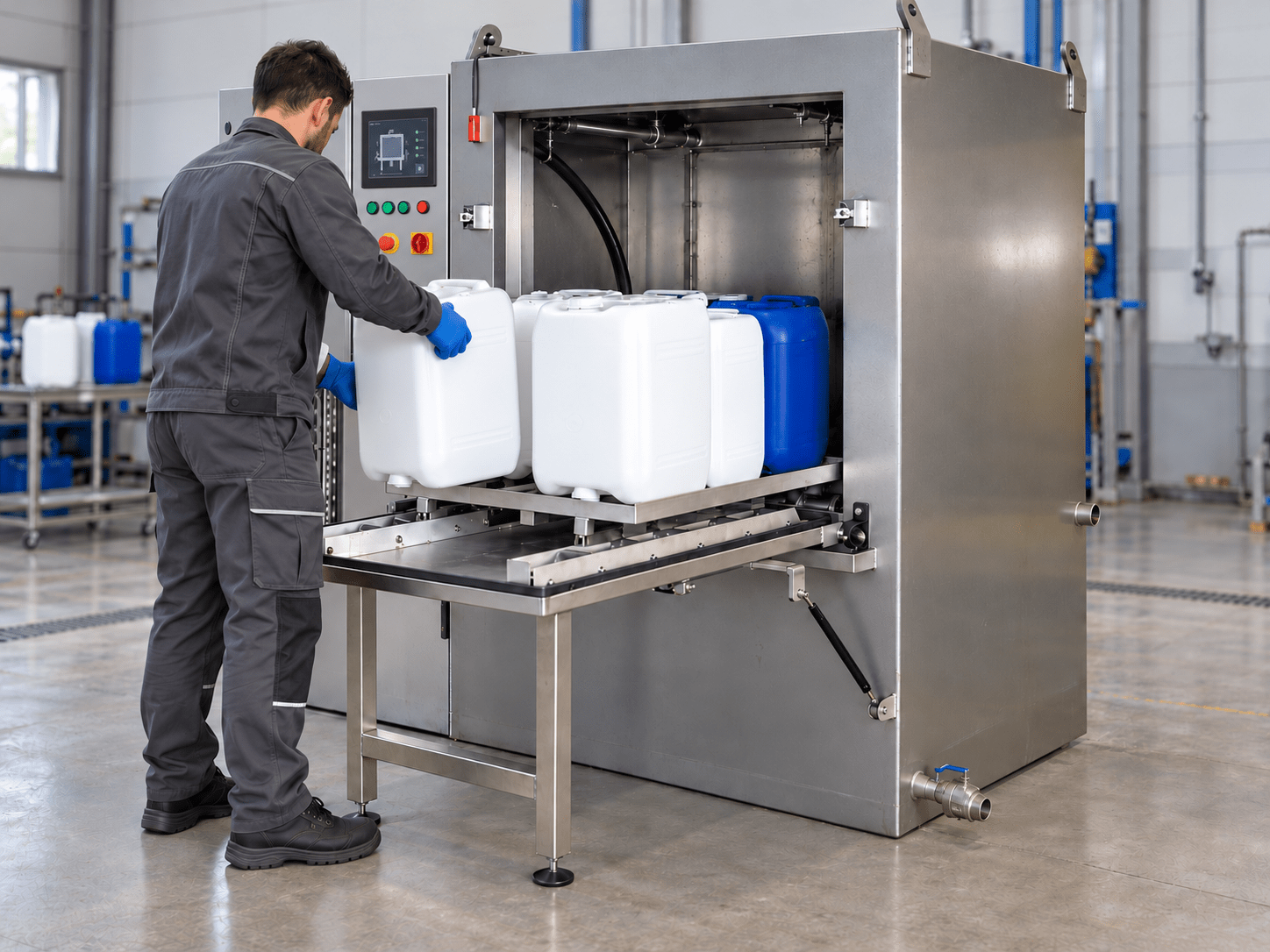
Washing machine for industrial bottles and 20-litre drums
20-litre containers are used to transport and store a wide variety of products. They can hold oils, detergents, inks, ingredients, emulsions, cosmetics or auxiliary manufacturing fluids.
When the container is returned to the production line, a change of product is required, or it needs to be delivered clean, manual washing often becomes a bottleneck and a difficult process to standardise.
A lwasher for industrial bottles and jerrycans It allows you to control the positioning of the container, the mechanical action of the water, the detergent, the rinse and the spin cycle. However, two containers of the same volume may require different solutions. The diameter of the opening, the internal corners, the handle, the material and any previous residue have a greater influence than the figure of 20 litres printed on the label.
That is why the selection of the machine must begin with the actual container and the expected outcome. Based on this information, a compact batch-processing machine, a semi-automatic station or a multi-stage production line can be selected.
Washing machine for industrial bottles and 20-litre drums
What makes a 20-litre bottle different?
In commercial terminology, the terms “garrafa”, “bidón”, “jerrycan” and “botellón” are used to refer to containers that do not always look alike.
A plastic bottle may have a narrow neck, a built-in handle and deep corners.
A small metal drum may have a screw cap.
A 20-litre bucket or container can be opened fully and is suitable for use with brushes or a direct water jet.
This difference determines how the water enters and how it exits after the cycle. In an open container, it is relatively straightforward to reach the sides and bottom using spray nozzles or brushes. In a closed bottle, the system must direct the flow through the opening, cover the interior and allow the liquid and dirt to drain away without being trapped.
Stability during washing is also important. A lightweight container may be displaced by the force of the jets. The frame must hold each unit in the correct position without distorting it or obstructing the areas that need cleaning.
If the plant uses several formats, tool changeovers and the detection of incorrect positioning become an integral part of the design.
What you need to know before choosing a machine
The first question is not how many litres the container holds, but what it contained and what “clean” means in the context of the process.
A water-soluble residue does not behave like oil, dried ink or a viscous substance.
The temperature and detergent used to help remove a contaminant must also be compatible with the plastic, metal, seals and finishes.
It is advisable to keep a record of the previous product, its safety data sheet where applicable, and the destination of the container after washing.
Removing visible dirt for internal use is not the same as preparing a container for another formulation, for food contact or for a controlled filling stage.
A test using representative bottles allows us to see where residue remains, how much carry-over enters the bath, and whether the rinse removes the detergent.
That evidence is more useful than applying a generic time or temperature to all products.
How an industrial bottle washer works
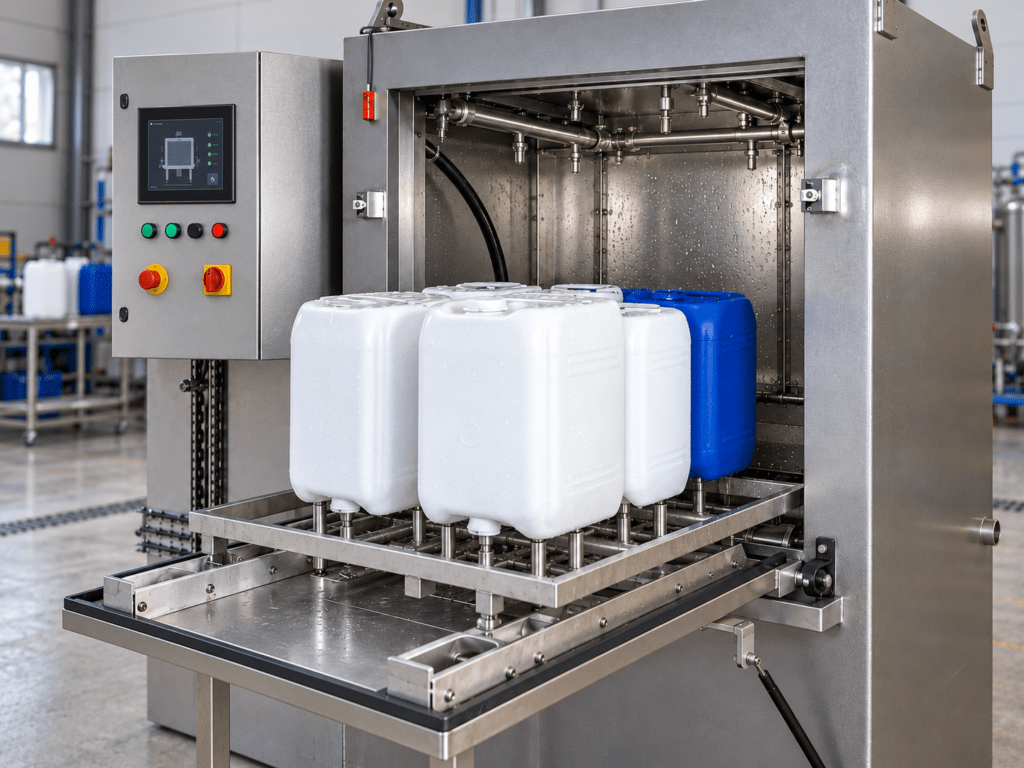
In a batch configuration, the operator places the bottles on a rack and closes the chamber. The machine circulates the wash solution to external nozzles and, where the design requires it, to spray arms or heads aligned with the bottle openings. The liquid loosens and carries the dirt away to the sump, where it may undergo filtration or separation before being returned to the circuit.
The cycle may include a separate rinse. This separation is important when the container must not retain any traces of detergent, or when the wash bath contains a concentration of contaminants that must not be carried over to the final stage. Next, a drainage time and position are required; drying is added when the subsequent process cannot tolerate residual moisture or when the production rate does not allow time for natural drainage.
Internal cleaning of narrow-necked containers
The main challenge is to ensure that a small opening provides sufficient coverage inside the container. A fixed or movable lance, a rotating nozzle or another specialised nozzle head can direct the fluid towards the walls, shoulders and base. The choice depends on the diameter of the opening, the internal shape and the type of dirt. There is no universal nozzle suitable for all containers.
Positioning must be repeatable. If the spout is not correctly aligned, some of the flow may be lost outside the container and the result will vary from one unit to another. That is why the loading tool, the supports and the container lock are integral parts of the process, not merely accessories.
External cleaning of handles, bases and threads
The outer surface may accumulate spills, dust or dried-on residue. The moulded handles, base, neck and thread create shadows where a front spray cannot reach properly. The nozzles should be positioned so that they encircle the container, ensuring that the rack does not obstruct these areas. Where lids, stoppers or separate accessories are present, it is advisable to decide whether to wash them in a dedicated basket or in a separate cycle.
How to clean oil drums with our drum washers
Compact unit or automatic production line
A automatic spray-wash machine A compact batch-processing machine is usually suitable when production volumes are moderate, there are several formats, or the operator can load a rack. It allows several bottles to be placed in a sealed chamber and the wash programme to be changed when the machine and process allow. Actual productivity includes loading, closing, the wash cycle, draining, unloading and any tool changes.
A automatic cleaning tunnel This is suitable when there is a continuous feed of containers, the format is stable and the plant needs to separate stations. The conveyor system can guide each unit through pre-wash, wash, rinse, drain and dry stages. Before automating the process, it is advisable to check that the waste, geometry and acceptance criteria have already been defined; otherwise, the line will repeat a process that is still uncertain.
Criterion | Batch processing | Automatic line |
Production | Low or medium defined batches | Medium or high continuous flow |
A variety of formats | It usually allows for chassis changes | It is advisable to limit file formats or automate settings |
Space and integration | A more compact layout | It needs to be part of a wider route and link up with other stages |
Process separation | It can be carried out in one or more tanks | Provides stand-alone stations |
Operator intervention | Batch loading and unloading | Less handling when feeding is automated |
Water and waste management
Recirculating water can reduce consumption, but the decision depends on what accumulates in the circuit. Particles, free oil, fine solids and dissolved substances require different treatments. A simple mesh can protect nozzles from large particles, whilst other contaminants require additional treatment stages or the controlled renewal of the bath.
Leakage does not automatically return the water to its original state. Monitoring of the bath may include detergent concentration, appearance, conductivity, pH or other parameters specific to the application. Disposal or external management must be determined based on the actual composition of the effluent and the requirements of the facility.
Where final clarification takes place, the water from this stage may be managed separately or reused in a previous stage, provided that the validated process permits this. This arrangement must be designed to prevent any apparent savings from leading to cross-contamination.
How to choose the right size for a bottle washing machine
The technical proposal requires details of the packaging and the process. Photographs are helpful, but they are no substitute for measurements or a sample when the interior has complex shapes. It is also necessary to know the target output for an actual shift, not just the maximum instantaneous number that one wishes to see coming off the machine.
- Nominal capacity, height, width, depth and weight of the container
- Diameter and position of the opening, type of stopper, handle and hard-to-reach areas
- Bodywork, seals, labels and components that must be retained
- Previous product, residue status and time elapsed before washing
- Interior, exterior or both cleaning, and acceptance criteria
- Number of bottles per hour, per shift or per day, and variation between formats
- The need for rinsing, draining, drying, traceability or inspection
- Available services, space, handling and connection to the line
- Conditions for treating, recirculating or removing process water
Using this information, it is possible to calculate the number of positions, analyse the frame and decide whether a batch chamber or a tunnel is more suitable. The final test must be carried out using the most representative waste and packaging, including difficult cases that could affect the process.
Tailor-made solutions from IBERKLEEN
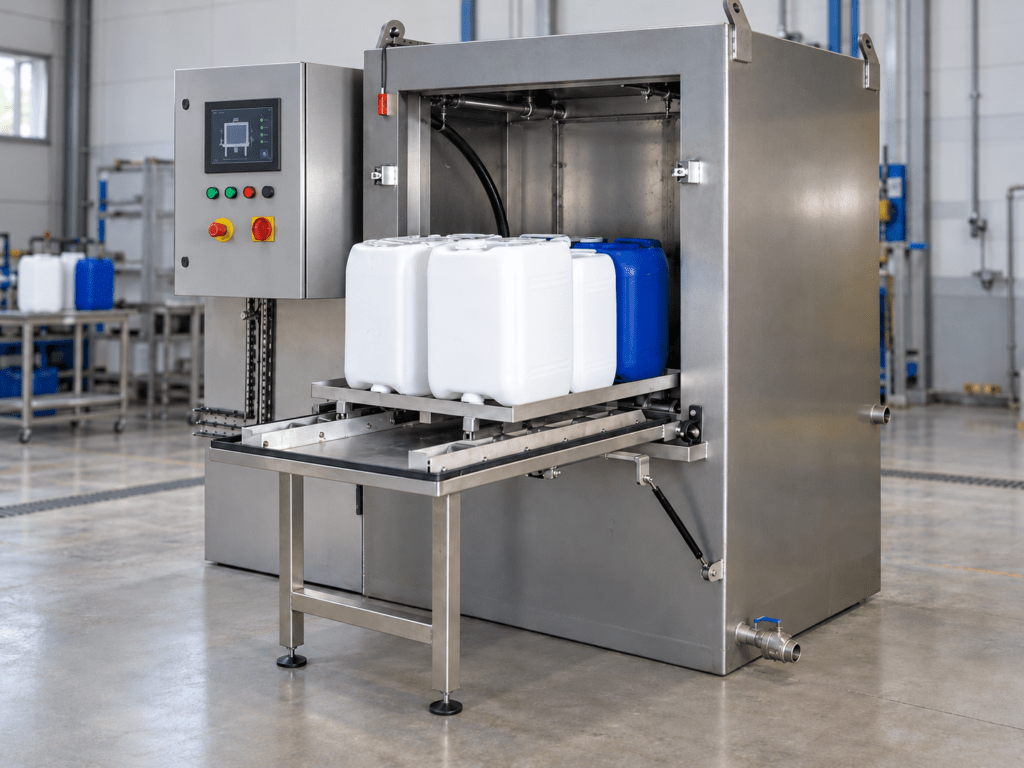
IBERKLEEN designs spray washers, automatic equipment and bespoke solutions for industrial cleaning processes. For an application involving 20-litre bottles, the design may include positioning devices, internal and external washing, washing and rinsing circuits, filtration, oil separation, draining, drying and automation, depending on the residue and production volume.
The final configuration is not decided solely on the basis of the catalogue. We analyse an actual bottle, the product it contains, the required outcome and the production rate. Where the application warrants it, a trial run allows us to fine-tune the process before finalising the machine specification.
❓ Frequently asked questions about bottle and jerrycan washers
It may be possible if the formats, residues and chemistry are compatible, but this should not be taken for granted. The tool, temperature, mechanical action and programme may need to be adjusted. If there is a risk of cross-contamination, it is advisable to separate batches, circuits or processes.
The equipment can be designed for both surfaces. The interior requires access via the mouth and a suitable head; the exterior requires coverage around the handles, base, neck and threads. The design is validated using the actual container.
It depends on the type of residue and the level of cleaning required. Water can remove soluble or loosely adhering dirt, whilst oils, inks and dry residues usually require a suitable chemical. The concentration and temperature are determined by consulting the technical data sheet and carrying out tests.
In some processes, yes, through sedimentation, filtration or separation. Recirculation must be controlled to ensure that the contaminant load does not compromise the result. The final rinse may require a separate circuit.
The first step is a draining position that does not retain water. If the process requires lower moisture content or rapid drainage, the use of air blowing or hot air may be considered. The geometry of the bottle determines the time required and the airflow.
There is no universal figure. Output depends on the number of positions, the time taken for each stage, loading and unloading, drainage, format changeovers and the availability rate. The quotation must specify the capacity under these conditions.
We need the dimensions and photographs of the container, a sample if possible, a description or product specification sheet for the previous product, units per hour or per shift, the expected outcome and the services available. With this information, we can plan the test and the most suitable configuration.
Request a cleaning assessment for your bottles
If you need to clean 20-litre bottles or drums, please send us a sample, photographs, dimensions, details of the residue and your expected production volume.
At IBERKLEEN We will examine the interior and exterior cleaning processes, the necessary stages and the level of automation before drawing up the proposal.