
Cleaning naval condensers: how to choose the right method
Cleaning naval heat exchangers is not simply a matter of removing visible dirt. In this type of equipment, a layer of scale, biofilm or sediment can restrict water flow and act as a barrier between the coolant and the heat exchange surface.
The condenser may continue to operate, but it will do so at temperatures, flow rates or power consumption levels that are far removed from its normal operating conditions.
The marine environment makes maintenance even more challenging. Seawater promotes the build-up of salts, sludge and organisms; access to the pipes may be restricted; and an ill-chosen intervention may damage materials, seals or surfaces already weakened by corrosion.
That is why there is no one-size-fits-all method. The decision must be based on the type of capacitor, the nature of the tank and whether the equipment can be dismantled for treatment off-site.
In this guide, we review the main methods for cleaning marine condensers and explain when an ultrasonic cleaning machine can transform a manual and irregular task into a controlled and repeatable process.
Cleaning of marine condensers: methods and equipment
What is a marine condenser and why does it need cleaning?
A capacitor is a heat exchanger in which a vapour transfers energy to a colder medium until it condenses.
Heat exchangers with an equivalent function are also used on board in air-conditioning, refrigeration and power generation systems, as well as in auxiliary circuits.
Depending on the design, heat exchange can take place via tubes, tube bundles, plates or coils.
When the cooling system operates using seawater, the equipment is constantly exposed to minerals, suspended solids and biological matter. Some of this contamination is trapped on surfaces, at the inlets to the tubes or in areas of low circulation.
In the other circuit, oils, corrosion products or other residues resulting from normal operation may be present. The cleaning process must target the specific contaminant on each side, rather than a generic notion of “limescale”.
Common types of fouling on marine condensers
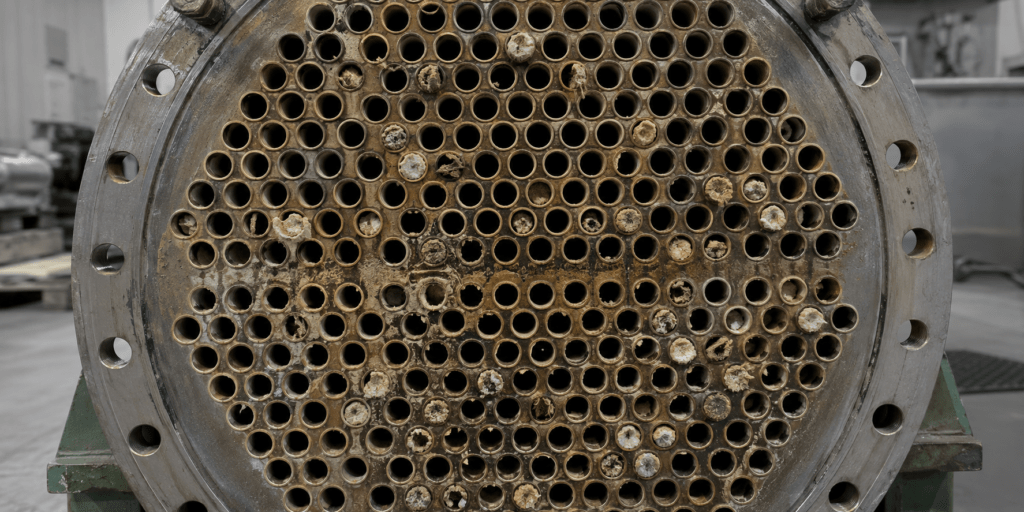
The mineral inclusions They adhere to tubes and plates and impede heat transfer.
The sediments and sludge They may narrow passageways, accumulate behind deflectors or partially block entrances.
The biofilm It forms a continuous layer on the surface and makes it easier for algae, molluscs and other organisms to attach themselves. In addition to this, oxides and corrosion products, particularly where operating conditions, materials or water treatment are unsuitable.
Not all of these types of fouling respond in the same way. A soft deposit can be removed by circulation or moderate mechanical action; a mineral scale may require a suitable chemical treatment; and a combination of biofilm, salts and particles may require several stages. Identifying the deposit prevents the pressure, temperature or chemical concentration from being increased without a technical reason.
How to tell when a marine condenser needs cleaning
The frequency should not be determined solely by the calendar. Conditions vary depending on the navigation area, water temperature, periods of inactivity and the system load. Operating trends provide a much more useful basis: a loss of cooling capacity, an increase in pressure differential, a reduction in flow rate, abnormal temperatures or the need to work harder to achieve the same result.
A visual inspection of the tube sheets, tube inlets, filters and the debris removed also provides useful information. It is advisable to record the condition before cleaning and compare it with the result afterwards. In this way, maintenance is no longer based on guesswork and can be tailored to the actual rate at which the equipment becomes fouled.
Preliminary diagnosis: five factors that change the process
Before selecting a cleaning machine or product, the task at hand must be defined. The five key factors are the geometry of the condenser, its materials, the predominant type of contamination, the extent to which it can be dismantled, and the result to be verified.
A circuit that is to remain permanently installed is not treated in the same way as a removable tubular bundle. Nor should a chemical be assumed to be compatible simply because it has worked in another capacitor: copper-nickel, stainless steel, titanium, aluminium, gaskets and coatings may react differently. If there is insufficient information, the responsible course of action is to carry out a controlled test using a representative sample or component.
Methods for cleaning marine condensers
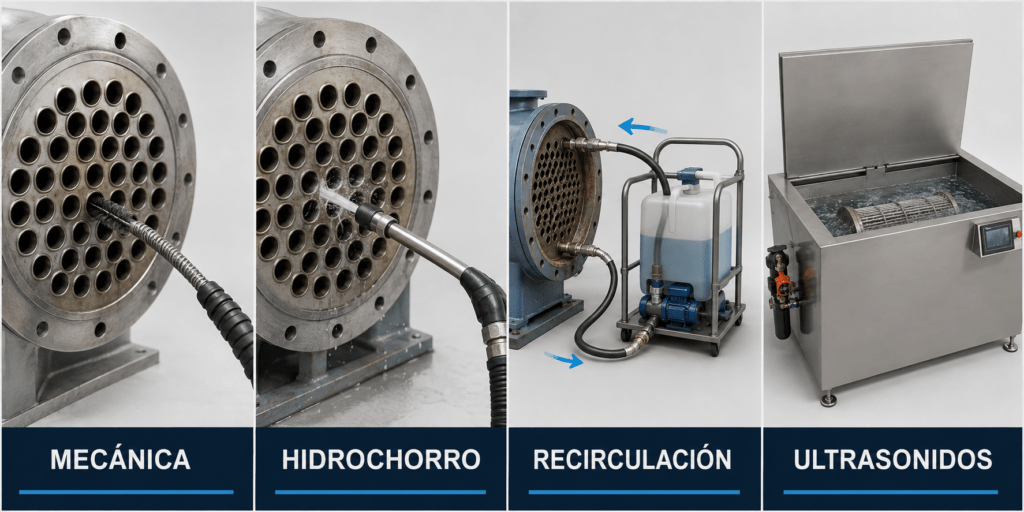
These methods are not necessarily mutually exclusive.
Many maintenance procedures involve a combination of an initial removal of coarse debris, a descaling stage, the loosening of adhering contaminants and a final rinse.
The best solution is one that cleans the required surfaces without causing damage, creating waste that is difficult to manage or requiring excessive operator time.
Method | When is it appropriate? | Main advantage | Point to check |
Brushing or mechanical cleaning | Easily accessible pipes and centrally located tanks. | Direct access and easy inspection. | Labour, scope and the risk of marking tubes or leaving areas untreated. |
Hydrojet | Internal and external pipe cleaning Open, sturdy tanks with access for a hose. | High mechanical action. | Pressure, safety, water consumption, containment and condition of the material. |
Chemical recirculation / CIP | Installed circuits or internal passages accessible to traffic. | You can clean it without dismantling the unit. | Compatibility, concentration, reaction, neutralisation and effluents. |
Immersion ultrasonography | Strands, plates or detachable components that can be submerged. | Action distributed across wet surfaces and complex geometries. | Duct filling, trapped air, chemistry, load, positioning and effective power. |
Combined process | Mixed soiling or stringent cleaning criteria. | It allows you to assign each stage to the type of waste it is best suited to handle. | Sequence, carry-over between baths, parameter control and validation. |
When is it advisable to clean a marine condenser using ultrasound?
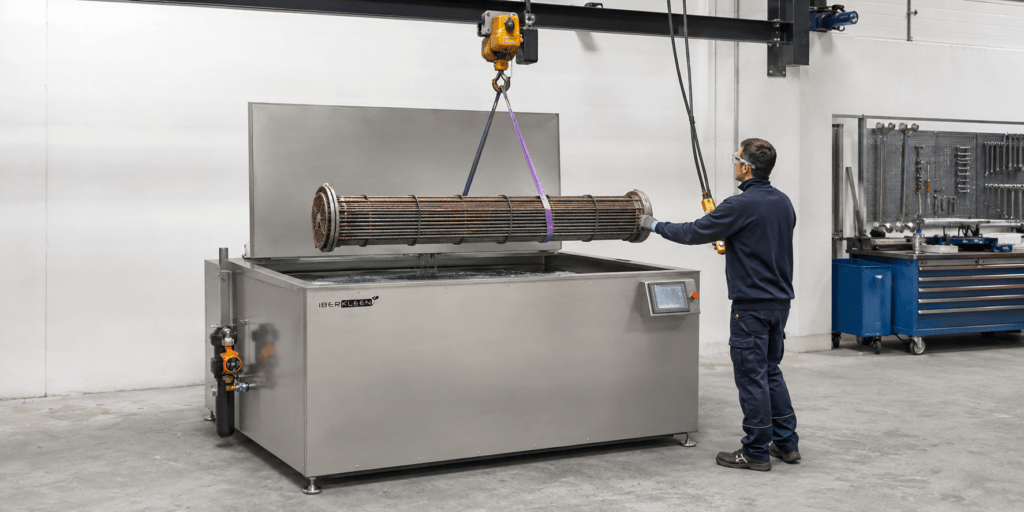
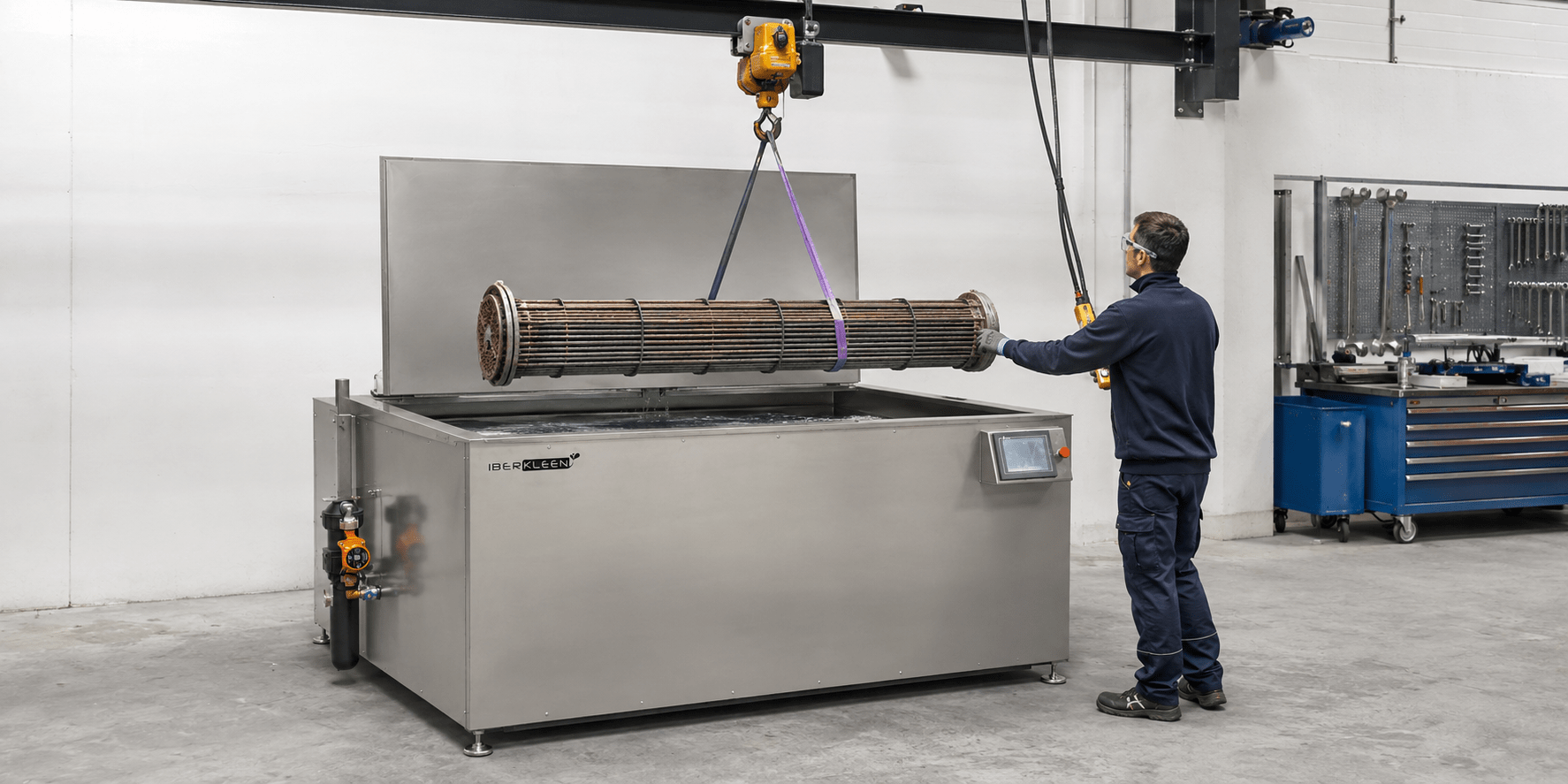
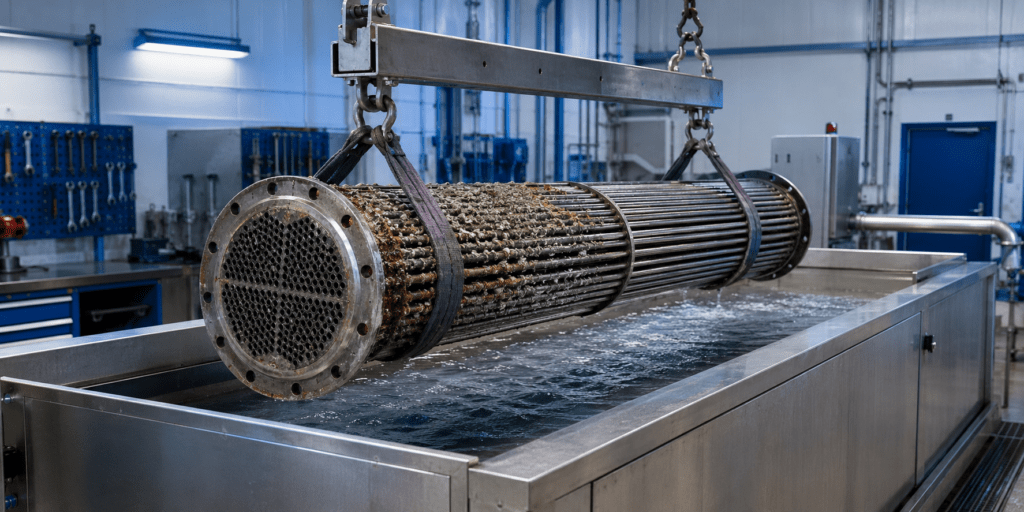
Ultrasound is particularly useful when the capacitor, the tubular beam, the plates or the internal components They can be dismantled and placed in a vat. Cavitation acts on the liquid surrounding the part and helps to dislodge contamination from external surfaces, cavities and the geometries exposed to the bath.
For this action to reach the interior of a pipe, it is not enough for the assembly to be partially wetted. The gaps must be filled correctly, air must be able to escape, and the arrangement must allow the ultrasonic energy to reach the target geometry. In long, dense beams or those with shielded areas, the distribution of transducers, the movement of the load and actual testing become just as important as the nominal power.
It is also important to be clear about the method’s limitations: if the capacitor cannot be dismantled, does not fit in the tank, or if the contamination requires a specific chemical reaction within a closed circuit, recirculation, mechanical cleaning or water jetting may be more practical. IBERKLEEN can analyse the entire process and recommend ultrasonics, spraying or a combination of both, but the technology must be adapted to the part, not the other way round.
Professional ultrasonic cleaning process
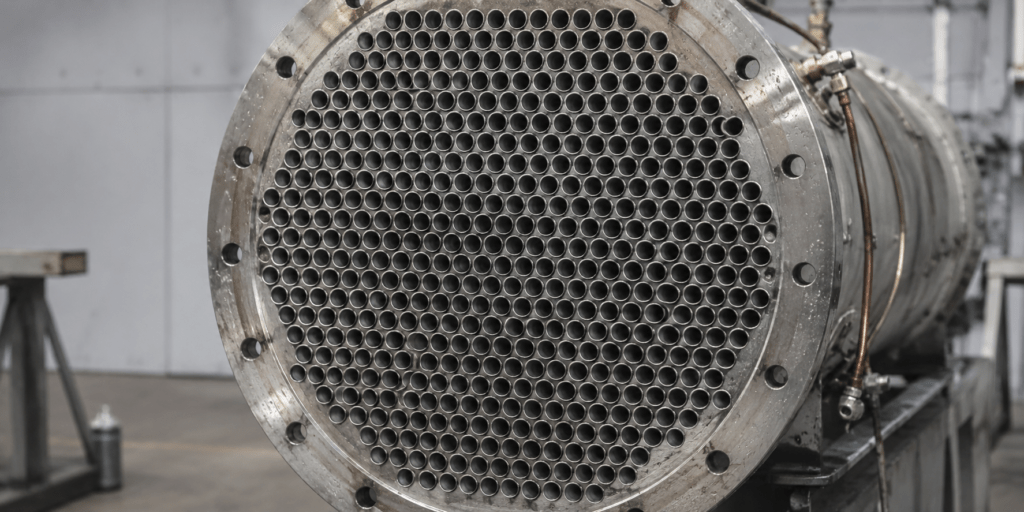
A reliable process begins before the ultrasonic system is switched on. The capacitor is received with its identification, and its material, dimensions, weight, condition, critical areas and contamination are recorded. Following safe dismantling, any coarse debris that might unnecessarily clog the bath is removed.
- Preparing the load. The beam or component is positioned securely, without resting it directly on active surfaces and leaving space for the liquid to circulate.
- Choosing a bathroom. The formulation is selected according to the contaminant and the material. The compatibility of acids, alkalis or inhibitors should not be assumed without first verifying it.
- Filling and venting. The tubes and cavities must remain in contact with the liquid; air pockets reduce the scope of the process.
- Controlled cycle. Time, temperature, chemistry, ultrasound and any movement of the load are adjusted on the basis of tests, not a one-size-fits-all formula.
- Clearing and neutralisation. Any residual detergent and loosened contaminants are removed. Where the chemical composition requires it, the appropriate neutralisation process is carried out.
- Drying, inspection and protection. The finish is determined by the material, the time remaining until assembly and the customer’s acceptance criteria.
How to choose a machine for cleaning condensers and tube bundles
The key factor is not just the tank’s capacity. It is necessary to check the actual usable volume, the maximum load, the loading system and the orientation of the condenser.
A piece may fit geometrically, yet leave very little space for circulation, movement or safe handling.
In naval maintenance equipment, it is advisable to consider the position and layout of the transducers, the possibility of oscillation or repositioning, overheating, filtration, the removal of oils and solids, the draining of sump tanks, and accessibility for cleaning the machine itself.
If the process involves rinsing, drying or anti-corrosion treatment, these stages must be sized in conjunction with the main tank to avoid creating a bottleneck.
At IBERKLEEN We supply ultrasonic cleaning machines for parts of various sizes and develop bespoke solutions. The POLARIS range can serve as a starting point for medium and large components, but the final selection requires knowledge of the capacitor’s dimensions and weight, the number of units, the residue and the production rate.
Preventative maintenance: clean according to condition, not on a hunch
A good programme combines inspections, operational data and ease of access.
Filters and strainers reduce the ingress of coarse debris; water control limits certain fouling mechanisms; and connections designed with maintenance in mind simplify recirculation when necessary.
For removable equipment, having a standardised procedure for receiving, cleaning, rinsing and validating reduces variability between operators.
The interval should be based on the condenser manufacturer, the vessel’s history and trends in pressure, flow rate and temperature.
If a drop in performance occurs earlier than expected, repeating the cleaning process without investigating the cause may mask a problem relating to corrosion, water treatment, filtration or operating conditions.
❓Frequently asked questions about cleaning marine condensers
In many designs, it is possible to carry out maintenance by means of chemical recirculation or mechanical cleaning of accessible tubes. Ultrasonic immersion generally requires the condenser, the bundle or the plates to be dismantled and placed in a tank. The manufacturer’s design and the actual access available determine the feasible option.
They can help remove scale, deposits and biological contamination, but the result depends on the degree of adhesion, the chemistry, the material and the geometry. Highly cemented deposits or mixed dirt may require pre-treatment or a combined process.
There is no one-size-fits-all answer. Compatibility depends as much on the material and its condition as it does on the chemical composition, temperature, duration and the intensity applied. Before finalising the process, it is advisable to consult the manufacturer’s documentation and carry out controlled tests where there is any uncertainty.
The interval depends on the design, operating hours, navigation area, water temperature and history of fouling. The manufacturer’s recommendation should be combined with indicators such as flow rate, pressure differential, temperatures and visual inspection. A fixed frequency may result in cleaning being carried out too early or too late.
The dimensions and weight of the condenser or beam, photographs and drawings, materials, type of waste, number of items per period, current process, acceptance criteria, available space, supplies and subsequent stages. Based on this information, a decision can be made as to whether a standard machine, a bespoke tank or a multi-stage solution is suitable.
We analyse the process using your actual capacitor
At IBERKLEEN we manufacture ultrasonic cleaning machines and industrial cleaning solutions for workshops, shipyards and maintenance companies.
If you need to standardise the cleaning of marine heat exchangers, please send us the dimensions, weight, materials, type of fouling and expected output.
We will assess whether an ultrasonic, spray, recirculation or combined process is appropriate, and we can carry out tests on a representative sample before sizing the equipment.