
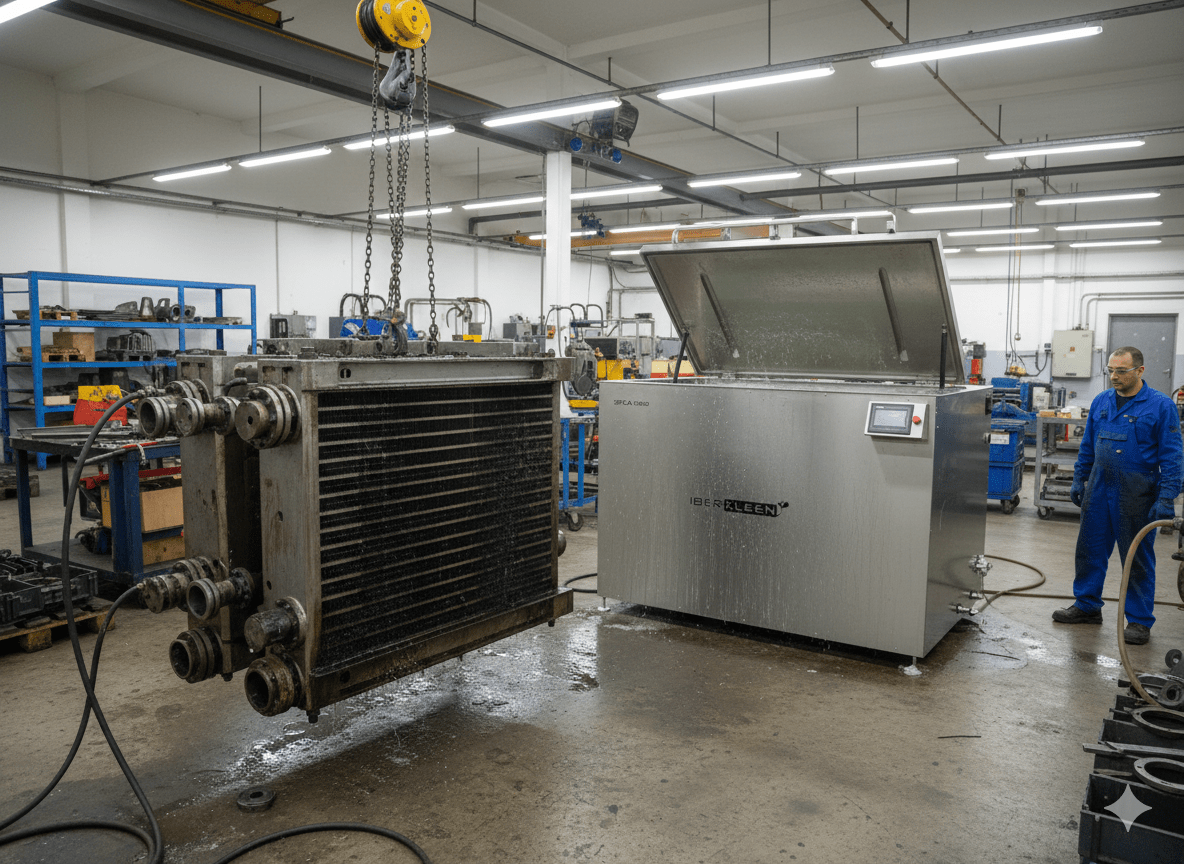
How to clean heat exchangers and when to use ultrasonics
In any industrial plant, a heat exchanger usually works “silently” until it stops working well.
The complicated thing is that the loss of performance almost never happens all at once: dirt accumulates, heat transfer coefficients gradually drop, consumption rises... and the process adapts as best it can.
Therefore, understanding the cleaning of heat exchangers and choosing the right method is one of the most impactful decisions in terms of efficiency, energy cost and operational reliability.
The key to this article is twofold: first, to answer what anyone searching for when typing this keyword (what it is, when to clean, methods available). And then, once that intention has been resolved, to guide you to a solution that many plants are incorporating because of its effectiveness in complex geometries: the ultrasonic cleaning.
Cleaning of heat exchangers: methods, frequency and ultrasounds
What is heat exchanger cleaning and why is it necessary?
The cleaning of heat exchangers is the set of actions aimed at eliminating deposits and encrustations that adhere to the heat exchanging surfaces: plates, tubes, channels, fins or heads, depending on the design of the equipment.
With use, it is normal for layers of limescale, oxides, sludge, organic matter or biofilm to appear and act as an insulator.
Therefore, although the exchanger is “still working”, it is not in optimal conditions.
Even a thin layer can have a significant impact on thermal performance. In fact, technical literature and industry articles emphasise that keeping heat exchangers clean is essential to avoid production losses and damage that can become irreversible if fouling is allowed to progress.
Furthermore, in hygienic processes (food, beverages, pharma) cleanliness is not only about efficiency: it is also about safety and compliance with internal standards.
Why heat exchanger cleaning directly impacts plant efficiency
A fouled exchanger penalises the process in two waysThe heat transfer capacity is reduced and the resistance to the fluid flow increases. Consequently, the system needs to “compensate” with more energy (by increasing temperature, flow rate or operating time) and with more pumping effort.
The cost is not just in the energy bill. When fouling becomes persistent, more frequent shutdowns occur, seals deteriorate, under-tank corrosion occurs and, in the worst case, material thins to the point of leakage.
On the other hand, if the heat exchanger is at a critical point (pasteurisation, reactor, condensation, chillers), the impact translates into temperature variability, lower process stability and more difficulties in maintaining the quality of the final product.
A useful piece of data from technical studies to put it in context: layers less than 1 mm can lead to significant efficiency losses. For example, a 0.8 mm fouling layer can reduce system efficiency significantly (by up to around 25% according to industry-cited studies).
Do not take this number as a universal number - it depends on the type of tank and design - but as a warning: sometimes “little” dirt costs a lot of money.
When and how often to clean a heat exchanger
There is no one-size-fits-all periodicity. However, there are very practical signs which usually indicate that the clean-up has already paid off:
 The equipment takes longer to reach the target temperature or needs more power to reach the target temperature.
Increases the pressure difference (pressure drop) through the heat exchanger.
The consumption of pumps, boilers or chillers is increased to maintain the same process speed.
In plate equipment, symptoms such as more frequent alarms, accelerated fouling or the need to intervene before the planned shutdown appear.
The most professional thing to do is not to set a date “just because”, but rather to combine calendar with data: thermal performance trending, ΔP trending and, where possible, inspections at scheduled outages.
In this line, there are manufacturers and technical services that recommend to clean formerly of fouling leading to production losses and damage, and rely on performance audits to define optimal frequencies.
Main heat exchanger cleaning methods
The choice of method is not a matter of fashion: it depends on the type of exchanger, the pollutant, the materials and the level of accessibility. These are the most common approaches in plant:
Chemical cleaning by recirculation and CIP (cleaning in place)
When disassembly and downtime are to be minimised, chemical cleaning by circulation is used. A cleaning fluid is passed through the equipment, normally with control of temperature, flow rate and process parameters.
In plate heat exchangers, the cleaning IPC is particularly common because it avoids the time-consuming work of opening the exchanger in many situations.
The great advantage is the speed of operation. The limitation is that its effectiveness depends on the chosen chemical really “attacking” the tank and on the circulation reaching all areas well.
High pressure hydroblasting (hydrojet / hydroblasting)
It is a powerful mechanical method of removing adhering scale using high-pressure water. It is fast and effective, but requires control so as not to damage delicate materials or seals.
It often involves partial or total disassembly, and does not always easily reach micro-channels or geometries with “shady” areas.
Manual cleaning (brushing, rinsing, dismantling)
In some equipment, some fouling is removed with a soft brush and water; others require the removal of plates to deal with stubborn dirt. Manufacturer's manuals describe this as part of maintenance, with warnings against prolonged exposure to cleaning agents because it can affect elements such as adhesives or gaskets.
Thermal cleaning or other specific methods
Thermal processes exist for certain cases (e.g. polymeric or carbonaceous soiling in very specific contexts). They are not the general “first choice”: they require control and experience due to the risks for materials, deformation or downtime.
Limitations of traditional cleaning methods
By now, many plants are aware of the “hidden cost” of cleaning exchangers by classical methods alone:
🔹 Hydro-jetting and manual cleaning depend on physical access. If the exchanger has complex channels or internal geometries with inaccessible areas, the result can be uneven: clean on the outside, persistent deposits on the inside.
🔹 Chemical cleaning can be very effective, but requires fine product selection and careful control. When the chemical is too aggressive, it increases the risk of attacking materials or seals; when it is too mild, it lengthens times or “masks” the problem without solving it.
In addition, environmental management and effluent treatment (neutralisation, waste) also weighs on the cost and operational burden.
When the problem recurs, or when the exchanger has difficult geometries, many companies incorporate an alternative that does not compete “by force”, but by scope and finesse: ultrasound.
Ultrasonic cleaning of heat exchangers: an advanced solution
Ultrasonic cleaning uses high-frequency acoustic waves in a liquid to generate cavitationmicro-bubbles that form and collapse, releasing micro-jets that act like a brush to evenly dislodge dirt from all surfaces in contact with water, even in hard-to-reach areas.
This changes the logic of the process. Instead of relying on the direct impact of a jet or the aggressiveness of a strong acid, the ultrasound works by repetitive and controlled micro-action on the entire submerged surface. It is therefore considered a particularly interesting solution for:
🔹 Removable plates (gasketed plate heat exchangers).
🔹 Components with corrugated channels or complex geometries.
🔹 Parts with adhering dirt in areas where the brush or jet cannot reach consistently.
Within the industry, methods are compared and ultrasound is included among the main approaches to cleaning heat exchangers, precisely because of its ability to clean them thoroughly and homogeneously.
Which types of scale are best removed by ultrasonic cleaning
Ultrasound works very well when the challenge is not just to “dissolve”, but to detach and dislodge dirt in recesses: sludge, fine sediments, biofilm, organic residues, particles embedded in micro-geometries, etc.
But let's be honest: it is not always a “one-size-fits-all” method. In extremely cemented mineral fouling, it may be more efficient to combine a mild chemical (compatible with the material) with ultrasonics, to soften and then loosen without damaging the exchanger.
On the other hand, if the exchanger is a large in-line tube bundle that is not easily disassembled, logistics dictate the method: it is often cleaned in situ with recirculation, and ultrasound comes into play when removing tube bundles or removable components, or when precision cleaning is required on specific elements.
A practical advantage of ultrasound is that it allows working with detergents formulated for cavitation and, in many cases, reduces the need for harsh chemicals. Even so, the cleaning agent still matters: not only does it clean, it also protects materials and improves release.
Professional ultrasonic heat exchanger cleaning process
A well thought-out ultrasonic cleaning is not “in and out”. It starts with diagnosis and ends with verification.
First, the type of exchanger, its material and the predominant pollutant are identified. With this information it is decided whether the intervention will be off-site (disassembly of plates or components for immersion) or whether a mixed approach (pre-treatment + ultrasound + rinsing) will be considered.
The bath is then prepared: appropriate solution, level, temperature and working parameters. The plates or elements are then immersed and cycles adjusted to the level of fouling are applied. The important thing here is uniformity: cavitation works on all wetted areas, which helps to restore internal surfaces that are often “half-finished” with other methods.
Finally, rinsing, inspection and, where applicable, performance validation is carried out after assembly. In short: ultrasound is powerful, but its real value comes when it is integrated into a controlled process.
At IBERKLEEN we accompany you in the process of selecting the right equipment and cleaning solution depending on your heat exchanger and dirt.
Safety, sustainability and waste management in industrial cleaning processes
Safety in heat exchanger cleaning must always be treated seriously. Methods such as high pressure hydroblasting requires strict protocols due to mechanical risk. And chemical cleaning, while effective, requires responsible management of effluents and neutralisations.
On the other hand, the cleaning by circulation (closed loop) is a common approach because it allows temperature and fluid velocity to be controlled during maintenance, but still generates waste that needs to be properly managed.
Here the ultrasound can bring an operational advantage: by reducing reliance on aggressive chemicals in many cases, it tends to simplify some of the waste management. It does not eliminate the need for environmental procedures, but it can reduce chemical load, improve operational safety and facilitate compliance.
Ultrasonic cleaning applications in different industrial sectors
At food and beverages, The aim is not only thermal efficiency, but also hygiene. That is why CIP routines are combined with deep cleaning when stubborn deposits appear or plates need to be restored to a very high level of cleanliness. Manufacturers in the industry emphasise the importance of cleaning to maintain hygienic processes and standards.
At pharmaceutical, traceability and repeatability are critical. Ultrasound is a good fit for precision cleaning on removable components when a homogenous and documentable result is desired.
At energy and cogeneration, Where fouling can be mixed (sediments, oxides, thermal deposits), ultrasound is used as an effective tool in component maintenance and, depending on industry applications, is also cited for cleaning heat exchangers in certain contexts.
At Industrial HVAC (chillers, chillers), the payback usually comes from efficiency and reduced breakdowns. When fouling is repeated and disassembly is feasible, ultrasonic cleaning of internal elements can help to recover performance without excessive aggressiveness.
❓ Heat exchanger cleaning frequently asked questions
In many cases it can replace or reduce it, especially in organic deposits and fouling in complex geometries. However, in very hard mineral encrustations it often works best as part of a combined process.
Yes, by cleaning-in-place by recirculation (CIP or other variants) in many scenarios.
Ultrasound, on the other hand, is usually applied on removable components or in specific configurations with far superior cleanliness.
Used with correct parameters and compatible solutions, it is considered a gentle and uniform method, precisely because it does not rely on direct abrasion.
By symptoms and analysis: hard water usually points to limescale; presence of corrosion or iron to oxides; in circuits with warm water and organics, biofilm is common. In demanding plants, samples are taken or inspected at shutdown.
It depends on method and severity. For reference, chemical cleaning by circulation involves recirculation for several hours in many cases (up to one working shift).
In ultrasonics, the time depends on the cycle and the level of soiling, as well as disassembly/assembly.
Diagnosis + correct method + control of parameters (temperature, chemistry, time) + final verification. Cleaning “without validation” usually comes back as a problem.
At IBERKLEEN we design ultrasonic cleaning machines for heat exchangers adapted to the needs of each client
If your recurring problem is “I clean but I don't recover performance” or “it gets dirty too fast”, it's usually a good time to seriously consider a ultrasonic cleaning machine for deep and professional cleaning.