

Washing machine for plastic crates and trays: how to choose and dimension
A crate and plastic tray washer has become a key piece of equipment in industries where hygiene, traceability and productivity cannot rely on manual washing.
As the turnover of returnable packaging increases, so do the challenges: organic waste, grease, biofilm, labels and moisture leading to rejects, rework and downtime.
In this guide we explain how a crate and plastic tray tunnel washer works, What types of machines are available and how to size the actual capacity according to your work rate.
Industrial plastic crate washer: types, tunnel and actual capacity
What is a crate washer and what is it for?
A plastic crate washing machine is an industrial equipment designed to automatically clean returnable crates (RPC), trays and plastic containers used in production and logistics.
Its aim is not only to “remove visible dirt”, but to standardise a cleaning and, where applicable, hygienic result, with controlled times and consumption.
Unlike manual washing, which is highly operator-dependent and often irregular, an industrial washer works with repeatable parameters: pump pressure and flow, temperature, chemical dosing, contact times and rinsing stages.
It therefore becomes a key piece of equipment for companies that need to maintain a constant flow of clean boxes without slowing down production.
In addition, these machines are increasingly integrated into automated lines, where boxes enter dirty and leave ready to return to the circuit, reducing handling, incidents and rejects due to contamination.
What problems it solves in the plant
In the plant, returnable crates pass through multiple points of contact: floors, pallets, trucks, chambers, wet areas or handling areas.
Over time, this leads to a build-up of residues, stains, biofilm, labels, grease or organic debris, depending on the sector. If cleaning is not consistent, problems arise that go far beyond aesthetics.
On the one hand, there is the hygiene:
🔹 In food, meat or poultry, a badly washed carton can become a vector for cross-contamination.
🔹 In pharmaceuticals or cosmetics, the risk translates into breaches of protocol or more demanding audits.
However, it also impacts on the traceabilityold labels, stickers or dirt in critical areas complicate identification and batch control, leading to errors and rework. In addition to this a silent effect: productivity falls because manual washing consumes hours and creates bottlenecks, especially in peak workloads.
A crate washer not just “clean”.”stabilises processes. Fewer rejects, fewer incidents, less time wasted and a clean crate availability that avoids downtime due to lack of returnable packaging.
How a crate and plastic tray tunnel washer works
Our industrial systems work in the following formats tunnel (continuous)The box advances through different zones, each with a specific function. This allows the process to be adapted to the level of soiling without oversizing the entire system.
It usually starts with a pre-wash, useful for removing loose particles and reducing dirt load in the main wash.
Then comes the stage of washing, where the combined action of temperature, detergent and pressure loosens adhering contamination indoors and outdoors.
Then, the rinse removes detergent residues and carries away remaining dirt. In installations with higher requirements, a final rinse with higher quality water or with finer conductivity control can be included.
On the other hand, many lines contain a practical challenge: the labels and glues. For this reason, some tunnels incorporate specific modules for label softening and removal, together with appropriate filtration to prevent the adhesive from recirculating and causing clogging.
Finally, the phase of drying or blowing reduces residual moisture so that the box can be stacked, labelled or reused immediately.
In high turnover sectors, this stage makes the difference between a “clean box” and a “ready to produce box”.
Types of crate washers
Although the continuous tunnel is the best known format, there are different configurations depending on volume and operation.
On the one hand, there are the washing machines manual or semi-automatic, where loading and unloading depends on the operator. They are often useful when volume is limited, layout is small or production is irregular.
However, when stable performance is required, washing machines come into play. automatic, which can incorporate conveyors, de-stacking, stacking and rate control.
There are also tunnels of one or two lines, designed to duplicate capacity or separate different formats, optimising the flow without multiplying installations.
Moreover, modularity is a real advantage: stages such as pre-washing, label removal, blowing, reinforced drying, steam extraction or more advanced filtration systems can be added as required. So the machine adapts to the process, rather than forcing the process to adapt to the machine.
Actual capacity: how to calculate cartons/hour and dimension the line
Talking about “cases/hour” sounds simple, but in the plant it is the number of cases per hour that matters. real capacity, not the theoretical one. Tunnel speed and the number of simultaneous boxes have an influence, but they are not the only factors.
For example, a common bottleneck appears at the infeed: if the crates arrive stacked, deformed or badly oriented, the infeed becomes irregular and the line loses performance. A similar situation occurs at the outfeed: if stacking or drying does not go well, accumulations and stoppages are generated.
Therefore, good sizing requires thinking about the big picture: production rate, peak times, crate return time, availability of staff and space. A good practice is to calculate the “peak hour” requirement and add margin for short stops, maintenance and actual dirt variation.
In addition, if different formats are washed in the same line, it is important to consider that the change of casing affects the occupancy of the tunnel and the stability of the flow. In these cases, a two-line configuration or an accumulation system can be decisive.
Compatibility with box formats
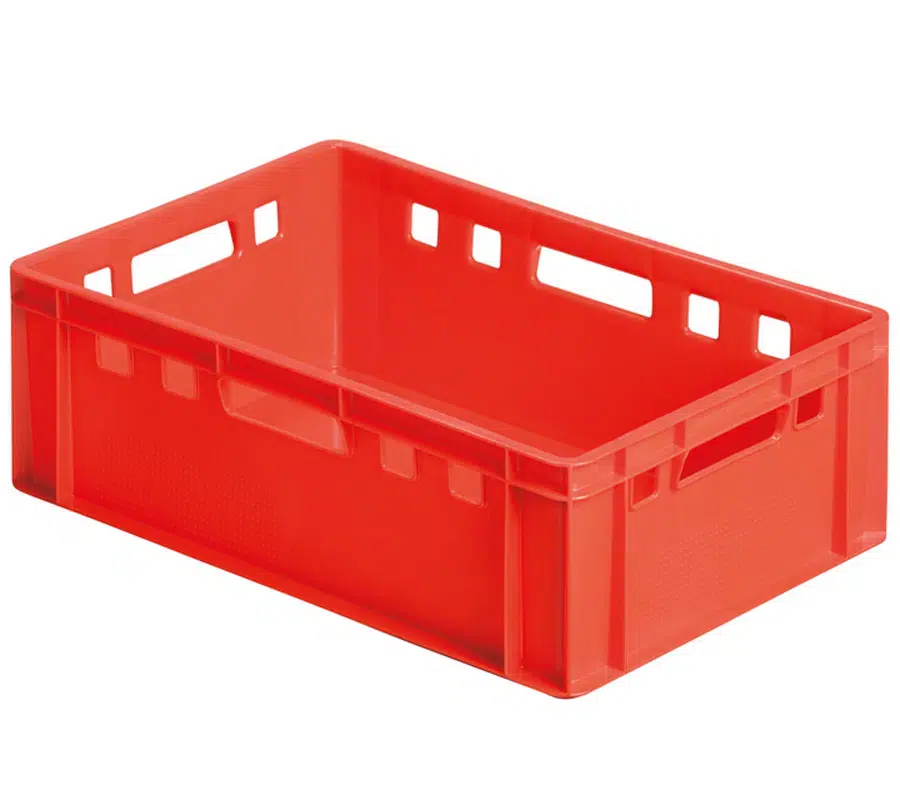
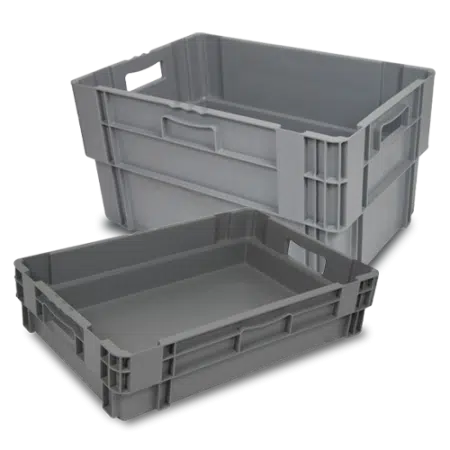
Not all enclosures behave the same inside a tunnel. Some have grooves, reinforcements, ribs, blind areas or geometries that retain dirt and water. So compatibility is not just a question of “external dimensions”.
In standard formats such as E2/CBL and other logistic enclosures, the internal design determines how the jet reaches critical areas. For example, enclosures with very tight walls may require oriented nozzles, higher pressure or longer contact times.
On the other hand, the stacking and stability also play a role. If the box is deformed or displaced, the washing coverage is no longer uniform. Consequently, it is key to define the “entry side” and maintain a standard of orientation, especially if repeatable results are desired.
Finally, height and weight determine the conveyor, guidance and traction.
Sometimes the problem is not cleaning but moving the box without jamming.. Therefore, before choosing a machine, it is advisable to work with a real sample of typical box and dirt.
Key technical specifications
In a crate washer, specifications are no frills: they determine performance, consumption and maintenance.
Firstly, the construction. In industrial and, especially, food environments, it is common to opt for stainless steel and a design that facilitates the cleaning of the machine itself. Next, there are the nozzlesThe orientation, density and accessibility directly influence the coverage and ease of maintenance.
Then comes the heart of the system: pumps and hydraulic circuit. Good pressure without sufficient flow is no good, and neither is too much flow without pressure. In addition, the filtering is critical to prevent particles, labels or lumps from returning to the circuit and collapsing nozzles.
On the other hand, the heating (electric, steam or other solutions) marks the efficacy against fats and organics, and the dosage chemistry ensures stability: “eyeballing” is avoided and correct concentrations are maintained.
Finally, the steam extraction and condensation management improve safety and comfort in the room, as well as protecting nearby equipment. That is why in IBERKLEEN we offer steam recuperators to avoid having to make an extraction intake and to be able to recover the water, optimising losses.
Automation and integration in logistics
The crate washer is usually a part of a larger system. If the flow of crates in the plant is automated, it makes sense that the crate washing is automated as well.
For example, integrating input and output tapes, accumulators, destackers and stackers, The integration of the system, turners and returns allows a constant rate to be maintained and manual handling to be minimised. In addition, integration with readers, labelling or batch control improves traceability and reduces human error.
Automating without thinking about the layout is a mistake.. The key is to design the flow so that the washer does not become a funnel: stable inlets, unblocked outlet and space for maintenance.
Comparison of models
The best way to help the user choose is a simple table, comparing what really changes between models. Here is a useful format:
Parameter | Compact Model | Standard Tunnel | High Production Tunnel |
Type | Batch / semi | Continuo | Continuo |
Indicative production | Low-medium | Medium-high | High |
Typical areas | Washing + rinsing | Prewash + wash + rinse | Prewashing + washing + rinsing + blowing |
Label removal | Optional | Optional | Recommended |
Drying / blowing | Optional | Optional | Regular |
Logistics integration | Media | High | Very high |
Footprint and implementation | Baja | Media | High |
Consumption (optimisation) | Media | High | Very high (by control) |
That said, the final comparison must be adjusted to your actual case: box formats, pace and level of soiling. That's why a guide table works best if accompanied by a sizing.
Use cases by sector
In food and beverages, The crate and plastic tray washer is used to ensure hygiene and reduce the risk of cross-contamination, especially when crates are returned from the logistics circuit.
In meat and poultry, The combination of temperature, chemistry and correct rinsing becomes critical.
On the other hand, in fisheries and fresh product processing, In addition, odour and biofilm control is a key issue, and drying can be important to avoid build-up.
En general logistics, The priority is often productivity and continuous availability of clean packaging.
In pharmaceuticals and cosmetics, The requirement is for consistency and traceability of the process, with stricter acceptance criteria and internal validations.
Video demonstration of our crate washers
❓ Frequently asked questions on cleaning of plastic crates and trays
It depends on capacity, number of zones, automation and options (labels, blowing, extraction). More than the price, it is important to evaluate the total cost: consumption, maintenance and labour savings.
In most plants with constant volume, the payback comes in three ways: less manpower, fewer rejects and fewer stops due to lack of clean crates. If you also reduce water and energy consumption compared to manual washing, the payback tends to accelerate.
In continuous tunnels, the time depends on machine length and speed. The important thing is the result, not only the time: sometimes it is advisable to add pre-washing or blowing to avoid reprocessing.
It depends on the dirt: organics, grease, biofilm, etc. It is advisable to work with suitable chemicals and controlled dosage to maintain consistency.
Yes, but a suitable module should be provided and, above all, a filtration system to avoid recirculation of waste and clogging.
Utilities (water, drainage, power/steam, air if blown), maintenance space and a layout that avoids bottlenecks at entry/exit.
At IBERKLEEN we design crate washing machines and crate and plastic tray cleaning tunnels The range of products can be adapted to the needs of each customer: from compact equipment to multi-stage lines with full automation.
If you are considering incorporating a plastic crate or plastic tray washer, the most effective way is to size it according to your realityThe following information is available: box format, typical soiling, working rhythm and plant layout.
With just a few data we can define a precise solution and avoid oversizing or undersizing.
In order to prepare a technical proposal, it is useful to provide:
🔹 Type and dimensions of the box (ideally card or photo).
🔹 Volume: boxes/hour on average and at peak time.
🔹 Type of soiling (organic, grease, dirt, labels, etc.).
🔹 Objective: visual cleaning, hygiene, adhesive removal, drying.
🔹 Form of entry/exit: stacked or loose, orientation, available space.
🔹 Services available: water, drainage, power/steam, compressed air, extraction.
With these data, we can help you to make a tailor-made quotation.