

How to clean a paint spray gun: Complete step-by-step guide
If you use paint spray guns regularly, you'll know that keeping them clean is essential to ensure a professional finish and prolong their life. A dirty spray gun can clog, affect spray accuracy and increase material waste.
Without proper cleaning, paint residues can clog ducts, affect atomisation and compromise the quality of the work.
When you clean your spray gun thoroughly, you paint better, use less paint and extend the life of the nozzle and needle.
We have spent years seeing what works in small workshops and high-turnover booths: from the “Quick rinse and off you go!” to closed circuits with gun washers.
In this guide, we explain how to clean your spray gun efficiently and introduce you to the best solution to automate the process.
Paint Spray Gun Cleaning: Complete Guide to a Professional Finish
Why is it important to clean paint spray guns?
Keeping a paint spray gun in perfect condition offers multiple benefits:
🔹 Prevents blockages in the nozzle and spray lines.
🔹 Extends service life of the team.
🔹 Ensures uniform application of painting.
🔹 Reduces solvent and paint consumptionoptimising costs.
🔹 Prevents colour contamination in future work.
The frequency of cleaning depends on the type of paint used and the use of the spray gun. However, it is always advisable to clean the spray gun immediately after each use to prevent the paint from drying and causing damage.
Types of paint and their impact on cleaning
The cleaning method varies depending on the type of paint you use:
- Solvent paints: They require cleaning with specific solvents, as they are not soluble in water.
- Water-based paints: They are cleaned with water, but may need a special detergent to remove residues completely.
- Mixed or bicomponent paints: They contain hardeners and can dry quickly inside the gun, so it is crucial to use a proper cleaning method.
How to clean a paint spray gun step by step
1. Manual cleaning (traditional method)
If you do not have access to an automatic washer, you can clean your spray gun manually by following these steps:
Step 1: Quick purge
Empty the tank and run a little cleaner through the gun to flush out any residue. Do not fire into the air: use a container or collection system.
Step 2: Disassemble the spray gun carefully
For thorough cleaning, it is essential to dismantle the following parts:
- Mouthpiece and cap.
- Needle and spring.
- Paint tank.
- Inner ducts.
Start with the reservoir, cap, filter (if applicable), nozzle, needle, and air cap.
No brute force: take photos if it's your first time. In airbrushing, order is critical to avoid bending the needle.
Step 3: Cleaning by parts
Air cap and nozzle: brief soaking and gentle brushing. If there are scabs, use microbrushes; never use wires that may scratch.
Needle: cloth with cleaner and longitudinal movements; if you mark it, uneven finishes are guaranteed.
Ducts: microbrushes or rods with solvent; in HVLP, “gel formations” tend to accumulate if you mix bases.
Tank and cap: rinse and dry the thread thoroughly (stubborn residues remain there).
Step 4: Rinse thoroughly
Wipe quickly so that no cleaning film remains: invisible residues = haze and fish eyes.
Step 5: Drying and assembly
Low-pressure air (not a “hurricane jet” that throws pieces at you). Check that the trigger returns smoothly.
Step 6: Selective lubrication
A drop on joints and mechanisms, nothing on the tip of the needle or in product passages. In our experience, “light final lubrication on joints extends the life of the needle/nozzle” and prevents sluggish triggers.
Step 7: Test with thinner
Spray a small amount of thinner/clean water into a container to confirm uniform flow. If it spits, check the nozzle and seals.
X Disadvantages of manual cleaning:
- It takes time and effort.
- It can be difficult to remove debris in internal ducts.
- Higher consumption of solvents and water.
2. Cleaning with paint spray gun washing machines (professional method)
For those looking for speed and maximum efficiency, the paint spray gun washers are the best solution.
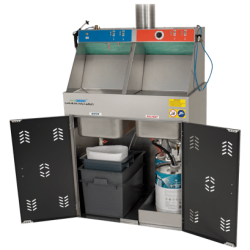
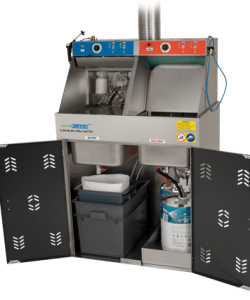
At IBERKLEEN we offer different models depending on the type of paint you use:
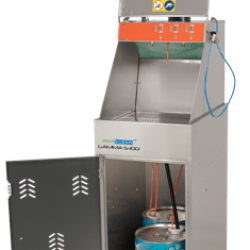
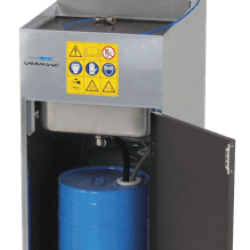
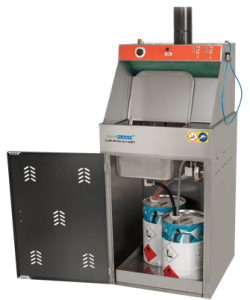
Solvent Spray Gun Washers
Ideal for solvent-based paints. They use a closed system that reduces solvent evaporation, optimising consumption.
🔹 Effortlessly removes paint and residue.
🔹 Minimises operator contact with chemicals.
🔹 They comply with environmental regulations.
Our GAMMA S line
Water Spray Gun Washers
Designed for water-based paints. Incorporate specific detergents and rinsing processes to remove residues without generating contamination.
🔹 Environmentally friendly.
🔹 Low water consumption.
🔹 Reduction in the use of chemicals.
Our GAMMA W line
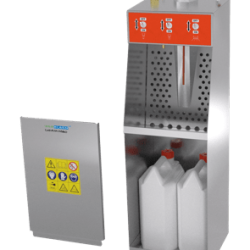
Mixed Gun Washers (Solvent + Water)
The best choice for bodyshops working with different types of paint. Allows switching between solvent and water depending on the paint used.
🔹 Versatility in cleaning.
🔹 Increased efficiency in waste disposal.
🔹 Reduction of operating costs.
Our GAMMA WS line
Tips according to type: HVLP, airless and airbrushing (important nuances)
HVLP (high volume, low pressure).
They tend to cause trouble in the air cap and diffusers. Use a brief soak + soft brush. If you switch from varnish to primer, do an “intermediate” rinse to avoid cross-contamination. In the workshops we visited, the typical mistake is to leave the edge of the nozzle to dry “for later”: bad idea, it hardens.
Airless.
Here, the king is the filter: body, handle and pump intake. Dismantle the reversible nozzle and clean it separately. Run cleaner through the hose until the water runs clear; if you use water-based paints, warm water speeds up the process. Practical tip: alternate short cycles “suction/recirculation” with 30–60 s breaks to allow the cleaner to take effect on the line.
Airbrushing (detail/art).
Very fine needles: no rush. Use microbrushes and avoid aggressive solvents that attack joints. I always keep a spare needle and mark the order of packaging with photos. “When a customer switches to a washing machine water-based, the first thing you notice is that no longer scratching nozzles microscopic”.
TIPS Depending on the paint: water-based, nitro/PU, synthetic/oil-based, chlorinated rubber and epoxy
Into the water
It will gel if left “halfway”. Rinse immediately after painting; use a specific detergent if partially dry. Do not use boiling water as it will damage the seals; lukewarm water will help. Then rinse with clean water to avoid streaks.
Nitro / Polyurethane (PU).
Use a compatible solvent. Be careful with foams If you mix products, it is best to do it in two stages: wipe → rinse. Do not lubricate excessively or the varnish will “open up”.
Synthetic/fatty.
Stickier: allow the cleaner to sit for a while and replace the bath if it becomes saturated. Use lint-free cloths, or you will contaminate the fan.
Chlorinated rubber.
Do not allow it to set; if it has “bitten”, you may need to use a gentle mechanical action (the correct brush) and change the solvent frequently.
Epoxy.
The border is the start of curing. If you take too long, it's over: clean up when you're done. A tip: prepare an “emergency kit” (clean bath + microbrushes) in parallel so you can tackle the nozzle and needle right away. If you're late, replace consumables; forcing tools will scratch parts.
Manual vs. gun washer: time, consumption, and safety
We've seen it all: from those who “live” with a perpetual bottle of solvent to those who control every millilitre. The truth? Both methods work., but not for the same scenario.
Manual (well done)
✅ Minimal initial cost and complete control over each individual part.
❗ Depends on the operator; greater variability and more contact with vapours.
⚠️ It is easy to “sin” by overconsuming if you do not organise dirty → intermediate → clean.
Gun washer (closed circuit)
✅ Time per cycle more stable (and lower at high rotation), less contact with solvents/VOCs, better repeatability.
✅ Versions water-based, solvent y mixed depending on what you paint.
💡 In workshops that alternate between water and PU/epoxy, the mixed It is the most versatile.
❗ Requires 10–15 minutes of training to establish routines (placing pieces, final purge).
“In high-turnover workshops, the spray gun washer reduces time and contact with solvents; consumption is more predictable in closed circuit.»
Common errors and how to avoid them (cross-contamination, drying, excess lubricant)
🔹 Cross-contamination: using the same bath for water and solvent. Solution: separate containers/stages or suitable washing machine.
🔹 Leave to dry for a moment.“: Urgent matters kill important ones; clean the nozzle and cap while hot.
🔹 Aggressive brushes: invisible lines today, fan problems tomorrow.
🔹 Lubricate the tip: prohibited; only joints and mechanisms.
🔹 Do not check filters (airless and HVLP with handle filter): half of the spitting comes from there.
🔹 Do not purge at the end: control shot with clean rinse into container.
🔹 Do not label cans: water / dirty rinse / clean rinse. It saves confusion.
When we install a washing machine in a mixed workshop, a quick improvement comes from standardise: same sequence, same duration, same positions. Less reworking and fewer “micro spits” on the varnish.
Safety and waste: PPE, ventilation, recycling centres and best practices
🔹 PPE whenever you handle solvents or pressure wash.
🔹 Ventilation: extraction wherever you clean; no improvising in enclosed areas.
🔹 Waste: separate dirty rinse y sludge; enter authorised manager or professional recycling centre.
🔹 Labelling: name containers and date of use.
🔹 Storage: lids closed, away from heat and sparks.
🔹 TrainingTen minutes with the new team prevents months of bad practices.
Which is the best option?
Cleaning a gun thoroughly is a short and precise routine which determines the quality of the finish. If you paint occasionally, methodical manual cleaning will work wonders. If you live with a spray gun in your hand, a paint spray gun washer It provides regularity, less exposure, and consumption control.
Looking for a solution to clean your paint spray guns?
Contact us to find out how our solutions can transform your operation.
❓ Frequently asked questions about cleaning paint guns
In intensive use, light daily + full week (with inspection of seals/filters). For occasional use, after each day.
One specific for pistols; avoid silicones or oils that contaminate finishes.
No. Separate stages/containers or use a washer-dryer.
Use suitable brushes, no wire brushes. If the nozzle is already marked, replace it: it is inexpensive compared to a ruined finish.
When the cycle time and the consistency of finish More important than the initial cost: cabins, bodywork and wood with several coats a day pay for themselves sooner.