
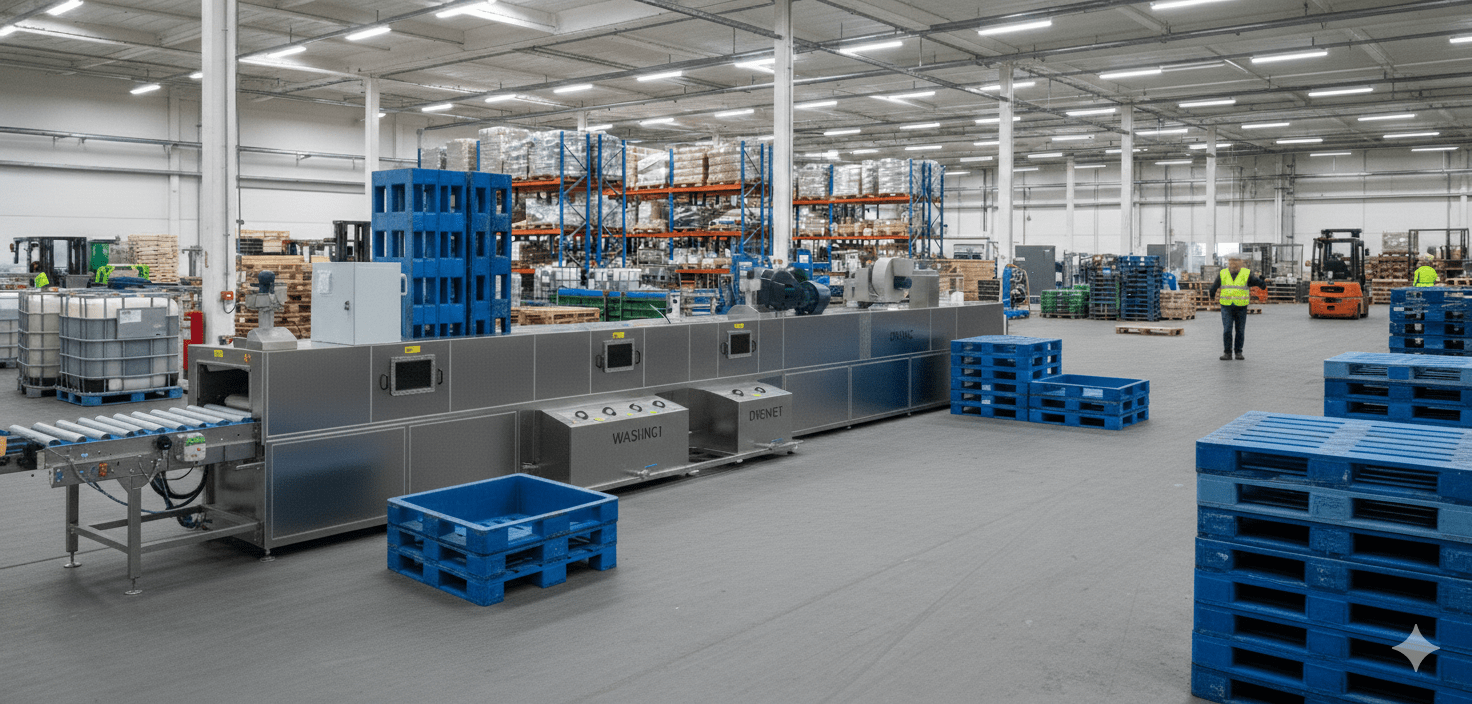
Industrial pallet washer for automatic washing of pallets and pallets
We manufacture tailor-made industrial pallet washers for the automatic washing of pallets, pallets and separators.
Tunnel solutions with high productivity, homogeneous washing and in-line integration according to the needs of each customer.
The pallet washer is an industrial solution designed to automatically clean reusable pallets, pallets and plastic or industrial separators, eliminating dirt, organic remains, dust, grease and residues accumulated during logistical or productive use.
In sectors where hygiene, productivity and process standardisation are key, a industrial pallet washer allows to replace slow and irregular manual cleaning with a continuous, controlled and repeatable system.
At IBERKLEEN we manufacture pallet and pallet washing machines from equipment for medium to large productions. pallet washing tunnels can be integrated in line, adapted to the type of pallet, degree of soiling and work rhythm of each customer.
In this guide you will find, step by step, how to choose and size a pallet/pallet washing machine, What types exist, what technical specifications make the difference and how to integrate washing and drying into your logistical flow.
If your goal is to get them really clean and ready to reuse, here's everything you need to make the right choice without wasting time and money.
Table of contents
What is a pallet and pallet washer?
A pallet and pallet washer is an industrial equipment designed for the automatic and thorough cleaning of reusable pallets and pallets, removing dirt, dust, grease, organic contaminants or residues from logistical and industrial use.
This type of machinery is mainly used in sectors where hygiene, traceability and process standardisation are critical, such as the food industry, pharmaceuticals or advanced logistics.
Unlike manual washing, pallet and pallet washers ensure consistent and repeatable results, reducing the variability of the process and minimising human error. In addition, they allow large volumes of pallets or pallets to be handled in short periods of time, which is essential in continuous production environments.
On the other hand, there are different types of pallet washing machines according to the working system:
🔹 Machines of type batch work in batches, cleaning a certain number of pallets or pallets in each cycle.
🔹 Continuous or tunnel washers allow a constant flow and are ideal for large productions.
🔹 There are also fully automated systems that can be integrated into existing logistics lines, requiring minimal operator intervention.
Why your company needs an industrial cleaning system
In many facilities, pallet cleaning is still carried out manually or with inefficient systems.
The accumulation of organic, chemical or biological waste on pallets represents a silent but critical problem for any industrial operation..
Without a proper cleaning process, these items become vectors for cross-contamination, which is of particular concern when handling food or pharmaceutical products. The proliferation of bacteria, fungi and unpleasant odours not only compromises the quality of the final product, but can also lead to severe regulatory sanctions.
On the other hand, internal logistics are directly affected when working with dirty pallets. Automated storage systems, such as stacker cranes or conveyors, suffer accelerated wear and frequent breakdowns when interacting with contaminated surfaces. This causes unscheduled downtime, increases maintenance costs and reduces the overall efficiency of the production line.
From a measurable economic perspective, In addition, implementing an industrial pallet or pallet washer brings immediate quantifiable benefits.
🔹 Washing time is reduced by up to 90% compared to manual methods, going from hours to minutes per pallet.
🔹 Water consumption can be reduced by up to 70% thanks to recirculation technologies, while the optimised use of detergents represents significant monthly savings.
🔹 Added to this is the reduction in the rate of pallet replacement, which can extend their useful life by an additional 3 to 5 years.
Also, having specialised equipment improves the corporate image in the face of customer audits and quality certifications. Regulated industries place great value on demonstrating traceability in sanitisation processes, something that an industrial washing machine documents through automated reports of each cycle performed.
How pallet washers work: From soiling to complete drying
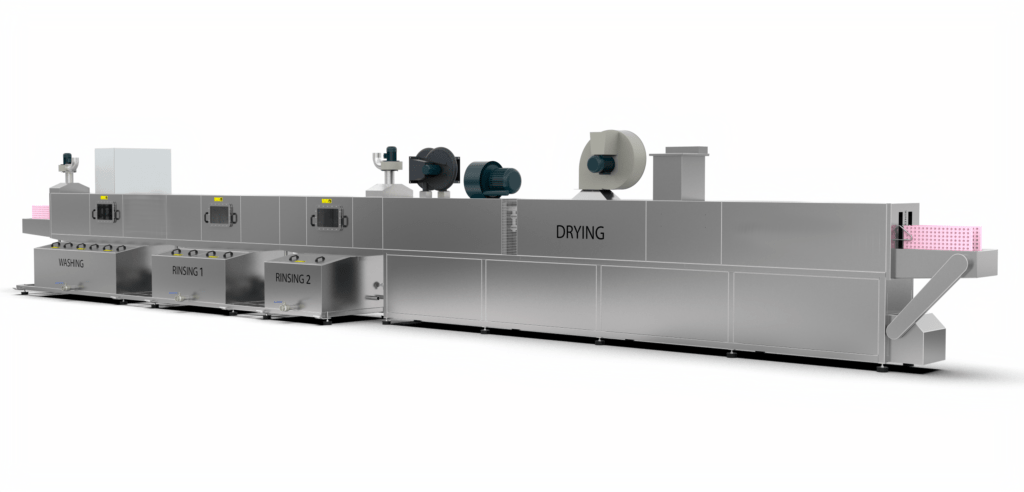
The operation of a pallet washing machine is based on a sequential process combining washing, rinsing and, in many cases, drying..
First, the pallets enter the machine manually or automatically, depending on the level of system integration. Once inside, they are subjected to a spray wash using high-pressure nozzles, which project hot water and detergent onto all surfaces.
Subsequently, the equipment can incorporate a rinsing phase with clean water, eliminating any remaining chemical product.
In applications where residual moisture is a critical factor, an air blowing drying stage is added, ensuring that the pallets are ready for immediate re-use.
Our pallet and pallet washers incorporate closed water circuits, filtering systems and automatic control of temperatures, levels and washing times to improve the efficiency of the process and adapt the cleaning to different degrees of soiling.
Types of industrial washing machines according to capacity and format
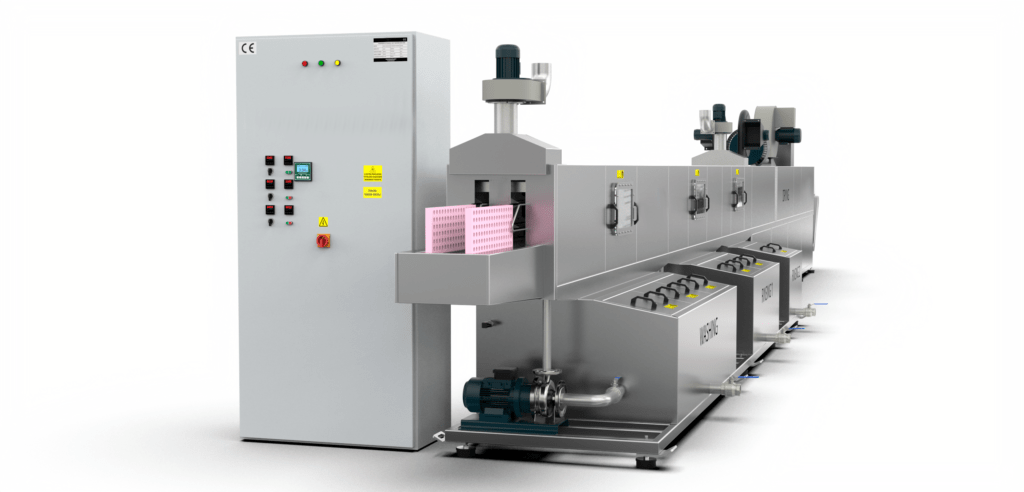
The pallet and pallet washing machines can be classified according to different criteria. One of the most common is the production capacity, expressed in number of pallets per hour.
At IBERKLEEN we design compact models for low to medium productions, as well as washing tunnels capable of processing large volumes on a continuous basis.
On the other hand, the pallet format is a determining factor. We also make designs for all types of pallets and pallets: European pallets, industrial pallets or plastic separators.
Finally, for us, plant integration makes a key difference.
Some of our washers operate as stand-alone equipment, while others are integrated directly into automated lines, connected to conveyors, accumulation systems or automatic loading and unloading zones.
Technical features you should know
The materials of construction define the durability and resistance of the equipment to aggressive environments.
EStainless steel AISI 304 or 316 is our standard for our structures and washing chambers., The new product, offering exceptional resistance to corrosion caused by water, detergents and thermal changes.
With reference to the critical components, the high pressure pumps They are usually electrically driven with power ratings between 5 and 30 kW depending on the required flow rate.
The level sensors ensure precise control of clean, dirty and detergent water tanks, avoiding dry runs that would damage the pumps. In addition, the flexible slat curtains in inlets and outlets minimise temperature losses and water spillage outside the washing area.
Our control systems incorporate Programmable PLCs with touch screens HMIs that allow multiple wash programmes to be configured.
They record parameters of each cycle, generate preventive maintenance alerts and facilitate the traceability required by ISO or HACCP certifications.
Some premium models include IoT connectivity for remote monitoring and predictive fault analysis.
As for the water, while a conventional washing machine consumes between 80 and 200 litres per pallet, closed-loop systems reduce this figure to 10-30 litres. of reinstatement, representing substantial annual savings on bills and landfill permits.
How to choose the right washing machine for your business and operation
Before making a purchase decision, it is essential to quantify the real volume of pallets or pallets that circulate daily in your facilities.
Do you handle 50 pallets a day or more than 500? This figure will determine whether you need a compact equipment that works in batch mode or a continuous system integrated into your production line.
Underestimating this capacity leads to bottlenecks, while over-sizing means unnecessary investment in under-used equipment.
Another critical aspect is to identify the prevailing level of soiling. Light residues such as dust or dry soil require less washing intensity than adhering contaminants such as oils, resins or decomposed organic matter. Meat, fish or chemical industries need systems with higher pressure, controlled temperature and deep disinfection capabilities, while dry logistics operations can be satisfied with simpler equipment.
The availability of physical space and ancillary services Does your electrical installation support the required power without additional works? Is there space for loading and unloading areas without hindering existing flows?
Also, future business developments should be considered. If you plan to grow in the coming years, opting for modular systems or systems with additional capacity margin will be more cost-effective than replacing equipment in the short term. Scalability is not only about volume but also about functionality: you may not need automatic integration today, but anticipating this possibility facilitates future expansion.
Finally, the regulatory compliance Do you require documented traceability of each cycle? Do you need validations of temperature or detergent concentration? Are there regular audits that examine your sanitising processes? These requirements point towards models with advanced control systems, digital recording and specific certifications to back up your operation against inspections.
Demonstration video of an industrial pallet washing machine
❓ Frequently asked questions about pallet and pallet washers
Calculating the ROI of an industrial washing machine requires consideration of multiple variables beyond the purchase price. Savings in labour costs are usually the most significant concept: replacing two operators dedicated to manual washing with an automated system represents an annual saving of €50,000-70,000 in salaries, social security contributions and protective equipment, without considering reductions in absenteeism or accidents at work.
Extending the useful life of pallets generates another measurable benefit. A new Euro pallet costs between €8-15, and medium-sized companies can manage 5,000-10,000 units. If systematic washing extends their useful life by just two additional years, the savings in replacement easily exceed €25,000 per year.
Considering these factors, energy and water savings, Medium sized installations typically recover their investment in 2-4 years, while high volume operations can recover their investment in 12-24 months.
Dimensions vary considerably according to capacity, but compact models are between 3-5 metres long by 2 metres wide. Tunnel systems can extend up to 12-15 metres. It is essential to provide additional space for loading/unloading areas, maintenance access and, if appropriate, location of water and purification tanks. An on-site assessment by the supplier ensures realistic planning.
Absolutely. Most modern washing machines are versatile and process both materials without the need for complicated adjustments. However, it may be necessary to modify parameters such as pressure or temperature depending on the type, as plastic pallets tolerate higher temperatures than wooden pallets, which can warp under excessive heat. Models with pre-configured programmes facilitate these changes by means of on-screen selection.
Daily maintenance is limited to checking detergent levels and basic filter cleaning, tasks that can be carried out by one operator in 10-15 minutes. Nozzles and brushes should be checked monthly. Specialised technical checks are scheduled every 6-12 months and include pumps, sensors and electrical systems.
The durability of a well-maintained industrial washing machine easily exceeds 15-20 years of continuous operation.
The main operating costs are electricity, water, detergent and maintenance. For an average capacity machine processing 100 pallets per day, he estimates approximately €1,000 per month for all items. Closed circuit equipment significantly reduces water consumption, while energy efficient models minimise electricity consumption. The cost per washed pallet is usually between €0.30-0.80 depending on configuration and volume.
Although generic detergents can technically be used, products formulated specifically for industrial washers offer better performance and protect components. These detergents are designed to work at specific temperatures and pressures, generate less foam (which interferes with sensors) and are compatible with recirculation systems. In addition, in the food industry it is mandatory to use certified products without toxic residues.
Our industrial washers are designed for severe soiling, but exceptionally adherent residues such as cured resins or paints may require manual pre-treatment or special extended wash programmes. Some systems incorporate pre-wash functions that soften contaminants before the main cycle. In extreme cases, it may be more economical to discard the pallet than to spend excessive time recovering it.
It depends on local legislation and the type of installation. Generally no specific permits are required for the equipment itself, but they may be necessary for plumbing modifications, electrical power installation or, especially, for discharges if you do not use a closed circuit. Consulting with the local council and the relevant water authority prior to investment prevents bureaucratic surprises later on.
Industrial washers with controlled pressures do not damage official markings engraved on wood. However, excessive or improperly calibrated pressures may affect painted seals or decals. Certified EPAL pallet operators allow washing as long as it does not compromise the legibility of the identification markings. Setting appropriate pressures and avoiding aggressive chemicals preserves these certifications.
Actual use cases by sector
Food industry
A meat processing plant implemented one of our high-capacity tunnel washers that processes 120 pallets per hour. Prior to this investment, they were dedicating three full-time operators to manual washing, with inconsistent results leading to audit rejects. After automation, they not only eliminated this labour cost, but also reduced cross-contamination incidents by 85%.
Cold logistics operator
This customer, which handles pharmaceutical products, was facing recurring problems with ice formation on wet pallets in -25°C cold rooms. The solution came in the form of a washer with an integral thermal drying system that guarantees residual moisture below 2%. This completely eliminated stops for ice chipping, workplace accidents due to slips and damage to automated storage systems, recouping the investment in less than 18 months.
Manufacturer of industrial chemicals
It needed to remove potentially reactive product residues between different production batches. They implemented a triple rinse system. This capability allowed them to take on contracts with pharmaceutical customers who demanded levels of cleanliness that were impossible to demonstrate with manual methods, opening up a new and highly profitable market segment.
Agricultural sector
A fruit and vegetable cooperative reduced its rot losses by 60% after implementing systematic washing of returnable pallets. Accumulated organic residues acted as vectors for fungi and bacteria that quickly affected fresh produce. The change not only improved the quality perceived by their distribution customers, but also extended the life of their pallets from 4 to 7 years, amortising the equipment through these additional savings.
We manufacture industrial pallet washers to measure
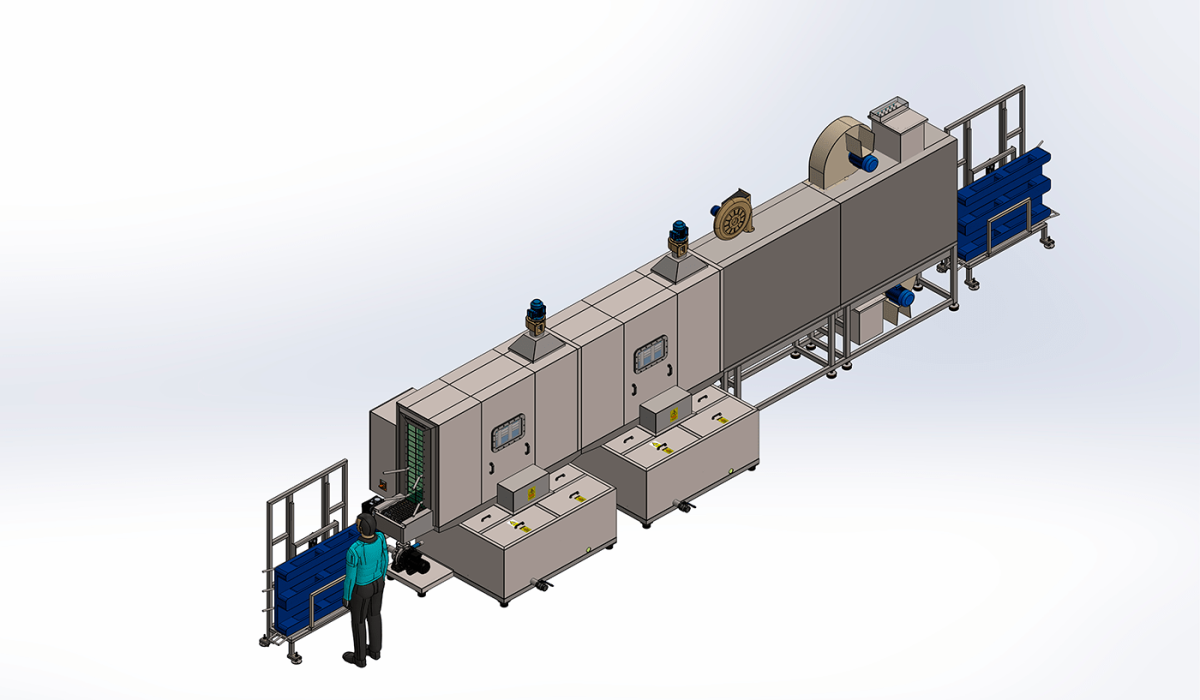
At IBERKLEEN we design and manufacture pallet washers y pallet washers adapted to each process. We can develop from compact equipment to automatic tunnel-type lines, with customised configurations according to dimensions, capacity, dirt and level of automation.
The new image that you are about to upload reinforces this approach very well, because it shows precisely one tunnel pallet washer, with pallet infeed and outfeed, linear washing body and automation-oriented industrial design.
Request your personalised quote
Each industrial operation presents unique needs that merit detailed analysis. before recommending specific equipment.
Our technical team is ready to make a complete assessment of your requirements, considering volumes, types of contamination, available space and sustainability objectives.
Based on this information, we design customised proposals that optimise the relationship between investment and operational benefits.
Don't wait for hygiene problems or logistical inefficiencies to affect your productivity.