

Cleaning in the Pharmaceutical Industry | Machines, detergents and technology for critical environments
In the pharmaceutical industry, cleaning of process equipment is not only mandatory, but critical to ensure product safety, prevent cross-contamination and comply with strict international regulations.
Whether in laboratories, production lines, cleanrooms or large-scale manufacturing plants, every surface that comes into contact with active ingredients, excipients or auxiliary materials must be cleaned in a validated, traceable and reproducible manner.
How to ensure effective residue removal in pharmaceutical processes with validated cleaning, specific detergents and GMP and FDA compliant technology.
What challenges does pharmaceutical cleaning present?
Cleaning in pharmaceutical environments requires rigorous control because waste can be as varied as it is complex.
From soluble excipients to substances such as petrolatum, lacquers, metal oxides, carbopols or polymers (such as Eudragit®), many of them are highly adhesive and difficult to remove.
Furthermore, these residues must be disposed of without damaging materials such as 316L stainless steel, glass, PTFE, polypropylene or silicone elastomers.
The entire process must conform to GMP (Good Manufacturing Practices)comply with the guidelines of the FDA, EMA y ICHand be validated according to standard operating procedures (SOPs).
Recommended technologies for the pharmaceutical industry
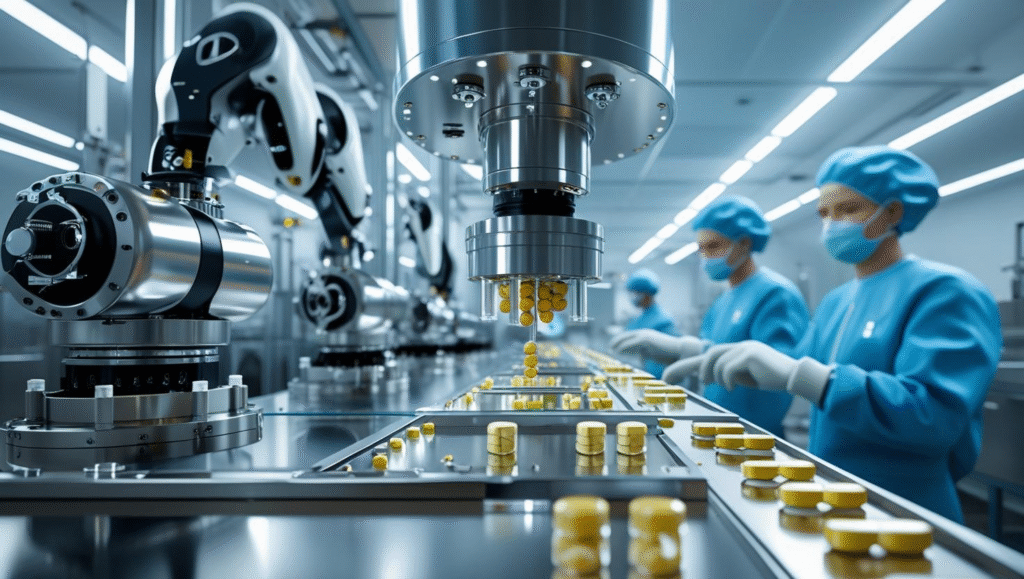
Ultrasonic cleaning in the pharmaceutical industry
Ultrasonic cleaning allows difficult residues to be removed from technical parts, valves, laboratory components or precision tooling, without abrasion and with high efficiency. Combined with mild alkaline or low-foaming acid detergents, it ensures uniform cleaning even in internal cavities or hard-to-reach areas.
Recommended for glassware, detachable parts, connectors, valves, syringes and critical R&D components.
CIP (Clean-in-Place) and automated spraying systems
In equipment such as reactors, tanks, piping, mixers or continuous production lines, CIP systems allow efficient cleaning without disassembly. They use programmed cycles with detergents compatible with fatty residues, emulsifiers, sugars, salts and metal oxides.
- Suitable for removing residues such as titanium dioxide, zinc oxide, petroleum jelly or pharmaceutical polymers.
- Can be integrated into validated processes with traceable documentation.
- Compatible with pyrogen and endotoxin control when combined with alkaline detergents.
Validated cleaning and pyrogen control
In the manufacture of injectable products, endotoxin control is mandatory. Cleaning with mild alkaline detergents at controlled temperatures, followed by rinsing with water for injection (WFI), allows pyrogens to be removed without compromising surfaces or altering equipment functionality.
Validated cleaning not only ensures patient safety, but also prevents batch losses, production downtime and regulatory rejections.
Common applications in the pharmaceutical industry
The mixing tanks and chemical reactorsespecially glass-coated ones, require regular internal cleaning to avoid build-up of excipients, polymers or active residues. CIP systems are essential to clean these surfaces in an automated way and without disassembly.
In the production of oral solids, the capsules, rotary presses and tablet dies accumulate dust, lubricants and product residues that must be removed with precision. The ultrasonic cleaning is ideal for these removable and difficult to access parts.
The bioreactors and fermentation equipment used in the production of vaccines, antibiotics and APIs have organic and cellular residues that must be removed with validated detergents, avoiding cross-contamination and ensuring a sterile environment.
The lines of sterile fillingwhere caps, vials and containers are handled, require rigorous cleaning of each component to meet cleanroom standards. Both ultrasonic washing and final rinsing with water for injection are essential to meet particulate and endotoxin limits.
Finally, all the metal, plastic or elastomeric components used in cleanrooms (such as connectors, valves, seals or tubing) must be cleaned with products that do not leave residues or alter the biocompatibility of the materials, thus ensuring their safe reuse in GMP environments.
Key recommendations
It is essential to use high purity detergentsformulated without phosphates, perfumes and dyes, and certified as LAL-compliant for pyrogen testing. This ensures safe and compliant cleaning in accordance with regulatory requirements.
Each cleaning cycle must keep under control critical parameters such as the temperature, concentration and duration of washingThe smallest variation can affect the efficiency of the process or damage sensitive materials.
The machines used must be equipped with electronic traceability and adjustable programmingThis allows each cycle to be recorded and to comply with documentary validation requirements.
It is recommended to limit the variety of detergents used to reduce risks of human error, simplify validation and ensure consistency between batches and equipment.
Finally, every cleaning operation must be documented in a SOP (standard operating procedure) and validated by appropriate analytical methods, ensuring batch to batch reproducibility and regulatory compliance.
At IBERKLEEN we develop cleaning solutions able to offer effective and sustainable solutions in the cleaning of the pharmaceutical industry.