
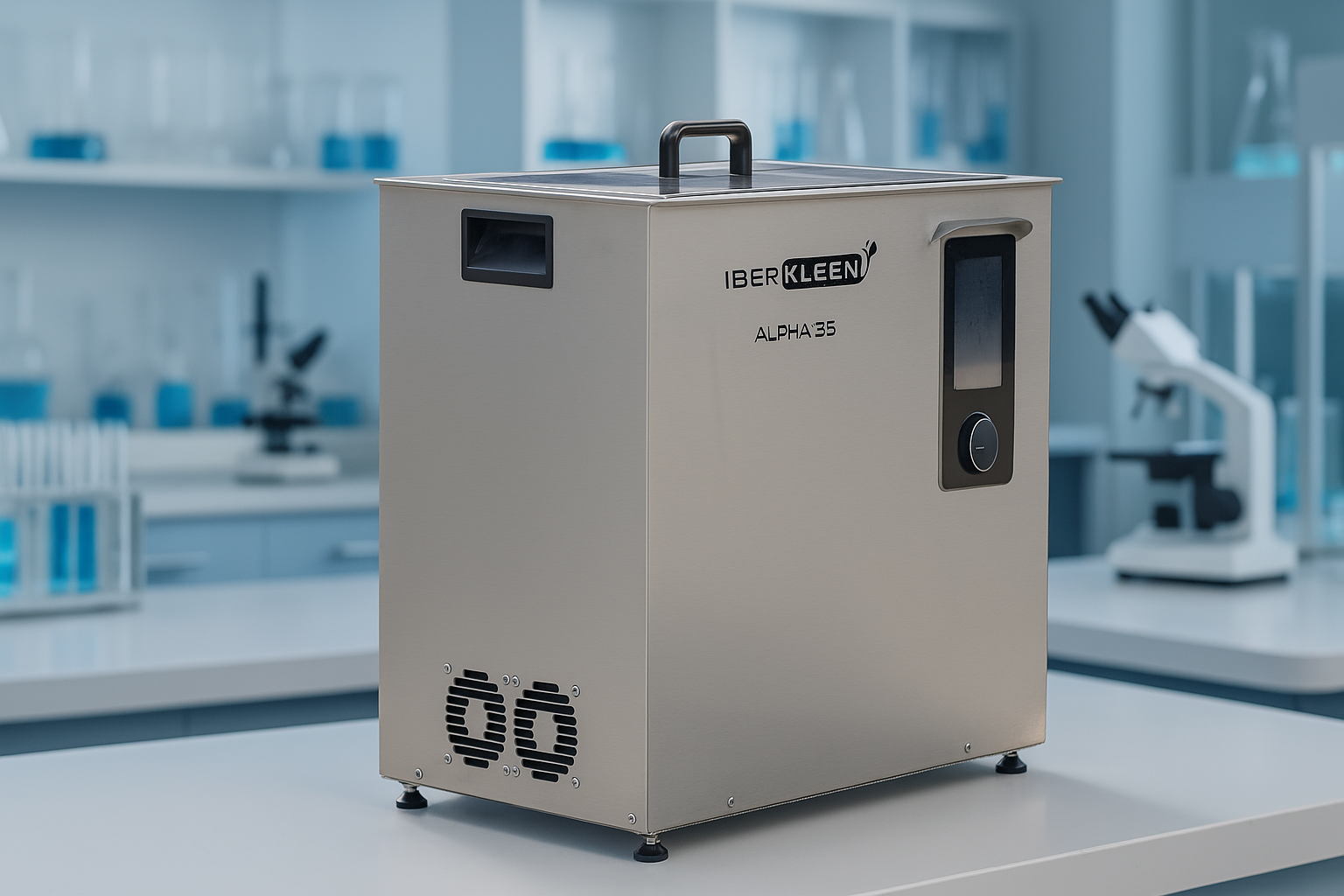
Laboratory cleaning machines: precision, safety and efficiency in every process
Cleaning in a laboratory is not a secondary task: it is the first step in ensuring the validity of experiments, preventing cross-contamination, and protecting both staff and equipment.
However, manual methods are time-consuming, operator-dependent and do not always guarantee a consistent finish.
That is why more and more research centres, universities, hospitals and pharmaceutical laboratories are incorporating laboratory cleaning machines.
These automated solutions ensure standardised processes, reduce human error, and enable safer and more efficient working.
Laboratory cleaning machines
Challenges of manual cleaning in laboratories
Although manual cleaning is still used in many laboratories, it has significant limitations. Incomplete rinsing can leave traces of detergent that alter an analysis. The use of brushes and sponges on delicate instruments can damage the material. And in environments where large volumes of glassware, pipettes or metal instruments are processed, the time invested is unsustainable.
Furthermore, the risk of staff exposure to biological or chemical waste necessitates a safer and more standardised system.
How laboratory cleaning machines work
The ultrasonic cleaning machines They use cavitation to remove microscopic residues in just a few minutes, even in cavities and complex geometries of pipettes, tubes or syringes.
The process does not damage surfaces and ensures uniform cleaning.
On the other hand, the automatic laboratory washing machines allow you to load full trays of glassware or instruments and run pre-programmed cycles of detergent, rinsing with purified water and controlled drying.
In this way, the material is ready for immediate use or for sterilisation.
Advantages of investing in laboratory cleaning machines
The purchase of specialised cleaning equipment represents a strategic investment for any laboratory:
🔹 Reproducible results: by removing invisible residues that alter chemical reactions or cell cultures.
🔹 Time and cost savings: automating the process frees up staff time.
🔹 Increased security: direct handling of contaminated materials is reduced.
🔹 Instrument durabilityCleaning cycles are less aggressive than manual methods and extend the service life of the material.
🔹 Regulatory compliance: facilitate audits and certifications in accredited laboratories.
Which machine to choose for your laboratory
The choice of equipment will depend on the volume and type of material to be cleaned. For small laboratories, the compact ultrasonic tanks They are an economical and effective solution.
In larger facilities, the multi-stage automatic washing machines offer high-volume capacity and precise control of each cycle.
It is essential to consider aspects such as compatibility with enzymatic or neutral detergents, the possibility of using deionised or ultrapure water in the rinse cycle, and the ease of programming cleaning cycles.
The laboratory cleaning machines They are not an expense, but an investment in reliability, productivity, and safety. With them, your laboratory can reduce time, minimise risks, and guarantee maximum quality in every result.
👉 If you would like more information about models, capacities, and prices, please contact us. We will advise you on choosing the most suitable equipment for your laboratory's needs.