

Cleaning for Stainless Steel Passivation | Industrial Machines & Technical Detergents
Prepare your surfaces for passivation with equipment and solutions that effectively remove free iron, oils and contaminants without compromising the integrity of the steel.
The passivation is an essential process in industry to prevent corrosion of stainless steel and other metals. Its effectiveness depends to a large extent on a technical pre-cleaning to remove any traces of oil, dust or free iron that may interfere with the formation of the protective chromium oxide passive layer.
In this article we address:
- What is passivation cleaning and why it is critical.
- Recommended methods and specific detergents.
- Technologies such as ultrasonic cleaning and CIP spraying.
- How to improve corrosion resistance in demanding applications.
How to passivate stainless steel
What is passivation cleaning?
Before applying a solution of chemical passivationIn order to ensure maximum chromium oxide formation, it is essential to clean the metal surface. This passive layer protects the stainless steel against aggressive environments and increases its service life.
Pre-cleaning eliminates:
- Free surface iron
- Oils, greases, machining residues
- Organic or inorganic contaminants
If this contamination is not properly removed, the passivating solution cannot react effectively with the metal surface, reducing the effectiveness of the treatment.
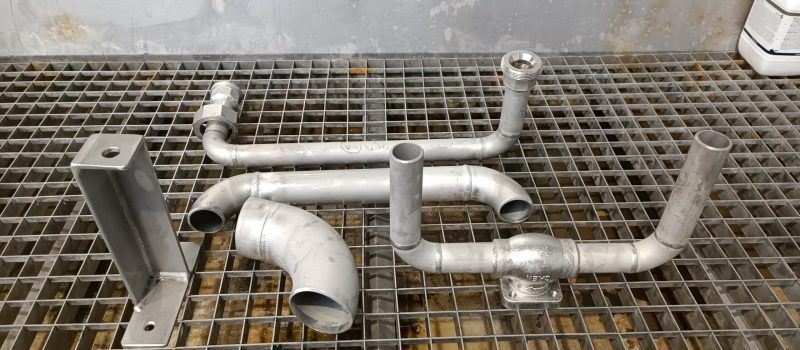
Practical cleaning guide for passivation
| Application | Cleaning method | Type of detergent |
|---|---|---|
Small and delicate components | Ultrasound or soaking | Mild acid |
Large components and surfaces | Sprinkling | Mild acid |
Heavily polluted surfaces | Manual plus active rinsing | Mild alkaline pre-acid |
Advantages of professional cleaning before passivation
- Increases the effectiveness of chemical passivation.
- Reduces defects due to localised corrosion or pitting.
- Extends the life of stainless steel.
- Improves biocompatibility and safety in medical and pharmaceutical industries.
- Complies with ASTM A967 and A380 standards.
In addition, a well passivated surface can self-cure if scratched, as the exposed chromium forms a new protective oxide layer on contact with oxygen.
How does the passivated stainless steel?
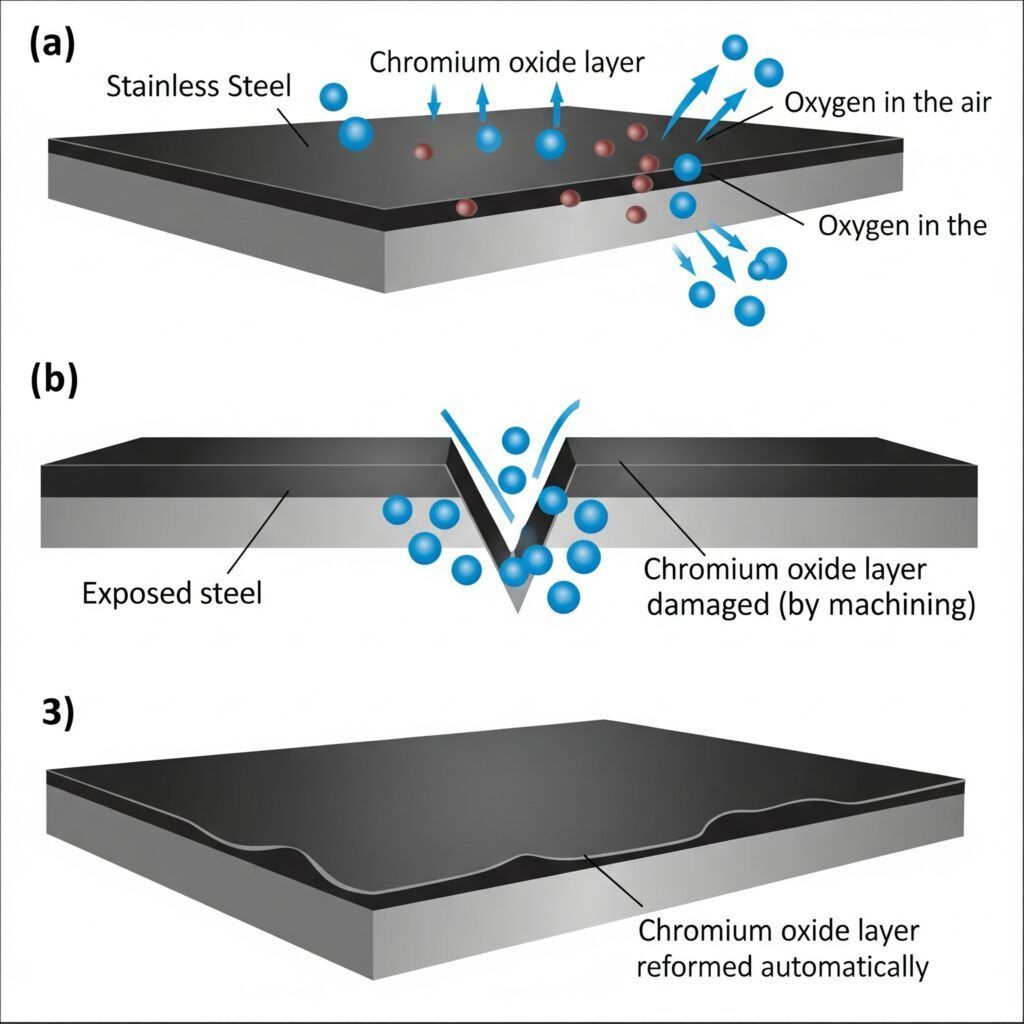
In the picture we illustrate the self-repairing property of stainless steel, specifically how its passivating chromium oxide layer protects it from corrosion and regenerates itself when damaged.
Next, we explain the process of self-regeneration of stainless steel:
Cachromium oxide coating to protect stainless steelThe first step (a) shows a piece of stainless steel with a thin black layer on its surface, called "chromium oxide layer". Blue spheres are shown above this layer representing "oxygen in the air", indicating that the chromium oxide acts as a barrier preventing oxygen from reaching the underlying stainless steel. This layer is the passivating layer.
Damaged (machining) chromium oxide layer: The second step (b) shows the same piece of stainless steel, but now has a V-shaped notch or indentation in the chromium oxide layer, which exposes the underlying stainless steel.
This damage is explicitly attributed to "machining". It shows how oxygen molecules enter this damaged area and come into direct contact with the exposed stainless steel.
Automatically reformed chromium oxide layer: The third panel (3) shows that the V-shaped notch is now filled again with the black chromium oxide layer. Oxygen molecules are again observed on the intact layer, indicating that protection has been restored.
With this image we see how stainless steel forms a protective chromium oxide layer (passivation layer) that prevents corrosion and, crucially, how this layer can be repaired spontaneously if damaged, thus maintaining the corrosion resistance of the material.
Cleaning machines for passivation
To have specialised machines for cleaning prior to passivation ensures a consistent, efficient and repeatable process. These solutions are designed for industrial environments where large volumes of critical parts or components are processed.
Key features:
Structure in stainless steel AISI 304 or 316resistant to acids and alkalis.
Automated cycles washing, rinsing and drying.
Compatibility with mild acid detergents.
Closed systems that reduce human contact with chemicals.
Success story: Pickling and Passivation of Stainless Steel
Pre-cleaning is the key to effective and long-lasting passivation of stainless steel. On IBERKLEEN we offer industrial machines, suitable detergents and technologies such as ultrasonic cleaning to ensure a surface free of contaminants and optimal for the formation of the passive layer.
Do you need advice or a cleaning machine for passivation?
At IBERKLEEN we help you to choose the best solution for your process.
Contact us for a test, demonstration or personalised quotation.