
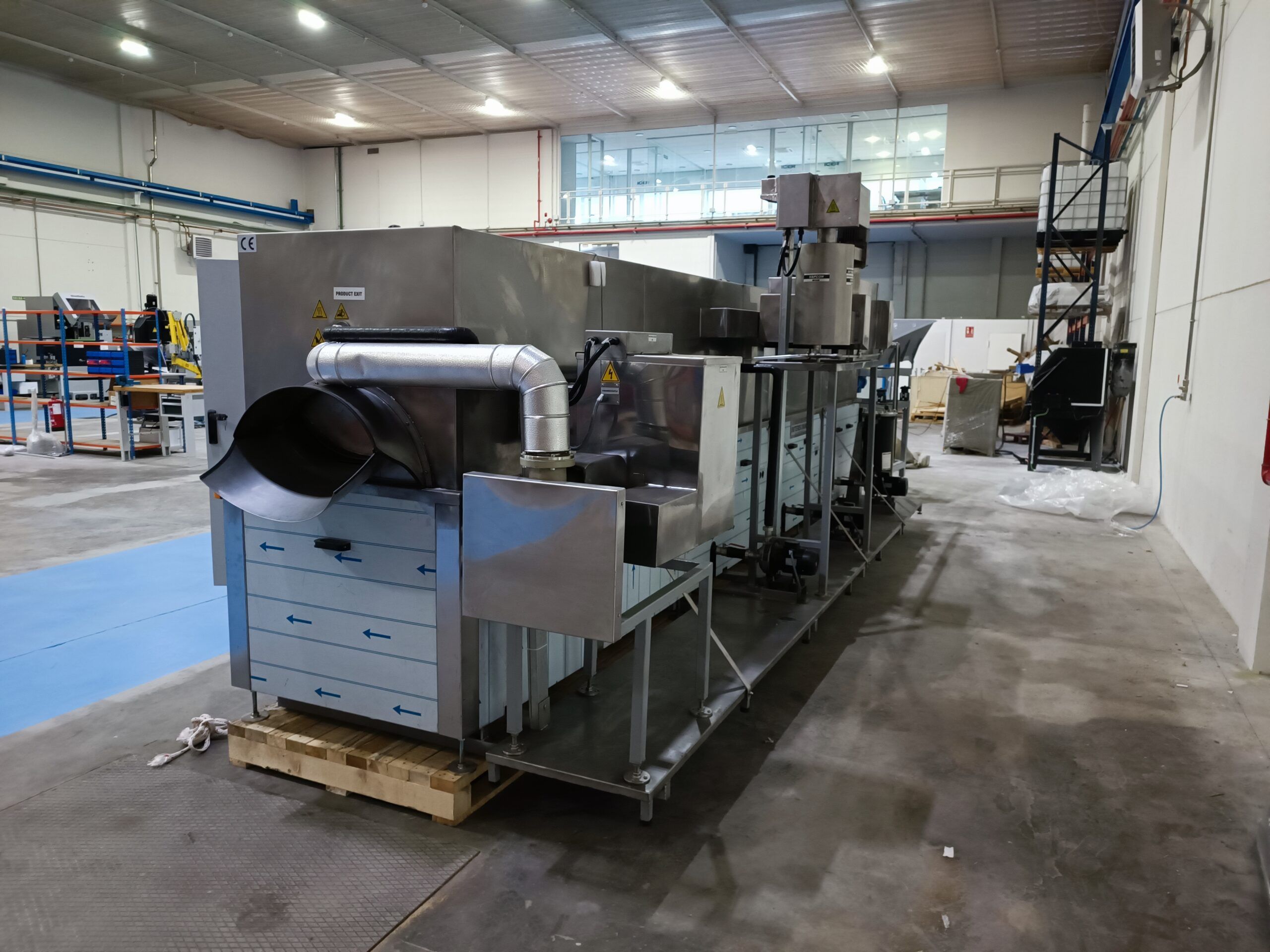
Cleaning machines for machining and bar turning: technology, quality and return on investment
A turned or bar turned part with cutting oil residues, chips or abrasive residues not only ruins the finish, but also increases rejects, rework and machine maintenance.
For workshops and manufacturers, the proper cleaning of each machined part is essential not only for quality, but also for competitiveness.
With our specialised bar turning cleaning machines we have enabled our customers to achieve the performance, accuracy and savings they were looking for.
Cleaning machines for machining and bar turning
Importance of cleanliness in machining and bar turning: quality, tolerances and costs
When machining, coolants, swarf and grease adhere to grooves, threads or inner surfaces.
If not properly removed, tolerances (flatness, concentricity, parallelism) are compromised, which may affect assembly or operation.
On the other hand, poor cleaning has hidden costs: increased tool wear, extra polishing, rework and customer complaints.
Most common machining and bar turning problems
🔹 Bonded cutting oils and coolants.
🔹 Metal shavings in threads, bores or cavities.
🔹 Abrasive polishing residues.
🔹 Corrosion of steels and alloys by retained moisture.
These contaminants affect not only aesthetics but also functionality, especially on precision parts such as bearings, shafts or threaded components.
Cleaning methods available in machining
Manual cleaning
Suitable for small batches or emergencies, but inconsistent and operator-dependent.
Batch washing chambers
They automate degreasing, rinsing and drying cycles. They are ideal for intermediate and repetitive production.
Ultrasonic cleaning
Cavitation reaches complex cavities and geometries, achieving clean finishes within minutes. It is the preferred technology for turned parts or parts with fine grooves.
Controlled solvents
Useful for very stubborn contaminants, but require special facilities and stringent waste management.
How ultrasonics works on machined parts
Ultrasonic equipment applied to machining works at frequencies of 28-40 kHz, capable of releasing oil and chips even in internal bores.
The temperature of the bath is controlled to help dissolve oils without compromising the part. In addition, the use of fastening and orientation accessories ensures that all surfaces are exposed to the cavitation effect, improving cleaning uniformity.
In many projects, we have realised ultrasonic machines with special rotating drums for the ultrasound to be fully effective during cleaning.
Comparison of cleaning technologies
Technology | Key benefits | Limitations |
Ultrasound | Thorough and uniform cleaning, less chemicals, useful in complex geometries | Initial cost, requires accessories and monitoring |
Batch aqueous | Automation, repeatability, high capacity | Bathroom management, more space required |
Solvents | High degreasing power, suitable for persistent contaminants | Strict regulation, waste and associated costs |
Manual | Flexible, low initial cost, useful in emergencies | Inconsistent, more risk of error and labour time |
Detergents and chemistry suitable for machining
Chemistry is key. The recommended detergents are:
🔹 Low foaming degreasersdo not interfere with ultrasound.
🔹 Anti-corrosion agentsprotect ferrous materials after washing.
🔹 Neutral or mild alkaline formulationscompatible with steel, aluminium and alloys.
In this way, oils and greases are removed without damaging the materials or leaving a residual film.
Cleaning equipment and machines for machining
The choice depends on the volume and type of parts:
🔹 Compact equipment → for small workshops or prototypes.
🔹 Industrial Ultrasonic Tanks → for large batches and complex geometries.
🔹 Aqueous multi-stage lines → for series production, with integrated pre-washing, rinsing and drying.
A good supplier should always offer you tests with real parts and technical support to size the equipment correctly.
Return on Investment (ROI)
A well dimensioned machine reduces rejects, rework and hours of manual cleaning.
🔹 Workshops replacing manual cleaning with ultrasonic cleaning reduce defects from 7 % to 2 %.
🔹 Cleaning times are shortened by up to 60 %.
🔹 Savings in chemicals and staff hours allow the investment to be recouped in less than 12 months in many cases.
How to choose a supplier for machining and bar-turning cleaning machines
It is not enough to buy the cheapest machine. It is key to evaluate:
🔹 Cleaning tests with your own parts.
🔹 Technical support and after-sales service.
🔹 Spare parts availability.
🔹 Validation against quality standards.
🔹 Assistance for automation and commissioning.
At IBERKLEEN we design cleaning machines for machining and bar turning The range of products can be adapted to the needs of each customer: from compact equipment to multi-stage lines with full automation.
❓ Frequently asked questions on machining and bar turning cleaning
Cleaning removes cutting oils, swarf and abrasive residues that can affect tolerances, cause corrosion or lead to assembly failures. It also ensures quality finishes and reduces the number of parts rejected by the customer.
Several systems are available: manual cleaning for small batches, aqueous batch washers with automatic cycles, ultrasonic equipment that reaches complex geometries and controlled solvents for very persistent contaminants. The choice depends on the volume of production and the type of soiling.
At IBERKLEEN we help you in the process of choosing the best equipment, be it multi-stage spraying, ultrasonic or another method.
Ultrasonics remove debris in grooves, bores and threads that are impossible to reach by hand. They also reduce cleaning time, consume less chemicals and deliver consistent results without damaging the surface of parts.
Low foaming degreasers, neutral or mild alkaline formulations compatible with aluminium and steel, and anti-corrosive additives are used to protect the part after washing. The detergent should be chosen according to the material and type of contaminant.
Consider production volume, part size, geometry, common contaminants and desired level of automation. A reliable supplier should offer testing of your parts, after-sales support and technical advice to secure your investment.
We can help you with the following information:
1️⃣ How many pieces do you clean per day?
- Less than 50 → Compact washer or assisted manual cleaning.
- 👉 Between 50 and 500 → Aqueous batch washer.
- 👉 More than 500 → Multi-stage aqueous line with automation.
2️⃣ What is the geometry of the parts like?
- Single (shafts, bushes, pins) → Aqueous batch or compact.
- Complex (internal threads, bores, deep grooves) → Industrial ultrasonics.
3️⃣ Which pollutants predominate?
- 👉 Cutting oils and coolants → Low foaming aqueous detergent.
- 👉 Shavings and abrasive residues → Ultrasonics + filtration.
- Dense and persistent fats → Controlled solvents.
4️⃣ Does your customer require standards and traceability (ISO, OEM)?
- No → Basic solution (compact or simple aqueous).
- Yes → Multi-stage line with validation + automatic parameter recording.
Please contact us for more information.