
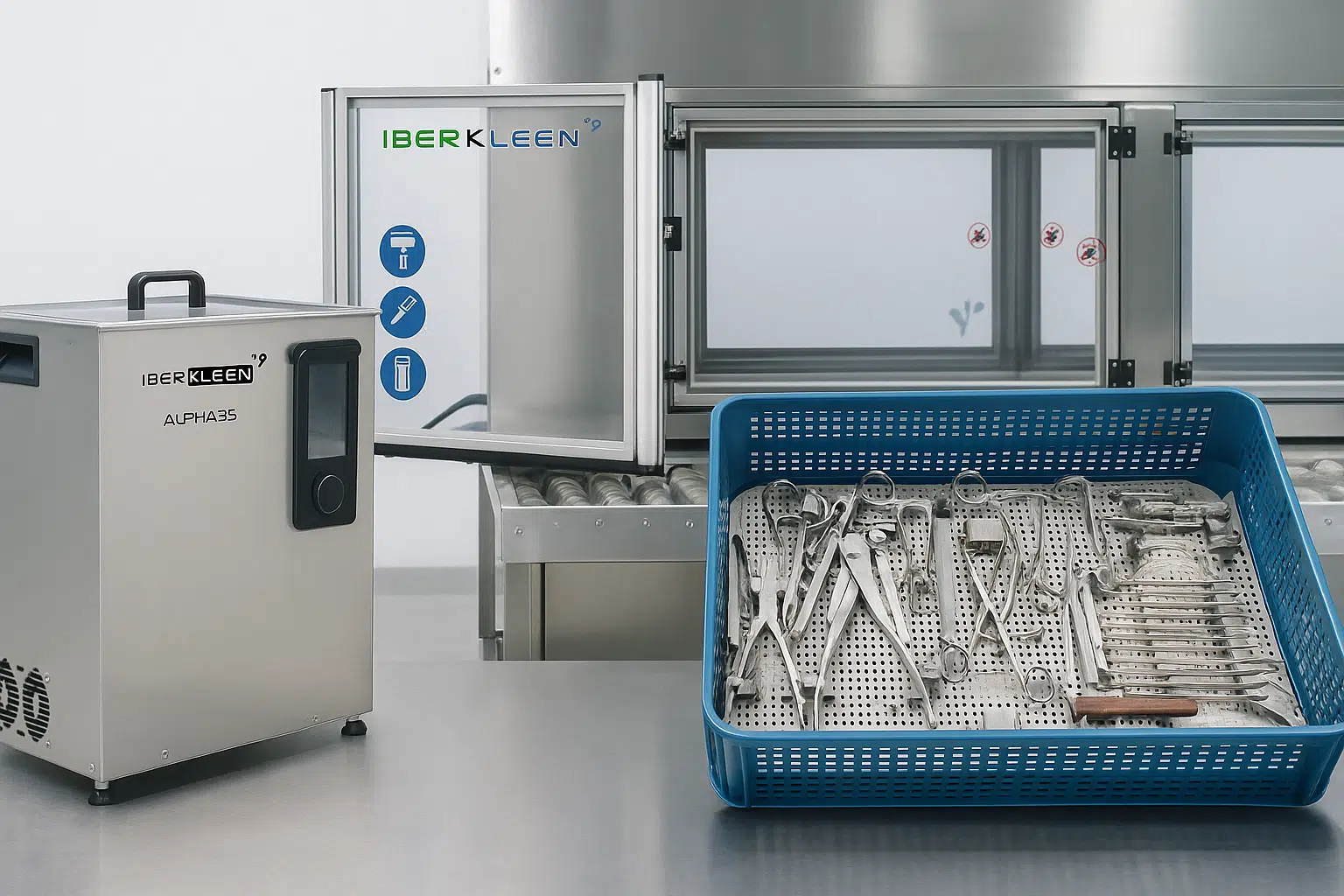
Ultrasonic cleaning of medical devices and surgical instruments: methods, detergents and equipment
The correct cleaning of surgical instruments and medical equipment is the basis of any safety protocol in hospitals, clinics and laboratories.
Before disinfecting or sterilising, it is essential to remove biological and chemical residues and particles that may compromise the effectiveness of the process.
In this context, the ultrasonic cleaning has become the standard for ensuring efficient material preparation, reducing risks of cross-contamination and extending equipment life.
Cleaning of surgical equipment
Importance of cleanliness in surgical instruments
Surgical instruments come into direct contact with blood, tissues and body fluids. If not properly cleaned, it increases the risk of pathogen transmission and the development of endotoxins that compromise sterilisation.
In addition, insufficient cleaning leads to corrosion, deterioration of stainless steel and loss of instrument precision. Therefore, cleaning is much more than a preliminary step: it is the guarantee of safety for both patient and professional.
Differences between cleaning, disinfection and sterilisation
There is no need to confuse the surgical cleaning with disinfection or sterilisation. Cleaning removes visible dirt and biological debris; disinfection reduces the microbial load; sterilisation ensures the destruction of all microorganisms.
Sterilisation without proper cleaning is ineffective, as the residues act as a barrier to steam, heat or the sterilising agent.
Methods available for cleaning of sanitary equipment
There are different cleaning techniques:
🔹 Manualvalid for basic instruments, although it depends on the operator and may damage surfaces if abrasives are used.
🔹 Mechanicsby washer-disinfectors, which offer automation and process control.
🔹 Ultrasoundcavitation is used to deep clean inaccessible areas such as hinges, lumens and internal surfaces.
Small centres tend to opt for soaking trays or compact equipment, while hospitals and large clinics use centralised installations with ultrasonic washers.
How ultrasonic cleaning works on sanitary ware
Ultrasonic cavitation generates millions of microbubbles in a liquid solution. As they collapse, they release mechanical energy capable of dislodging proteins, dried blood, fat and hard-to-reach particles.
This process is uniform and non-abrasive: it cleans complex areas without damaging stainless steel or medical plastics. It also significantly reduces cleaning time compared to manual methods.
A crucial aspect of ensuring effectiveness is the instrument orientation during the process.
Ultrasonic tanks allow parts to be positioned in a controlled manner with specific fixtures, avoiding dead zones and ensuring that even internal areas and narrow cavities receive cavitation action.
Therefore, in the medical device manufacturing industry, This technology is already considered the gold standard for the preparation of parts prior to sterilisation.
Most suitable detergents and solutions
The success of the process depends to a large extent on the detergent. The most recommended detergents are:
🔹 Proteolytic enzymesdegrade traces of blood and body fluids by mild biological action.
🔹 Mild alkaline (pH 7-9)corrosion prevention and protection of metal and plastic surfaces.
🔹 Low foamThe ultrasonic cavitation is essential not to interfere with the ultrasonic cavitation.
In critical applications, such as implantable devices, ultrapure water (WFI) is required in the final rinse to remove endotoxins.
In the field of manufacturing, it is common practice to apply a multi-stage cleaning processFirst a mild alkaline detergent to remove oily residues, followed by a short rinse to avoid drag-out, then an acid detergent to remove insoluble inorganic residues.
Finally, a thorough rinse with high purity water is performed. This combined protocol ensures that the devices arrive residue-free at the sterilisation stage.
Protein and endotoxin removal
It is not enough to clean the visible surface.
In medical device manufacturing and advanced surgery, the removal of proteins and endotoxins is mandatory. These residues, although inert, can trigger inflammatory reactions or treatment failures.
Therefore, validation of cleaning processes includes specific tests that certify the absence of biological and chemical residues, ensuring clinical safety and regulatory compliance.
Benefits of ultrasonic cleaning over traditional methods
The use of ultrasonic equipment offers clear advantages:
🔹 Increased efficiency in hard-to-reach areas.
🔹 Reduction of cross-contamination.
🔹 Time and labour savings.
🔹 Prolongation of instrument life.
🔹 Reduced consumption of aggressive chemicals and water.
These features have made ultrasound the technology of choice in hospitals, dental laboratories and clinics alike.
Standards and validation in medical cleaning
Cleaning processes must comply with international standards such as ISO 13485 and the FDA (21 CFR). In addition, process validation is required as part of the traceability of the medical device.
In the case of metallic devices, many companies carry out an additional step: the passivation.
This chemical treatment removes residual metallic contaminants and generates a protective layer against corrosion.
Currently, there is an increasing trend towards the use of citric acid passivation, It is safer than traditional nitric acid and offers equally effective results.
The typical process combines an alkaline detergent wash, an intermediate rinse, passivation and at least two final rinses with high quality water.
Practical applications in the health sector
Ultrasonic cleaning is applied in many areas:
🔹 Hospitalssurgical instrument trays: complete trays of surgical instruments.
🔹 Dental clinics: burs, tweezers, probes.
🔹 Laboratoriestubes, needles and small devices.
🔹 Veterinary medicinesurgical and diagnostic instruments.
In all cases, the objective is the same: to ensure safe instrumentation, prolong instrument life and reduce costs associated with premature replacement.
Ultrasonic cleaning equipment for medical devices and surgical instruments: what you should consider
When choosing an ultrasonic cleaning machine for sanitary ware, it is important to consider:
 Vat capacityfrom small 5-litre units to centralised systems.
Frequency of work28-40 kHz for general cleaning, higher frequencies for delicate parts.
Compatibility with enzymatic detergents.
Programmable cycles to standardise the process.
The decision must be aligned with the volume of instruments to be processed and the safety standards of each facility.
At IBERKLEEN we develop cleaning solutions able to offer efficient and sustainable solutions in cleaning of surgical instruments and medical equipment