
Success story:
Parts washer for snack production lines
- Company: MARTIRELO
- Country: Spain
- Need: Cleaning of mixers, hoppers, buckets and parts of the production line.
- Substances to be removed: Food waste from the production process.
- Material and dimensions of the parts to be processed: Various sizes and geometries.
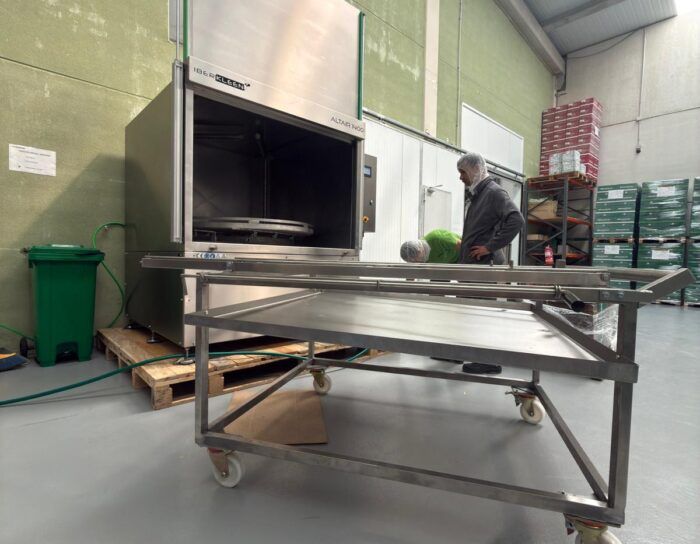
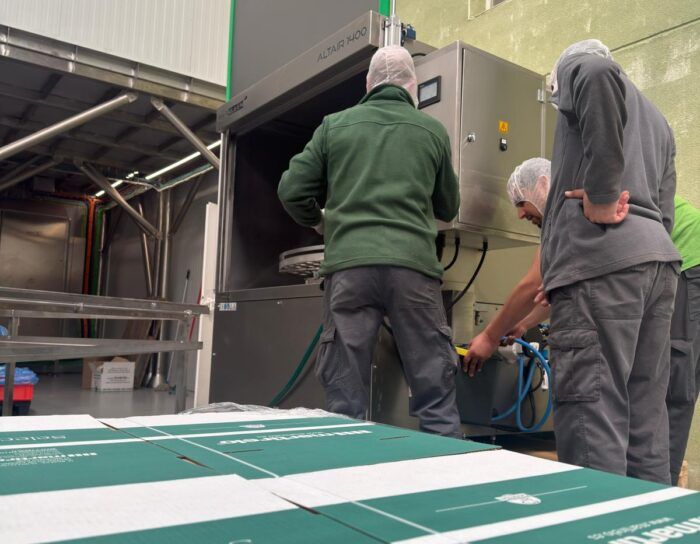
- Installation: ALTAIR 1400 rotary washing machine with loading trolley, pneumatic door and detergent dosing pump.
- Cleaning procedures: Degreasing and rinsing.
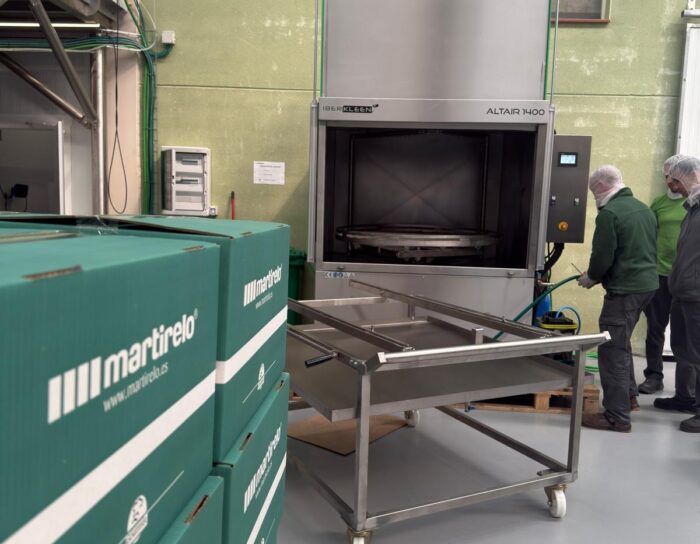
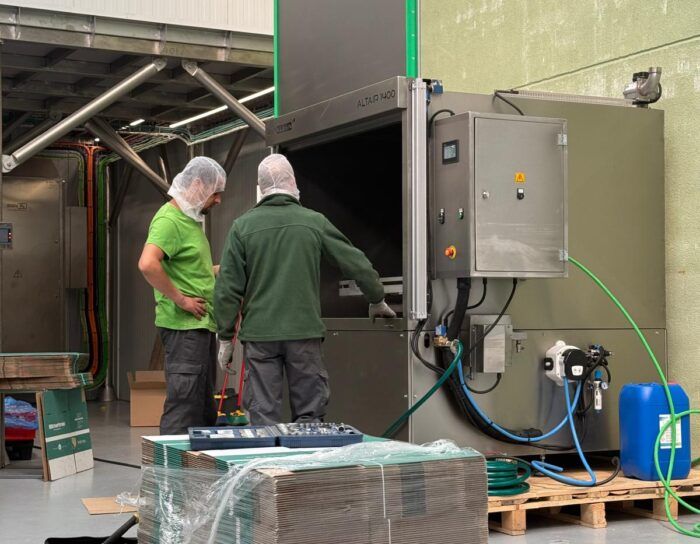
Table of contents
On a production line for snacks, nuts or crisps, it is not enough simply to keep the main plant clean. It is also necessary to clean all removable parts involved in the process on a regular basis: bowls, hoppers, trays, buckets, containers, production tools and equipment used for weighing, dosing, seasoning or packaging.
At MARTIRELO, a company specialising in the food sector, IBERKLEEN It installed an industrial parts washer to facilitate the cleaning of such items within a real production environment.
The aim of the project was not to “clean parts of the snack production line”, but to solve a very common problem in this type of factory: how to clean the removable parts used in snack, nut and crisps production lines in a more organised, consistent and efficient manner.
The challenge: parts covered in grease, salt, seasoning and food residues
Snack production lines handle products that generate very distinctive types of contamination. Oils, salt, flavourings, spices, starch, food powders and product residues can build up on metal parts, containers, trays, hoppers or contact surfaces.
The problem lies not only in the amount of dirt, but also in where it accumulates. Many parts have bases, edges, corners, holes, joints, flanges or internal areas that manual cleaning cannot always reach effectively.
Furthermore, in a factory operating on a continuous production basis, cleaning must be tailored to the pace of work. If the process relies too heavily on the operator, on the time available or on sporadic manual cleaning, it is more difficult to maintain a consistent and organised routine.
For this reason, MARTIRELO I needed a solution that would allow me to centralise the washing of parts and adapt it to the type of dirt typically found on a snack food production line.
Cleaning of buckets, hoppers, trays and containers on snack production lines
In this type of facility, the parts that need to be cleaned may vary depending on the production line, the product and the process. Cleaning a tray or a bucket is not the same as cleaning a multi-head weigher bowl, a dosing hopper or a component used in the seasoning process.
Items that typically need washing include:
- multi-head weigher hoppers;
- feed hoppers;
- dosing hoppers;
- weighing buckets;
- trays;
- cubes;
- food containers;
- removable parts on the production line;
- production equipment;
- components used for transport or in contact with the product;
- components associated with seasoning drums.
The key to the project lies in tailoring the cleaning solution to the customer’s specific components. In a snack food factory, the washing machine should not be viewed as a generic machine, but as a tool that is integrated into the plant’s cleaning workflow.
For a more comprehensive overview of cleaning methods, equipment and criteria, please see our guide on cleaning of food-grade parts.
Cleaning of drums and seasoning drums in the food industry
In production lines for crisps, nuts, appetisers and extruded snacks, seasoning processes tend to generate particularly stubborn residues. Seasoning drums, rotating drums, mixers or equipment used to add salt, oil and seasonings can accumulate grease, food dust and traces of flavouring.
When these parts or components can be removed and taken to a washing area, an industrial washing machine allows for a more controlled cleaning process than conventional manual cleaning.
Cleaning curing vats or curing drums requires consideration of several factors: the dimensions of the item, its internal geometry, the type of residue, the frequency of cleaning and the loading method. In some cases, the items will be small or medium-sized; in others, they will be bulky components requiring a bespoke solution.
That is why, in projects such as MARTIRELO, IBERKLEEN does not base its approach solely on the name of the part, but on the actual process: what gets dirty, how it is dismantled, how often it is cleaned, and what level of repeatability the factory requires.
The solution installed by IBERKLEEN at MARTIRELO
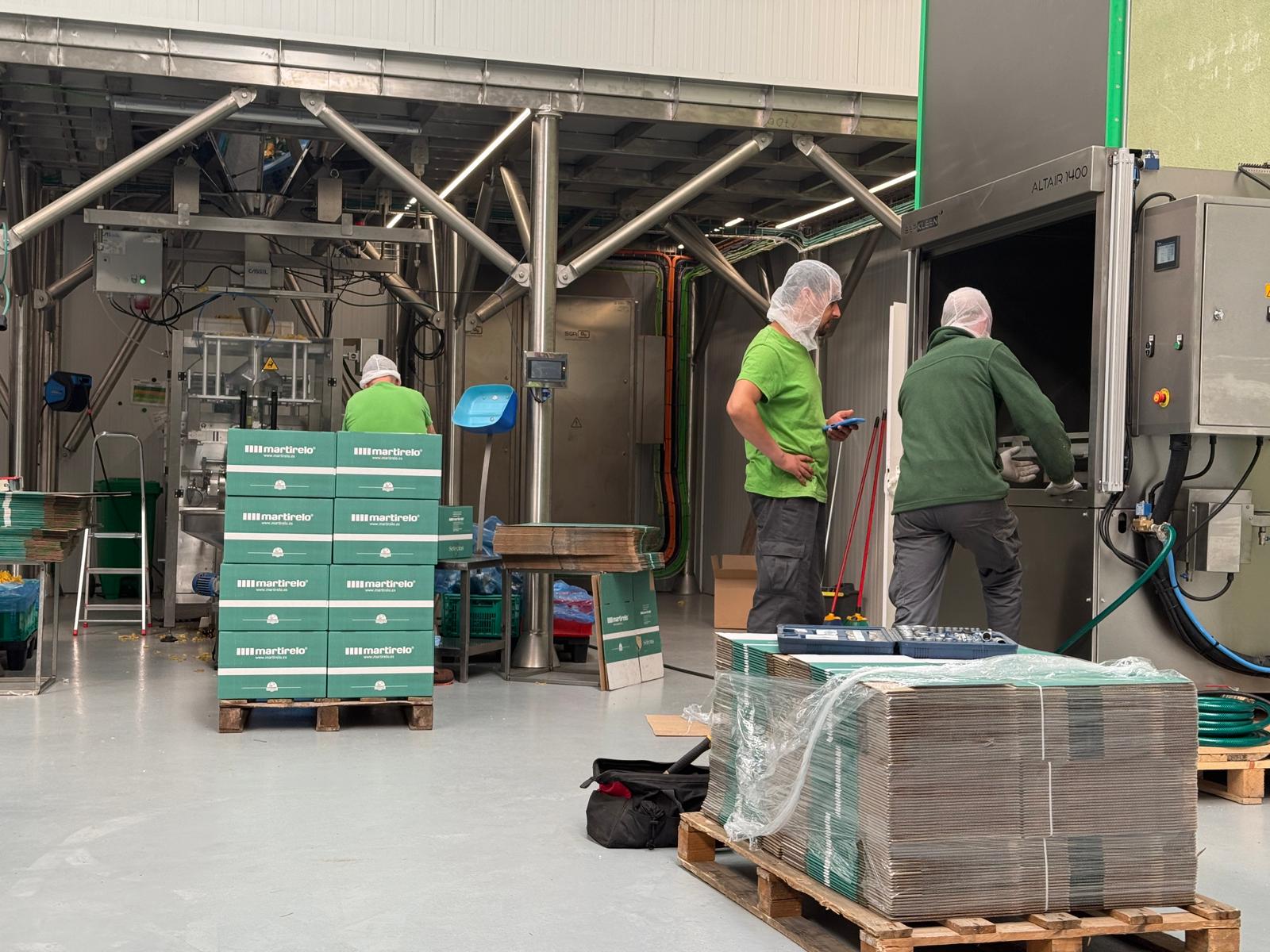
For this project, IBERKLEEN installed an ALTAIR 1400 industrial washing machine at the MARTIRELO site. The equipment was intended for cleaning parts and removable components used on food production lines, particularly in processes relating to snacks, nuts and crisps.
Before deciding on a solution, the parts to be cleaned, the type of dirt, the working environment and the expected frequency of use were analysed. In this type of application, the choice of machine should not be based solely on the external dimensions of the equipment, but on how it will be used within the factory.
The ALTAIR 1400 helps to create a more organised washing area, tailored to items that may accumulate grease, salt, seasoning or product residues. Its installation ensures that the process does not rely solely on manual cleaning of each item individually, thereby improving repeatability and ease of operation.
Advantages over manual cleaning of food-contact parts
Manual cleaning can be useful for one-off tasks, but on food production lines it has its limitations when there are large numbers of items to wash or when the same type of dirt accumulates on a daily basis.
A parts washer for snack production lines helps to streamline the process. The parts are taken to a designated area, loaded into the machine and washed using a setting tailored to the type of residue and the intended use. This reduces the need for improvisation and helps to ensure a more consistent result.
Another significant advantage is the reduced reliance on the operator. With manual cleaning, two people may achieve different results depending on the time taken, the pressure applied, access to internal areas or the attention paid to each part. With an industrial washing machine, the process is more controlled.
It also improves ergonomics. Manually cleaning buckets, hoppers, containers or trays can involve awkward postures, handling waste and direct exposure to grease, salt or detergents. By centralising the process in a single machine, the work becomes more organised and safer for staff.
Furthermore, a more structured cleaning process helps to maintain the equipment. Preventing the build-up of oil, seasonings or food dust helps to keep production equipment in better condition and reduces problems associated with stuck-on residue.
Applications in factories producing crisps, nuts and snacks
Although this project was carried out at MARTIRELO, the need is common to many food companies. Factories producing crisps, nuts, extruded snacks, savoury snacks, savoury products and ready meals often use removable parts that require frequent cleaning.
This type of washing machine can be used in production areas where the following processes take place:
- weighing;
- dosage;
- seasoned;
- transport;
- mixture;
- manipulation;
- packaging;
- product preparation.
What features should a parts washer for snack production lines have?
A parts washer for snack production lines must be suited to the food environment and the type of residue produced. It is not enough for the machine simply to have washing capacity; it must facilitate a practical, repeatable process that is compatible with day-to-day factory operations.
One of the first aspects to consider is the type of item. Multi-head weigher trays, dosing hoppers, trays, containers and production tools can vary greatly in size, weight and shape. The machine must allow for easy loading and effective cleaning of areas where dirt accumulates.
It is also important to analyse the type of residue. Grease, salt, seasonings, food dust or product residues do not behave in the same way. Therefore, the process may require adjustments to the detergent, temperature, wash time, pressure or filtration system, depending on the application.
Another key point is how easy the machine itself is to clean. In a food factory, the washing equipment must also be kept in good condition to prevent dirt from building up in the work area.
Finally, it is important to assess how the machine will fit into the production flow: where it will be located, how the parts will be loaded, how many times a day it will be used, which operators will be involved, and what level of automation the customer requires.
Results of the project in MARTIRELO
Thanks to the system installed by IBERKLEEN, MARTIRELO now has a more organised washing solution that is tailored to the removable parts used in its production process.
The installed washing machine enables the centralised cleaning of buckets, hoppers, trays, containers and other production equipment, reducing reliance on scattered manual processes and facilitating a more consistent workflow.
The value of the project lies in having devised a solution to a real-world factory problem: parts that repeatedly become soiled, food waste that is difficult to remove by hand, and the need to maintain production continuity through a more organised cleaning process.
Without resorting to unconfirmed data or made-up percentages, the result can be summarised as an improvement in the internal washing process: greater order, greater repeatability and a solution tailored to MARTIRELO’s food environment.
IBERKLEEN: washing solutions for removable parts in the food industry
IBERKLEEN designs and installs parts washers and industrial cleaning solutions for food companies that need to clean removable parts, containers, hoppers, buckets, trays, production tools or components associated with processing lines.
Each project is assessed on the basis of the customer’s actual items, the type of soiling, the frequency of washing, the available space and the process requirements.
If you need to clean multi-head weigher hoppers, feed hoppers, containers, trays, seasoning drums or removable parts from a snack, nut or crisps production line, we can assess your requirements and propose a bespoke solution.
Request for information or a demonstration
❓ Frequently Asked Questions
Multi-head weigher hoppers, feed hoppers, dosing hoppers, weighing buckets, trays, buckets, containers, production tools and removable parts used on snack, nut or crisps production lines can be cleaned.
Yes, provided that the washing process is suited to the type of residue. On snack production lines, it is common to deal with grease, oil, salt, spices, flavourings, starch, food powder and product residue.
Yes. Multi-head weigher hoppers, weighing hoppers and dosing buckets are common components in food production lines. The solution must be tailored to their size, shape, washing frequency and the type of dirt involved.
Yes. Feed hoppers and dosing hoppers can be cleaned in an industrial washer, provided that their dimensions, weight and shape are compatible with the selected machine.
It can be used for removable components of drying drums, provided that their dimensions, geometry, weight and type of residue are assessed in advance. For bulky parts, it may be necessary to devise a bespoke solution.
Yes. This type of solution is particularly useful in factories producing crisps, nuts, savoury snacks and other snacks, where salt, oil, seasonings, flavourings and removable parts are used, all of which require frequent cleaning.
Yes. IBERKLEEN assesses the parts to be cleaned, the type of dirt, daily production volumes, frequency of use, available space and process requirements in order to recommend a parts washer tailored to each factory.